
The biliary tree is a network of ducts that carries bile from the liver to the small intestine. The gallbladder connects to this network, storing and concentrating bile between meals. Bile helps the body absorb dietary fats and fat-soluble vitamins.
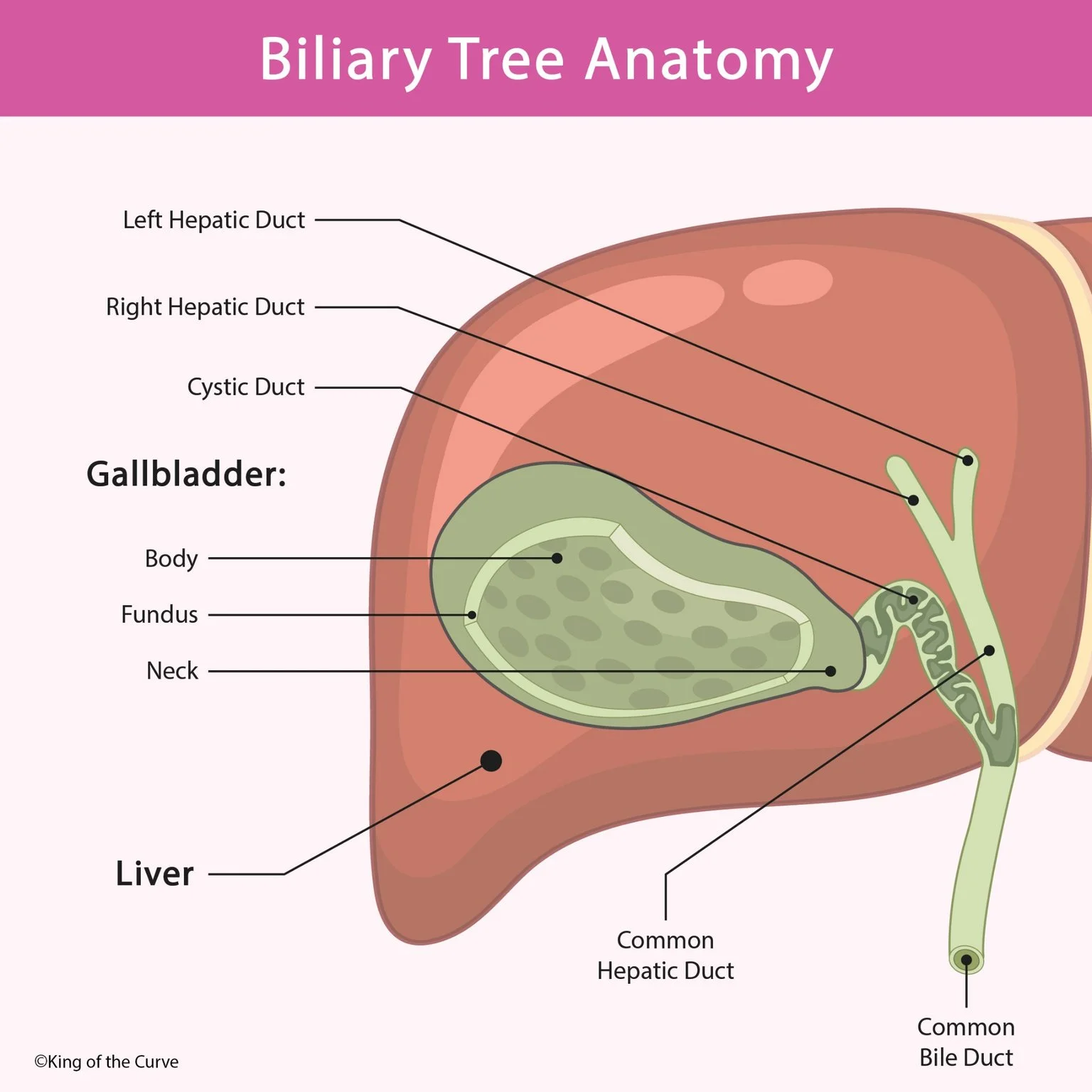
🏭 The Liver Produces Bile
Liver cells produce bile, which flows into tiny channels called bile canaliculi. These channels drain into progressively larger ducts within the liver.
The ducts eventually form the right and left hepatic ducts.
🌿 Right and Left Hepatic Ducts
The right hepatic duct drains the functional right side of the liver, while the left hepatic duct drains the functional left side.
These ducts typically unite near the liver’s porta hepatis to form the common hepatic duct.
🔗 The Common Hepatic Duct
The common hepatic duct carries bile away from the liver.
It joins the cystic duct, which connects to the gallbladder. Below this junction, the duct is called the common bile duct.
🫙 The Gallbladder and Cystic Duct
The gallbladder lies against the underside of the liver. It stores bile and concentrates it by absorbing water and electrolytes.
Its three main regions are:
Fundus: The rounded, blind end.
Body: The main central portion.
Neck: The narrowed region that continues into the cystic duct.
Bile can travel through the cystic duct in either direction—into the gallbladder for storage or out during emptying.
📊 Main Structures and Functions
| Structure | Main Connection or Location | Main Function |
|---|---|---|
| Right hepatic duct | Drains the functional right liver | Carries bile toward the common hepatic duct |
| Left hepatic duct | Drains the functional left liver | Carries bile toward the common hepatic duct |
| Common hepatic duct | Formed by the right and left hepatic ducts | Carries bile away from the liver |
| Gallbladder | Located beneath the liver | Stores and concentrates bile |
| Cystic duct | Connects the gallbladder to the main biliary pathway | Allows bile to enter and leave the gallbladder |
| Common bile duct | Formed by the common hepatic duct and cystic duct | Delivers bile toward the duodenum |
🍽️ Bile Release After a Meal
Fats and proteins entering the small intestine stimulate the release of cholecystokinin, or CCK.
CCK promotes gallbladder contraction and relaxation of the sphincter of Oddi. This helps bile flow through the common bile duct into the duodenum.
🚪 Where Bile Enters the Intestine
The common bile duct usually joins the main pancreatic duct near the duodenum, forming the hepatopancreatic ampulla.
Secretions enter the second part of the duodenum through the major duodenal papilla. The sphincter of Oddi regulates flow at this outlet.
🧠 Remembering the Duct Connections
Two junctions explain the basic arrangement:
Right hepatic duct + left hepatic duct = common hepatic duct
Common hepatic duct + cystic duct = common bile duct
The liver produces bile, the gallbladder stores it, and the common bile duct carries it toward the intestine.

Frequently Asked Questions (FAQs)
-
Aim for 4-6 focused hours, ensuring you incorporate breaks to avoid burnout.
-
Practice mindfulness techniques, take practice exams under realistic conditions, and maintain a balanced lifestyle.
-
Set short-term goals, seek support from mentors, and reward yourself for small achievements.
-
Regular exercise improves focus, reduces stress, and enhances overall mental clarity.
-
KOTC offers personalized learning tools, gamification features, and adaptive question banks to help students stay on track without burnout.