
Bilirubin is a yellow pigment produced during heme breakdown. The liver processes it for elimination through bile, while intestinal bacteria convert it into products that leave mainly in stool.
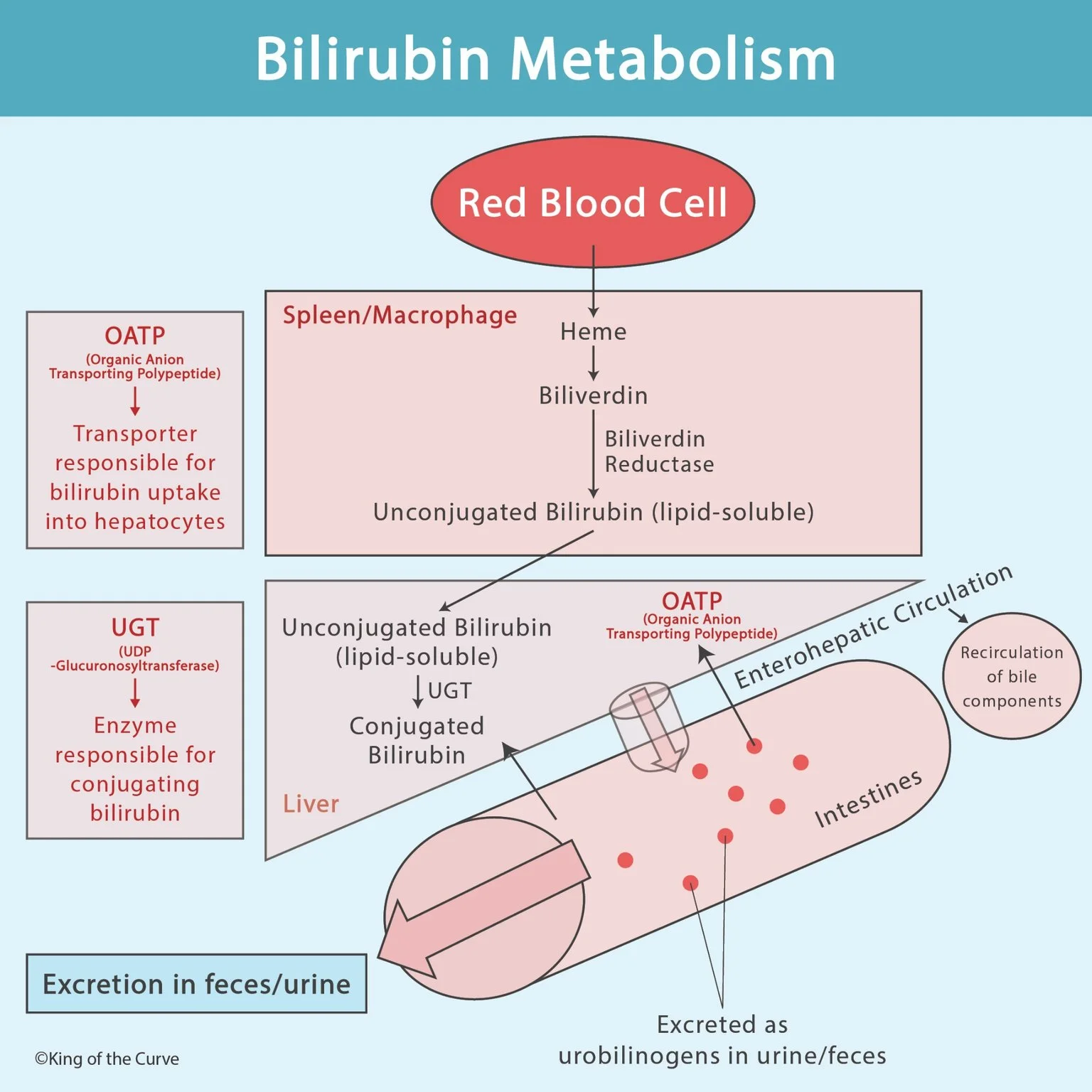
🩸 1. Red Blood Cell Breakdown
Macrophages remove aging red blood cells, particularly in the spleen, liver, and bone marrow.
Hemoglobin is separated into globin and heme. Globin is broken into amino acids, while heme enters the pathway that produces bilirubin.
🧪 2. Heme Becomes Bilirubin
Heme oxygenase converts heme into biliverdin, releasing iron and carbon monoxide.
Biliverdin reductase then converts biliverdin into unconjugated bilirubin.
🚚 3. Albumin Carries Unconjugated Bilirubin
Unconjugated bilirubin is poorly soluble in water. It travels through blood bound to albumin, which delivers it to the liver.
Because it is tightly albumin-bound, unconjugated bilirubin is not normally filtered into urine.
🏭 4. The Liver Conjugates Bilirubin
Hepatocytes take up bilirubin and attach glucuronic acid using UDP-glucuronosyltransferase 1A1, or UGT1A1.
This produces conjugated bilirubin, which is more water-soluble and suitable for secretion into bile.
📊 5. Main Steps of Bilirubin Metabolism
| Stage | Main Location | Key Event |
|---|---|---|
| Red blood cell breakdown | Macrophages | Hemoglobin is broken down, releasing heme |
| Biliverdin formation | Macrophages | Heme oxygenase converts heme into biliverdin |
| Unconjugated bilirubin formation | Macrophages | Biliverdin reductase converts biliverdin into bilirubin |
| Blood transport | Circulation | Albumin carries unconjugated bilirubin to the liver |
| Conjugation | Hepatocytes | UGT1A1 attaches glucuronic acid to bilirubin |
| Biliary secretion | Liver and bile ducts | Conjugated bilirubin enters bile and reaches the intestine |
| Intestinal conversion | Intestine | Bacteria convert bilirubin into urobilinogen |
| Elimination and recycling | Intestine, liver, and kidneys | Most pigment leaves in stool; some is reabsorbed, and a small amount reaches urine |
🟢 6. Conjugated Bilirubin Enters Bile
The transporter MRP2 moves conjugated bilirubin into bile canaliculi.
Bile carries it through the biliary system into the small intestine. This is the main route by which the liver eliminates bilirubin.
🦠 7. Intestinal Bacteria Form Urobilinogen
Intestinal bacteria convert bilirubin into urobilinogen, a largely colorless compound.
Most remains in the intestine and is converted into pigments, including stercobilin, that contribute to stool’s brown color.
🔄 8. Some Products Are Recycled or Excreted in Urine
Some urobilinogen is reabsorbed into portal blood and returned to the liver for resecretion into bile.
A small amount escapes hepatic uptake and reaches the kidneys. Urinary urobilinogen can oxidize to urobilin.
🧠 9. Key Clarifications for the Illustration
Albumin transport is an essential step between bilirubin production and liver uptake.
OATP transporters contribute to hepatic bilirubin handling, particularly the reuptake of conjugated bilirubin. Describing OATP as the sole transporter responsible for bilirubin uptake is an oversimplification.
The final products should also be distinguished: stercobilin is a major fecal pigment, while a small amount of urobilinogen and its oxidation products is eliminated in urine.

Frequently Asked Questions (FAQs)
-
Aim for 4-6 focused hours, ensuring you incorporate breaks to avoid burnout.
-
Practice mindfulness techniques, take practice exams under realistic conditions, and maintain a balanced lifestyle.
-
Set short-term goals, seek support from mentors, and reward yourself for small achievements.
-
Regular exercise improves focus, reduces stress, and enhances overall mental clarity.
-
KOTC offers personalized learning tools, gamification features, and adaptive question banks to help students stay on track without burnout.