
Bile salts help the digestive system absorb dietary fats and fat-soluble vitamins. Most are recovered after use and returned to the liver, allowing the same molecules to support digestion repeatedly.
This recycling pathway is called enterohepatic circulation. It connects the liver, biliary system, small intestine, and portal bloodstream.
🧪 1. What Are Bile Salts?
Bile acids are produced from cholesterol in the liver. They are commonly conjugated with glycine or taurine and exist mainly in their ionized form—bile salts—at intestinal pH.
Bile salts are amphipathic, meaning they contain both water-attracting and fat-attracting regions. This structure allows them to interact with dietary lipids in the watery environment of the intestine.
Bile contains more than bile salts. It also includes water, electrolytes, phospholipids, cholesterol, and bilirubin.
🏭 2. The Liver Produces and Secretes Bile
Liver cells, called hepatocytes, synthesize bile acids and secrete bile into small channels called bile canaliculi. Bile then travels through the bile ducts.
Between meals, much of this bile is directed into the gallbladder for storage. Some bile can also flow directly into the small intestine.
The liver therefore performs two connected tasks: producing new bile acids and recovering bile acids returning from the intestine.
🫙 3. The Gallbladder Stores and Concentrates Bile
The gallbladder stores bile and concentrates it by absorbing water and electrolytes.
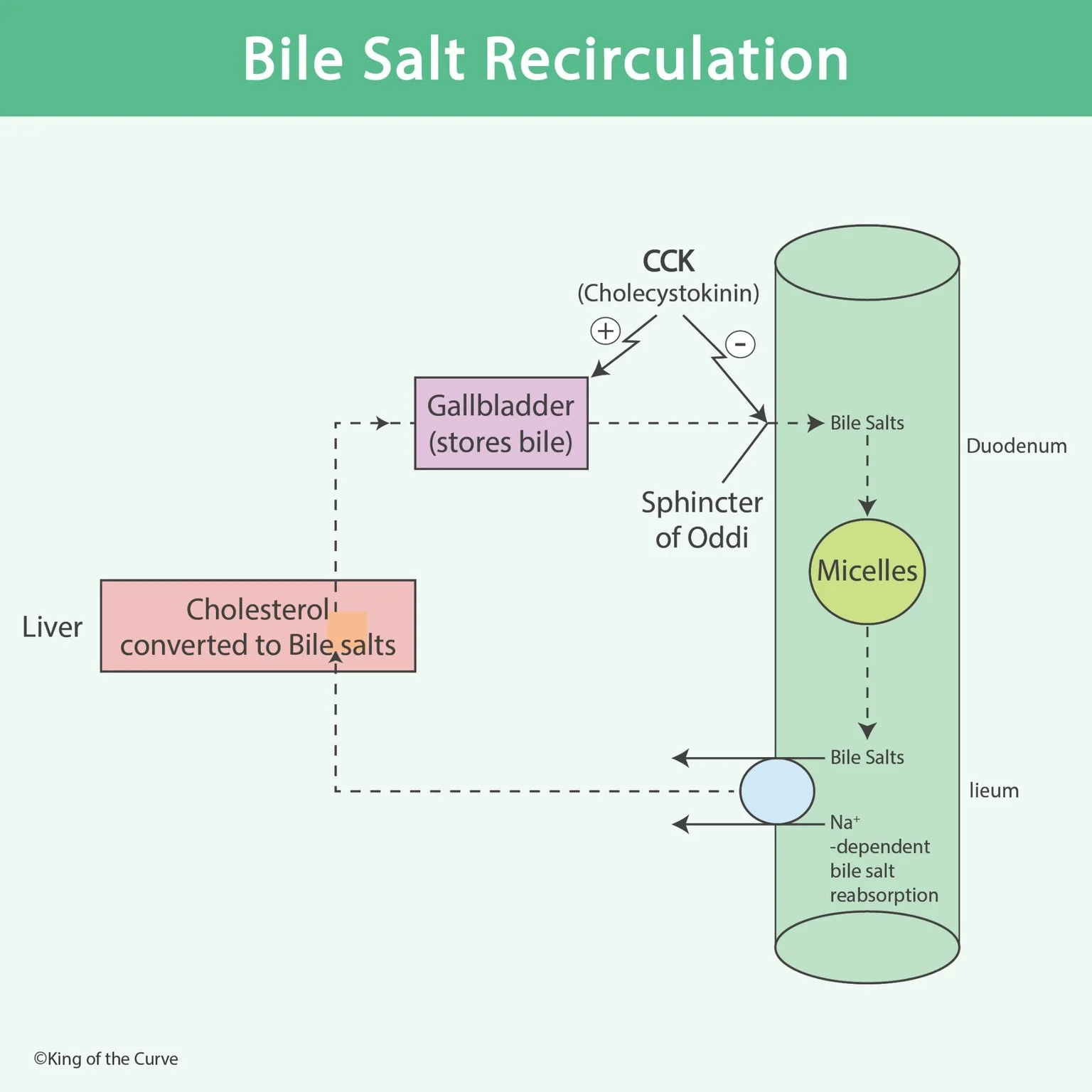
When a meal enters the small intestine, particularly one containing fats and proteins, intestinal I cells release cholecystokinin, or CCK.
CCK promotes gallbladder contraction and relaxation of the sphincter of Oddi. Together, these actions help deliver bile into the duodenum.
The inhibitory symbol in the illustration represents reduced sphincter contraction, allowing bile to pass more easily.
🍽️ 4. Bile Salts Support Fat Digestion
Dietary fats tend to collect into large droplets that are difficult for digestive enzymes to access.
Bile salts help emulsify these fats and stabilize smaller droplets, increasing the surface area available to pancreatic lipase.
Bile salts do not enzymatically break down triglycerides. Pancreatic lipase performs that chemical digestion, producing mainly free fatty acids and monoglycerides.
Bile salts then help keep these digestion products dispersed in the intestinal contents.
🫧 5. Micelles Help Deliver Lipids to Intestinal Cells
Bile salts combine with lipid digestion products to form mixed micelles. These small structures can contain fatty acids, monoglycerides, cholesterol, and fat-soluble vitamins.
Micelles help transport these substances through the watery layer near the intestinal lining.
The lipids leave the micelles and enter intestinal cells. Bile salts generally remain in the intestinal lumen and continue along the digestive tract.
Micelles are different from chylomicrons, which are assembled inside intestinal cells to transport absorbed lipids through the lymphatic system.
📊 6. The Main Stages of Bile Salt Recirculation
| Stage | Main Location | Key Event |
|---|---|---|
| Synthesis | Liver | Cholesterol is converted into bile acids |
| Storage and concentration | Gallbladder | Bile is stored and concentrated between meals |
| Release | Duodenum | CCK promotes gallbladder contraction and sphincter of Oddi relaxation |
| Digestive action | Small intestine | Bile salts support emulsification and mixed micelle formation |
| Reabsorption | Mainly terminal ileum | Conjugated bile salts undergo sodium-dependent uptake |
| Return to the liver | Hepatic portal circulation | Reabsorbed bile acids travel back to the liver |
| Recovery and resecretion | Liver | Hepatocytes take up returning bile acids and secrete them into bile again |
🔄 7. The Terminal Ileum Recovers Most Bile Salts
Most bile acids are recovered from the intestine rather than lost in stool.
The terminal ileum is especially important because its intestinal cells express the apical sodium-dependent bile acid transporter, commonly called ASBT.
This transporter uses the sodium gradient to bring bile salts into intestinal cells. They subsequently leave across the basolateral membrane and enter the portal circulation.
Some bile acids are also absorbed passively elsewhere in the intestine. Overall, approximately 95% of the secreted bile acid pool is normally recovered.
🩸 8. Portal Blood Returns Bile Acids to the Liver
Reabsorbed bile acids travel to the liver through the hepatic portal vein. Hepatocytes remove them from portal blood and resecrete them into bile.
This completes the enterohepatic cycle.
The diagram simplifies this return pathway: bile salts do not move directly from the ileum into the gallbladder. They first return through portal blood to the liver.
A small amount escapes recovery and leaves the body in stool. New bile acid synthesis replaces these losses.
⚖️ 9. Recycling Conserves Resources and Regulates Production
Recycling allows a relatively small bile acid pool to support the digestion of multiple meals. The body can reuse existing molecules instead of synthesizing the entire supply from cholesterol each time.
Bile acids also act as signaling molecules. Their return provides feedback that helps regulate further synthesis in the liver.
The central sequence to remember is:
Liver → bile → small intestine → ileal reabsorption → portal blood → liver
The gallbladder stores bile between meals, while the intestine and liver work together to recover and reuse its bile salts.

Frequently Asked Questions (FAQs)
-
Aim for 4-6 focused hours, ensuring you incorporate breaks to avoid burnout.
-
Practice mindfulness techniques, take practice exams under realistic conditions, and maintain a balanced lifestyle.
-
Set short-term goals, seek support from mentors, and reward yourself for small achievements.
-
Regular exercise improves focus, reduces stress, and enhances overall mental clarity.
-
KOTC offers personalized learning tools, gamification features, and adaptive question banks to help students stay on track without burnout.