
The Babinski sign is an upward movement of the great toe following stimulation of the sole, sometimes accompanied by spreading of the other toes. It is also called an extensor plantar response. Its meaning depends on age: it can be normal in infancy, but in older children and adults it suggests dysfunction of descending motor pathways in the central nervous system.
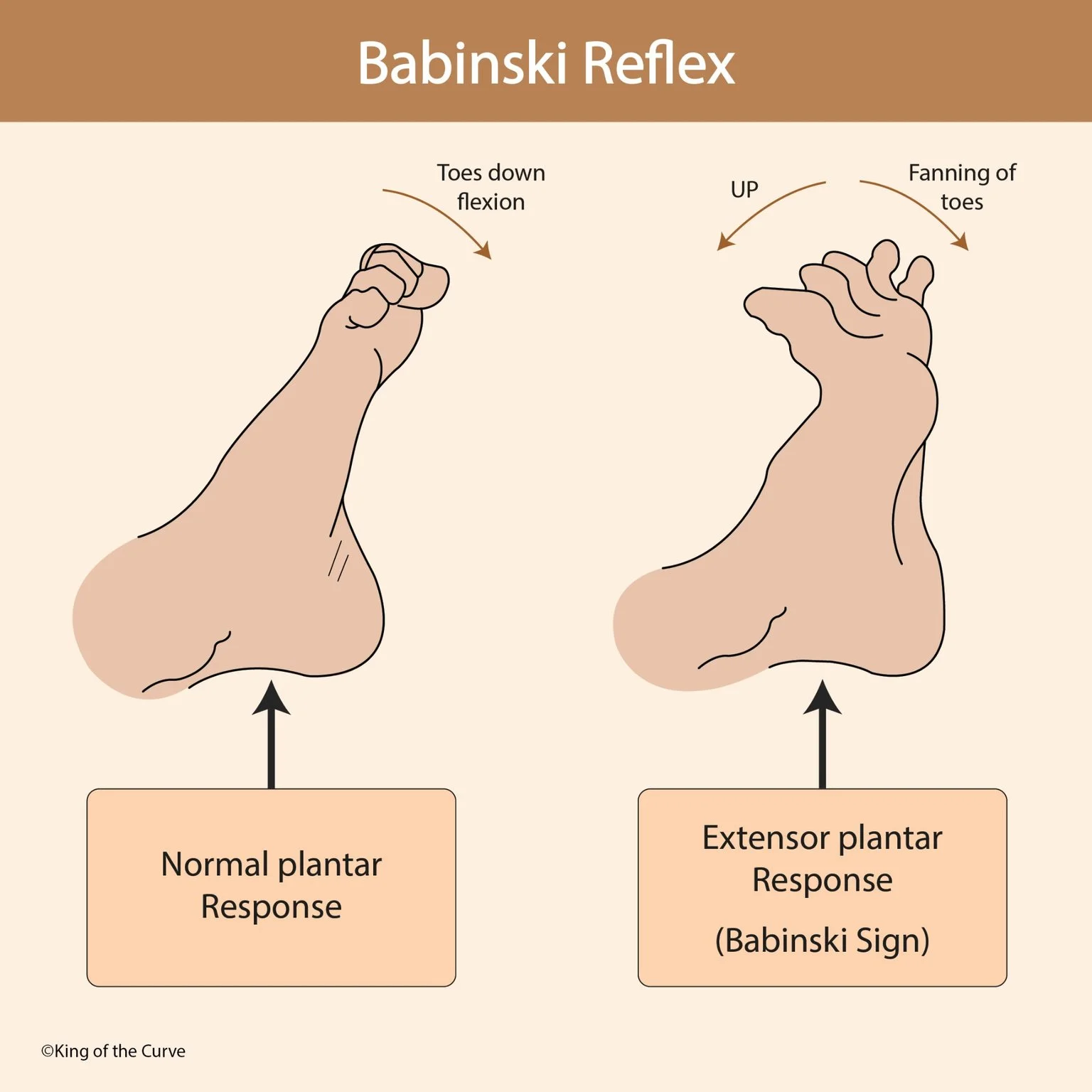
👣 The Normal Plantar Response
In most healthy adults, stimulation of the sole causes the toes to curl downward. This is the flexor plantar response, illustrated on the left side of the diagram. “Plantar” refers to the sole of the foot, while “flexor” describes the downward toe movement. Some examinations produce little or no movement, which should be documented separately rather than automatically interpreted as abnormal.
⬆️ Recognizing an Extensor Plantar Response
The defining movement of a Babinski sign is extension of the great toe, meaning that it moves upward toward the top of the foot. The other toes may fan outward, but fanning is not required. The diagram’s right-hand image illustrates this pattern. Upward movement of the entire foot, without clear great-toe extension, does not by itself establish a Babinski sign.
🧠 The Role of the Corticospinal Tract
The corticospinal tract carries descending signals from the cerebral cortex through the brainstem and spinal cord. It contributes to voluntary movement and helps regulate spinal motor responses. Disruption of this system can alter the response to stimulation of the sole, producing an extensor response. The sign helps identify a pattern of upper motor neuron dysfunction, but it does not identify the exact location or cause by itself.
📊 Comparing Plantar Responses
The direction of great-toe movement is central to interpretation. Age, examination technique, and associated neurological findings determine the significance of the response.
| Feature | Flexor Plantar Response | Extensor Plantar Response |
|---|---|---|
| Great-toe movement | Downward flexion | Upward extension |
| Other toes | Usually curl downward | May fan outward |
| Typical adult interpretation | Expected response | Suggests corticospinal pathway dysfunction |
| Infant interpretation | Must be assessed in developmental context | Can be normal before descending motor pathways mature |
| Common description | Downgoing plantar response | Upgoing plantar response or Babinski sign |
| Diagnostic limitation | Does not exclude every neurological disorder | Does not establish a specific diagnosis or lesion location |
👶 Why the Response Can Be Normal in Infants
Infants have developing descending motor pathways, so an extensor plantar response can occur without neurological disease. It commonly disappears during the first 12–24 months as the nervous system matures. Persistence beyond the expected developmental period warrants clinical assessment, particularly when accompanied by abnormal muscle tone, weakness, or delayed motor development. Adult interpretation should therefore never be applied directly to a newborn.
🩺 How Clinicians Examine the Response
During examination, a clinician uses a blunt instrument to stroke the outer border of the sole from the heel toward the forefoot, then curves inward toward the base of the great toe. The stimulus should avoid injury. The examiner observes the toes and compares both feet. Technique matters because ticklishness, discomfort, voluntary movement, and rapid withdrawal can obscure the underlying response.
🔄 Distinguishing Withdrawal From a Babinski Sign
A person may quickly pull the foot away when the sole is stimulated. This withdrawal response can involve several joints and create misleading toe movements. Clinicians distinguish it from a reproducible extensor plantar response by examining the movement’s timing and pattern, especially the great toe. A response that remains unclear is best recorded as equivocal rather than forced into a positive or negative category.
🧩 Interpreting the Sign With the Neurological Examination
A Babinski sign can occur with conditions affecting central motor pathways, including stroke, spinal cord disease, and multiple sclerosis. Its significance becomes clearer when considered alongside muscle strength, tone, tendon reflexes, sensation, and coordination. Associated findings may include increased reflexes, spasticity, or clonus, although these are not always present together. The plantar response contributes one piece of evidence within a broader neurological assessment.

Frequently Asked Questions (FAQs)
-
Aim for 4-6 focused hours, ensuring you incorporate breaks to avoid burnout.
-
Practice mindfulness techniques, take practice exams under realistic conditions, and maintain a balanced lifestyle.
-
Set short-term goals, seek support from mentors, and reward yourself for small achievements.
-
Regular exercise improves focus, reduces stress, and enhances overall mental clarity.
-
KOTC offers personalized learning tools, gamification features, and adaptive question banks to help students stay on track without burnout.