
🎵 Beat Periods and Frequency: Understanding Wave Interference
When two sound waves of slightly different frequencies travel together, they interact through a phenomenon known as wave interference. This interaction produces a pattern of alternating loud and soft sounds called beats. The image illustrates how two waves with frequencies of 100 Hz and 110 Hz combine to create this effect, helping visualize an important concept in acoustics and physics.
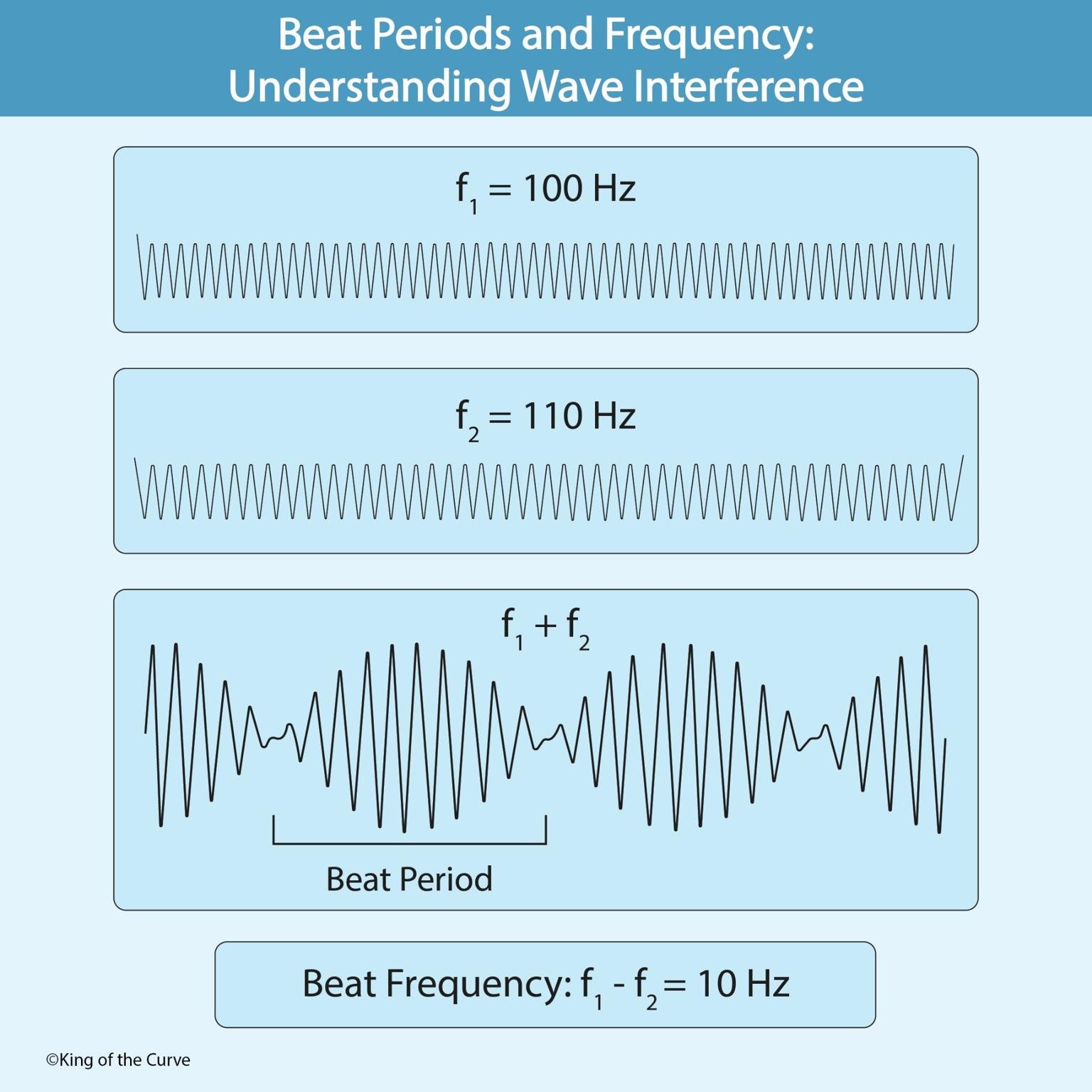
🔍 Understanding the Individual Waves
The diagram begins with two separate waves:
f₁ = 100 Hz
f₂ = 110 Hz
Each wave oscillates at its own frequency, meaning the number of cycles per second differs slightly. Because of this difference, the waves gradually move in and out of phase over time. This shifting phase relationship is what creates the beat pattern when the waves are combined.
🌊 Formation of the Beat Pattern
When the two waves are superimposed (f₁ + f₂), a new waveform emerges. This combined wave shows regions of high amplitude (loud sound) and low amplitude (soft sound). The distance between two consecutive loud regions is called the beat period.
This pattern is not a new frequency itself but rather a modulation of amplitude caused by interference. The underlying oscillations still occur at the original frequencies, but the envelope of the wave changes over time.
⏱️ Beat Frequency Explained
The beat frequency is the number of beats heard per second and is calculated using the difference between the two frequencies:
Beat Frequency = ∣f1−f2∣
In this example:
f₁ = 100 Hz
f₂ = 110 Hz
Beat Frequency = 10 Hz
This means you would hear 10 beats per second, corresponding to how often the waves align constructively.
📊 Summary Table
| Concept | Description |
|---|---|
| Wave Frequencies | f1 = 100 Hz, f2 = 110 Hz |
| Interference Type | Constructive & Destructive |
| Beat Frequency | |f1 − f2| = 10 Hz |
| Beat Period | Time between successive loud sounds |
| Result | Alternating loud and soft sound pattern |
🧠 Clinical & Practical Relevance
Beat frequency is widely used in tuning musical instruments, where musicians adjust frequencies until the beats disappear, indicating perfect tuning. It is also important in medical acoustics, Doppler ultrasound, and signal processing, where interference patterns help analyze wave behavior.
🩺 Key Takeaway
Whenever two waves of slightly different frequencies combine, they produce beats, with a frequency equal to the difference between the two waves. Understanding this concept is essential for grasping wave interference in physics, music, and real-world applications.

Frequently Asked Questions (FAQs)
-
Aim for 4-6 focused hours, ensuring you incorporate breaks to avoid burnout.
-
Practice mindfulness techniques, take practice exams under realistic conditions, and maintain a balanced lifestyle.
-
Set short-term goals, seek support from mentors, and reward yourself for small achievements.
-
Regular exercise improves focus, reduces stress, and enhances overall mental clarity.
-
KOTC offers personalized learning tools, gamification features, and adaptive question banks to help students stay on track without burnout.