
🧂 Body’s Response to Increased Na⁺ Intake
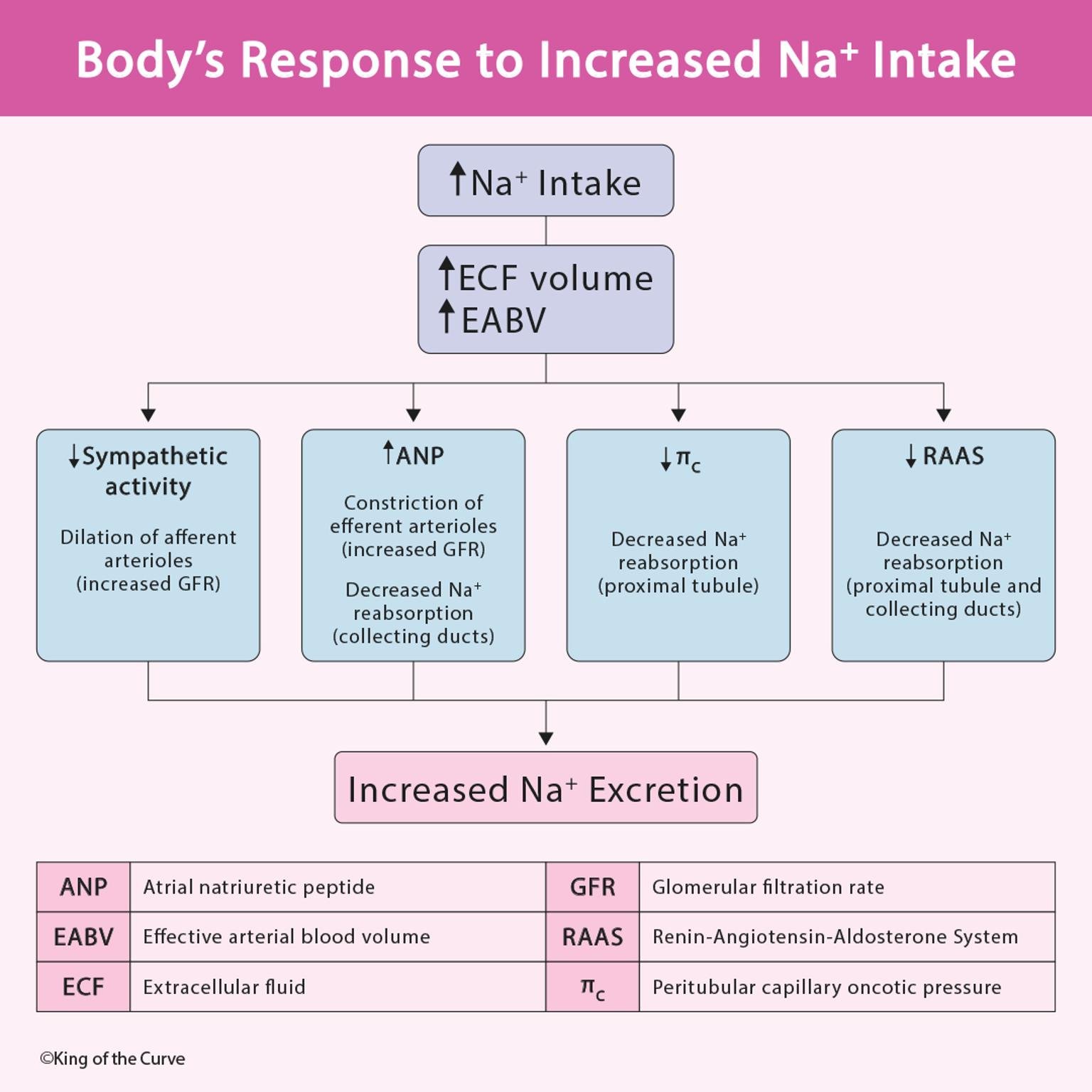
When sodium (Na⁺) intake increases, the body activates several physiological mechanisms to maintain fluid balance and prevent excessive volume expansion. Since sodium is the primary determinant of extracellular fluid (ECF) volume, any increase in sodium intake leads to a corresponding rise in ECF volume and effective arterial blood volume (EABV). To counteract this, the body initiates coordinated responses aimed at increasing sodium excretion and restoring homeostasis.
🔄 Initial Effect: Volume Expansion
An increase in sodium intake leads to:
↑ ECF volume
↑ Effective arterial blood volume (EABV)
This expansion signals the body that there is excess fluid, triggering mechanisms to reduce sodium reabsorption and promote its excretion.
⚙️ Key Regulatory Mechanisms
1. ↓ Sympathetic Activity
Reduced sympathetic tone leads to:
Dilation of afferent arterioles
Increased glomerular filtration rate (GFR)
This enhances filtration of sodium at the glomerulus, promoting its excretion.
2. ↑ Atrial Natriuretic Peptide (ANP)
ANP is released from the atria in response to increased blood volume.
Effects include:
Constriction of efferent arterioles → ↑ GFR
Decreased Na⁺ reabsorption in collecting ducts
Overall, ANP strongly promotes natriuresis (sodium excretion).
3. ↓ Peritubular Capillary Oncotic Pressure (πc)
With increased plasma volume:
Protein concentration decreases
Oncotic pressure falls
This leads to:
Reduced Na⁺ reabsorption in the proximal tubule
4. ↓ Renin-Angiotensin-Aldosterone System (RAAS)
Volume expansion suppresses RAAS activity:
↓ Renin release
↓ Angiotensin II
↓ Aldosterone
Result:
Decreased Na⁺ reabsorption in proximal tubule and collecting ducts
📊 Summary Table
| Mechanism | Change | Effect on Kidney | Outcome |
|---|---|---|---|
| Sympathetic Activity | ↓ | ↑ Afferent dilation → ↑ GFR | ↑ Na+ excretion |
| ANP | ↑ | ↑ GFR, ↓ Na+ reabsorption (collecting duct) | ↑ Natriuresis |
| Oncotic Pressure (πc) | ↓ | ↓ Proximal Na+ reabsorption | ↑ Na+ excretion |
| RAAS | ↓ | ↓ Na+ reabsorption (PT & CD) | ↑ Na+ excretion |
🧠 Integrated Response
These mechanisms do not work in isolation. Instead, they act simultaneously to ensure efficient sodium removal. Increased GFR enhances filtration, while decreased tubular reabsorption ensures that more sodium remains in the filtrate and is excreted in urine. This coordinated response prevents excessive fluid accumulation and maintains blood pressure within a normal range.
🩺 Key Takeaway
An increase in sodium intake leads to volume expansion, which triggers multiple compensatory mechanisms—↓ sympathetic activity, ↑ ANP, ↓ oncotic pressure, and ↓ RAAS—all working together to increase sodium excretion and restore fluid balance.

Frequently Asked Questions (FAQs)
-
Aim for 4-6 focused hours, ensuring you incorporate breaks to avoid burnout.
-
Practice mindfulness techniques, take practice exams under realistic conditions, and maintain a balanced lifestyle.
-
Set short-term goals, seek support from mentors, and reward yourself for small achievements.
-
Regular exercise improves focus, reduces stress, and enhances overall mental clarity.
-
KOTC offers personalized learning tools, gamification features, and adaptive question banks to help students stay on track without burnout.