
⚛️ The Aufbau Principle: Understanding Electron Configuration
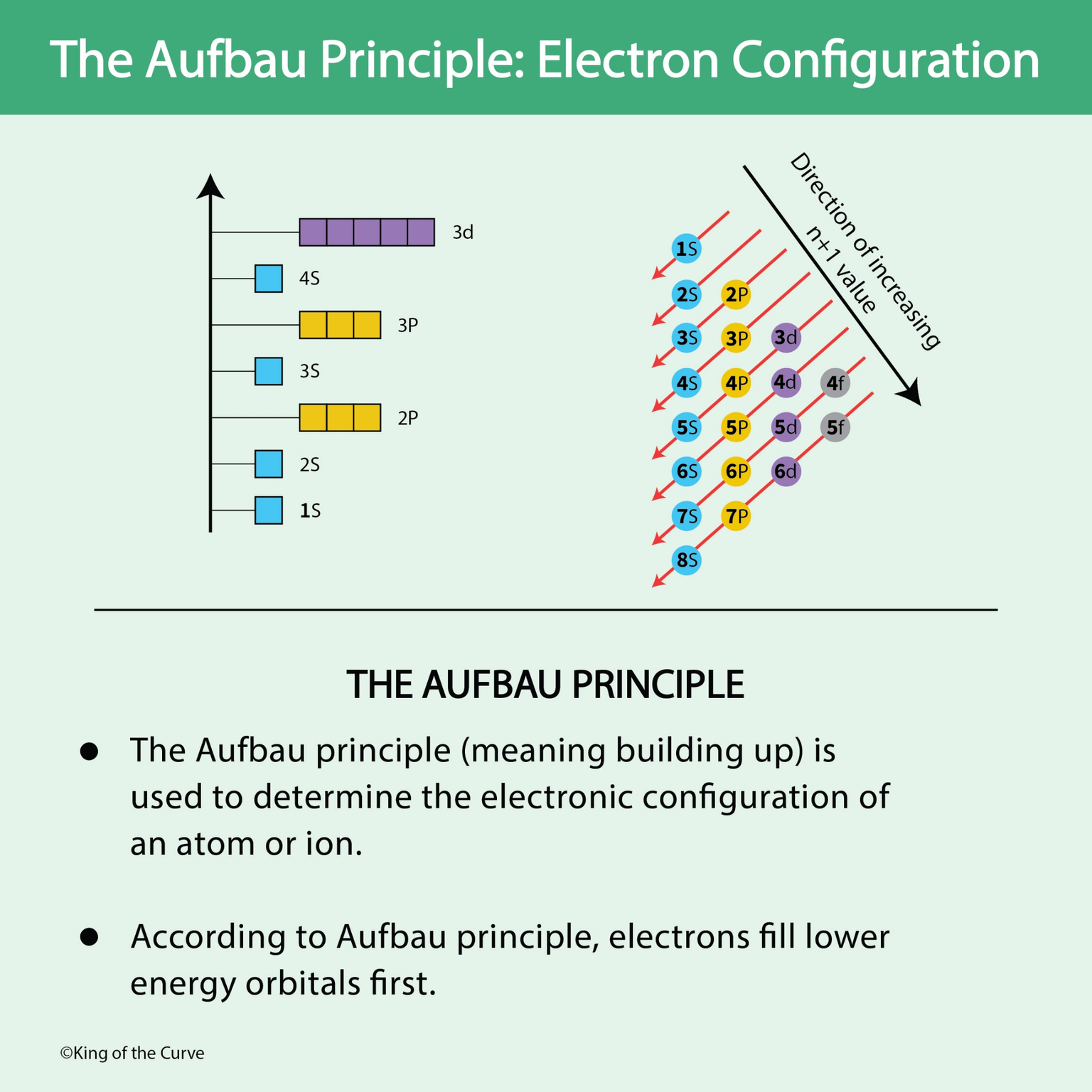
The Aufbau principle explains how electrons are arranged in atomic orbitals. The word Aufbau comes from German and means “building up.” When constructing the electron configuration of an atom, electrons generally occupy the available orbitals from lower energy to higher energy.
📈 Electrons Fill Lower-Energy Orbitals First
Electrons tend to occupy the lowest-energy orbitals available before filling higher-energy ones. The sequence begins with the 1s orbital, followed by 2s, 2p, 3s, and so on. This provides the foundation for writing ground-state electron configurations.
🔢 The n + ℓ Rule
Orbital filling order can be predicted using the n + ℓ rule, where n is the principal quantum number and ℓ is the angular momentum quantum number. The orbital with the lower n + ℓ value fills first. If two orbitals have the same n + ℓ value, the orbital with the lower n value fills first.
↘️ Remember the Diagonal Rule
A useful way to memorize the typical filling sequence is the diagonal rule. Following the diagonal arrows gives: 1s → 2s → 2p → 3s → 3p → 4s → 3d → 4p → 5s → 4d → 5p → 6s → 4f → 5d → 6p → 7s → 5f → 6d → 7p.
🧩 Know the Orbital Capacities
Each subshell has a maximum number of electrons determined by its number of orbitals. The s subshell holds 2 electrons, p holds 6, d holds 10, and f holds 14. These capacities are essential when constructing complete electron configurations.
| ⚛️ Subshell | 🧩 Number of Orbitals | 🔢 Maximum Electrons |
|---|---|---|
| s | 1 | 2 |
| p | 3 | 6 |
| d | 5 | 10 |
| f | 7 | 14 |
✍️ Example: Electron Configuration of Sodium
Sodium has 11 electrons in its neutral state. Applying the Aufbau principle gives 1s² 2s² 2p⁶ 3s¹. The first ten electrons fill the lower-energy orbitals, while the eleventh electron enters the 3s orbital.
⚠️ Aufbau Is Not the Only Rule
Correct electron configurations also require the Pauli exclusion principle and Hund’s rule. Pauli's principle limits an orbital to two electrons with opposite spins, while Hund's rule states that degenerate orbitals are occupied singly before electrons pair.
🔬 Important Exceptions
The Aufbau sequence is a useful model, but some elements have ground-state configurations that differ from a simple application of the filling order. Chromium and copper are classic examples because the energies of the 4s and 3d subshells are very close. For MCAT questions, recognize that experimentally observed configurations can contain exceptions to the basic pattern.
🎯 MCAT High-Yield Takeaway
For the MCAT, remember lower energy first, know s/p/d/f capacities, and use the diagonal rule. Combine the Aufbau principle with Hund’s rule and the Pauli exclusion principle to solve electron-configuration and orbital-diagram questions efficiently.

Frequently Asked Questions (FAQs)
-
Aim for 4-6 focused hours, ensuring you incorporate breaks to avoid burnout.
-
Practice mindfulness techniques, take practice exams under realistic conditions, and maintain a balanced lifestyle.
-
Set short-term goals, seek support from mentors, and reward yourself for small achievements.
-
Regular exercise improves focus, reduces stress, and enhances overall mental clarity.
-
KOTC offers personalized learning tools, gamification features, and adaptive question banks to help students stay on track without burnout.