
🍂 Terminal Velocity: Forces in Balance
Terminal velocity is the constant maximum speed reached by an object falling through a fluid, such as air, when the upward resistive forces balance the downward forces. For a simplified falling object where air drag and gravity are the main forces, terminal velocity occurs when drag equals the object's weight, producing zero net force and therefore zero acceleration.
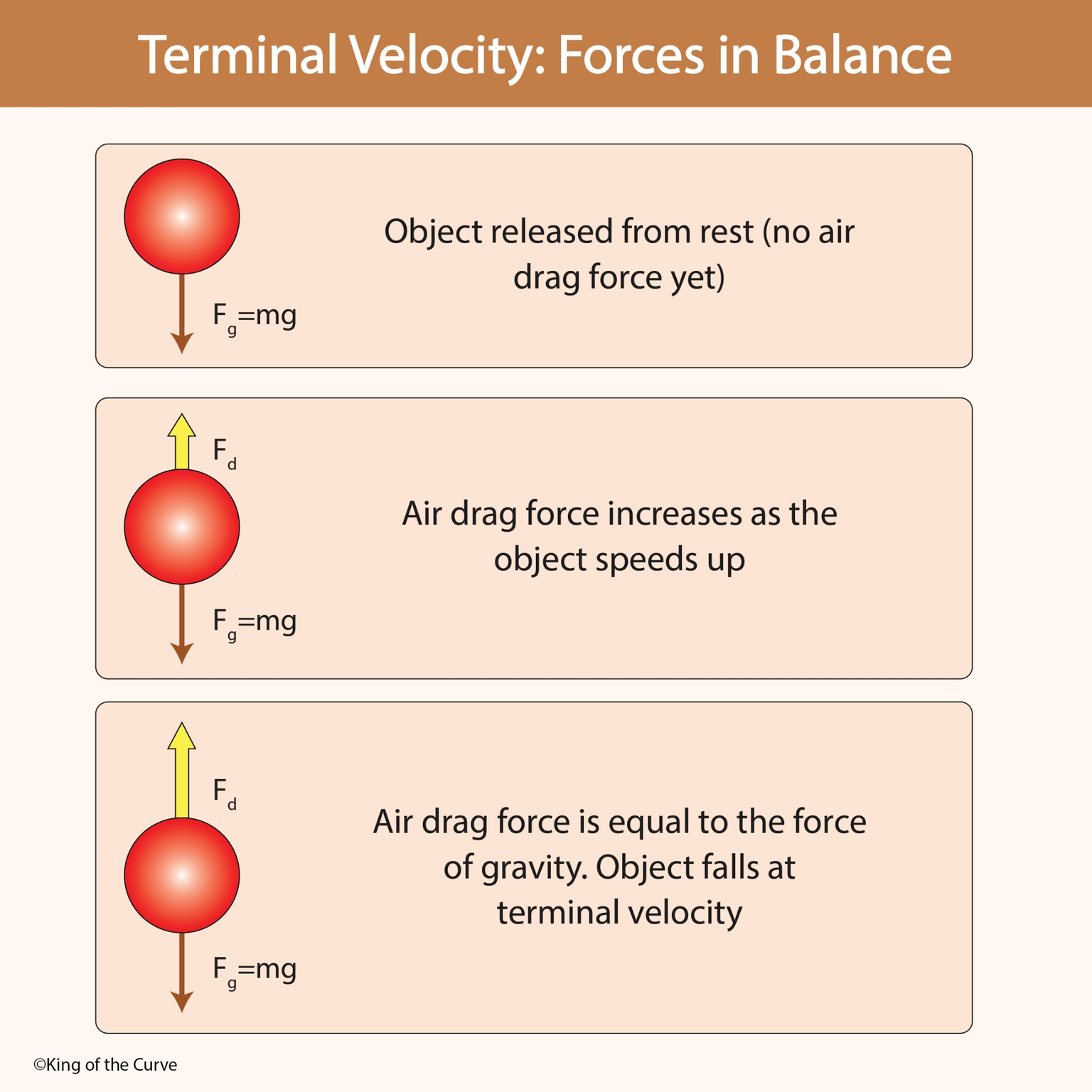
⬇️ What Happens When an Object Begins to Fall?
At the instant an object is released from rest, its velocity is zero, so aerodynamic drag is initially zero in the usual drag models. Gravity pulls the object downward with a force approximately equal to F₉ = mg, where m is mass and g is gravitational acceleration. Because there is initially an unbalanced downward force, the object accelerates.
💨 How Air Resistance Changes During the Fall
As the object's speed increases, air resistance (drag) increases. Drag acts opposite the direction of motion, so for a falling object it acts upward. The increasing drag reduces the magnitude of the net downward force, causing the object's downward acceleration to become progressively smaller.
⚖️ Reaching Terminal Velocity
Eventually, drag can become equal in magnitude to the object's weight. In the simplified model shown, Fᵈ = F₉ = mg. The forces then balance, making the net force zero. According to Newton's second law, ΣF = ma, so zero net force means the object's acceleration is zero.
🚀 Does the Object Stop at Terminal Velocity?
No. Zero acceleration does not mean zero velocity. Once terminal velocity has been reached, the object continues moving downward at a constant velocity. This distinction between velocity and acceleration is an important physics concept for the MCAT.
📐 What Determines Terminal Velocity?
Terminal velocity depends on factors such as the object's mass, cross-sectional area, shape, drag coefficient, and the density of the surrounding fluid. For quadratic drag, a commonly used model is Fᵈ = ½ρCᵈAv², showing why drag becomes stronger as velocity increases.
🪂 Why Does Surface Area Matter?
Increasing an object's effective cross-sectional area generally increases drag at a given speed. This is why a parachute can dramatically reduce terminal velocity: its large area produces enough drag to balance the person's weight at a much lower falling speed.
🧠 Terminal Velocity and the MCAT
| 🍂 Stage | ⬇️ Gravity | ⬆️ Drag | ⚖️ Net Force | 🚀 Acceleration |
|---|---|---|---|---|
| Just released | Downward | ≈ 0 | Downward | Maximum downward |
| Speeding up | Downward | Increasing upward | Downward | Decreasing magnitude |
| Terminal velocity | Downward | Equal upward | 0 | 0 |
The MCAT may ask you to connect a free-body diagram with Newton's laws. If an object is moving at terminal velocity, remember that its velocity is constant, acceleration is zero, and the forces are balanced.
🎯 MCAT High-Yield Takeaway
The key sequence is release → accelerate → drag increases → net force decreases → terminal velocity. At terminal velocity, the object is still falling, but ΣF = 0 and a = 0. The most common mistake is assuming that zero net force means the object must be stationary—it actually means its velocity is not changing.

Frequently Asked Questions (FAQs)
-
Aim for 4-6 focused hours, ensuring you incorporate breaks to avoid burnout.
-
Practice mindfulness techniques, take practice exams under realistic conditions, and maintain a balanced lifestyle.
-
Set short-term goals, seek support from mentors, and reward yourself for small achievements.
-
Regular exercise improves focus, reduces stress, and enhances overall mental clarity.
-
KOTC offers personalized learning tools, gamification features, and adaptive question banks to help students stay on track without burnout.