
🧪 How Atomic Size Influences Acid Strength
Acid–base chemistry is one of the most frequently tested topics on exams like the MCAT, and understanding the factors that determine acidity can significantly improve your performance. One major factor influencing acid strength is atomic size. When atoms become larger, they stabilize negative charge more effectively after losing a proton, which makes the acid stronger. This concept frequently appears in organic chemistry reactions, pKa comparisons, and biochemical mechanisms, making it a high-yield idea for premed students to master.
🧩 Understanding Acid Strength
Acid strength refers to how easily a molecule can donate a proton (H⁺). When an acid loses a proton, it forms a conjugate base. The stability of this conjugate base determines how strong the acid is. If the conjugate base is stable, the acid will release its proton more easily. In contrast, if the conjugate base is unstable, the molecule tends to hold onto its proton, making it a weaker acid.
⚖️ Role of Conjugate Base Stability
The most important rule in acid–base chemistry is that strong acids form stable conjugate bases. After deprotonation, the negative charge must be accommodated somewhere on the molecule. When that charge is stabilized, the overall system becomes energetically favorable. Factors that stabilize the conjugate base include resonance, electronegativity, and atomic size, with atomic size becoming especially important when comparing elements down the same column of the periodic table.
📊 Comparing Alcohols and Thiols
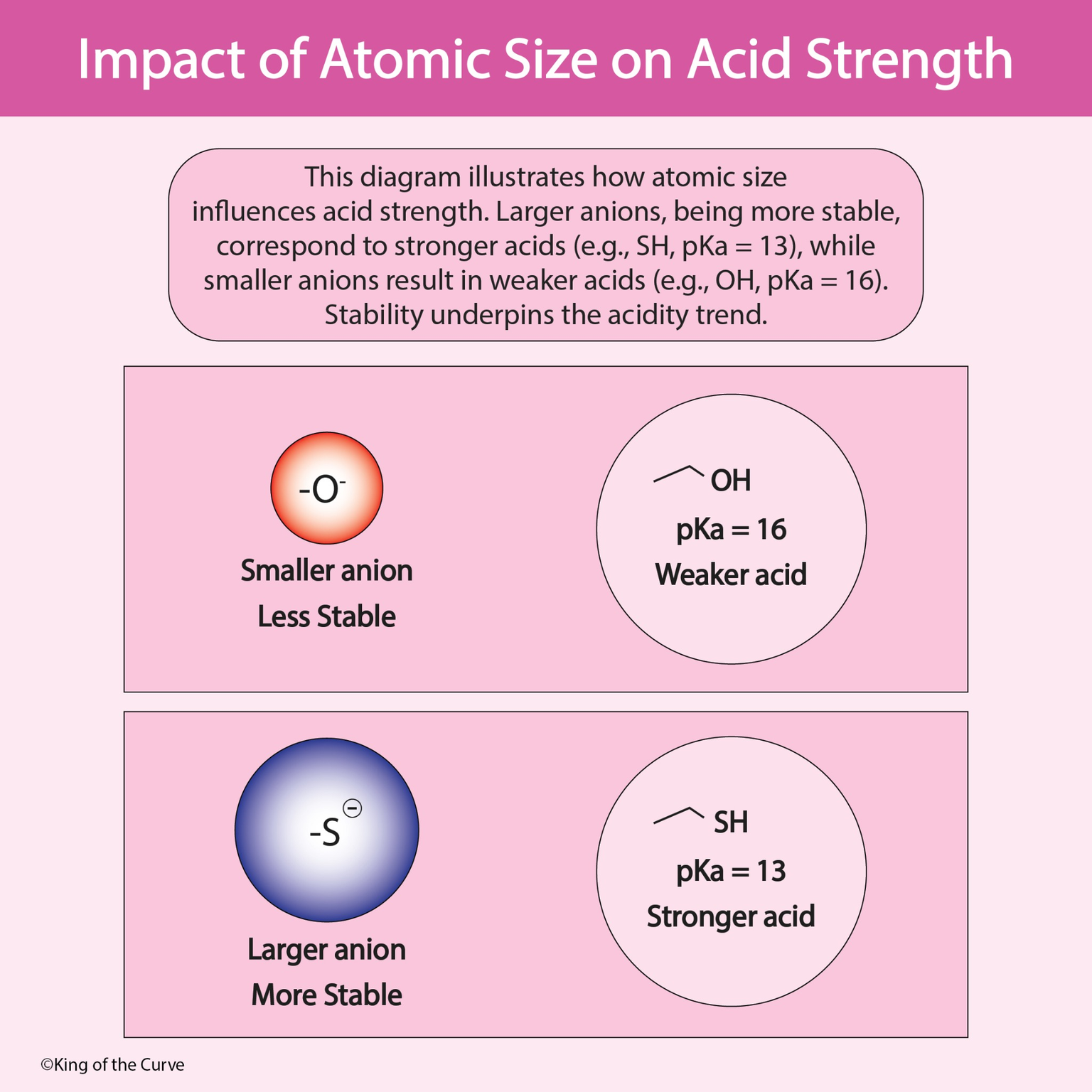
A classic example that illustrates the effect of atomic size involves comparing alcohols (ROH) and thiols (RSH). Even though oxygen is more electronegative than sulfur, thiols are actually stronger acids because sulfur is significantly larger. The larger atomic radius allows sulfur to disperse negative charge more effectively after losing a proton.
| Molecule | Conjugate Base | Approx. pKa | Relative Acid Strength |
|---|---|---|---|
| Alcohol (ROH) | RO− | ~16 | Weaker acid |
| Thiol (RSH) | RS− | ~13 | Stronger acid |
Because sulfur stabilizes the conjugate base better, thiols have lower pKa values, indicating stronger acidity.
📈 Why Larger Atoms Stabilize Charge
Larger atoms have more diffuse electron clouds, which allows negative charge to spread over a greater volume. This reduces electron–electron repulsion and lowers the overall energy of the conjugate base. When the conjugate base is lower in energy, the parent acid more easily releases a proton. This is why acidity increases when moving down a column in the periodic table.
🧠 MCAT Strategy for Acid Trends
On the MCAT, acid strength is often tested through comparison questions or reaction mechanisms. A helpful shortcut is remembering the periodic trend: acidity increases as atomic size increases down a group. For example, hydrogen halides follow the trend HF < HCl < HBr < HI in acidity. Even though fluorine is the most electronegative element, hydrogen iodide is the strongest acid because iodine stabilizes the conjugate base much better due to its larger size.
⚠️ Common Student Mistake
A common misunderstanding among students is assuming electronegativity always determines acidity. While electronegativity does influence acidity when comparing atoms across a row, it becomes less important when moving down a column. In those cases, atomic size dominates, because the larger atom stabilizes the negative charge more effectively than a smaller, highly electronegative atom.
🧬 Importance in Biology and Medicine
Acid–base chemistry plays an important role in biological systems. Many biochemical reactions depend on proton transfer, including enzyme catalysis, metabolic pathways, and drug interactions. Understanding how atomic size influences acidity helps explain why certain functional groups behave differently in physiological environments and why sulfur-containing compounds often appear in biochemical processes.

Frequently Asked Questions (FAQs)
-
Aim for 4-6 focused hours, ensuring you incorporate breaks to avoid burnout.
-
Practice mindfulness techniques, take practice exams under realistic conditions, and maintain a balanced lifestyle.
-
Set short-term goals, seek support from mentors, and reward yourself for small achievements.
-
Regular exercise improves focus, reduces stress, and enhances overall mental clarity.
-
KOTC offers personalized learning tools, gamification features, and adaptive question banks to help students stay on track without burnout.