
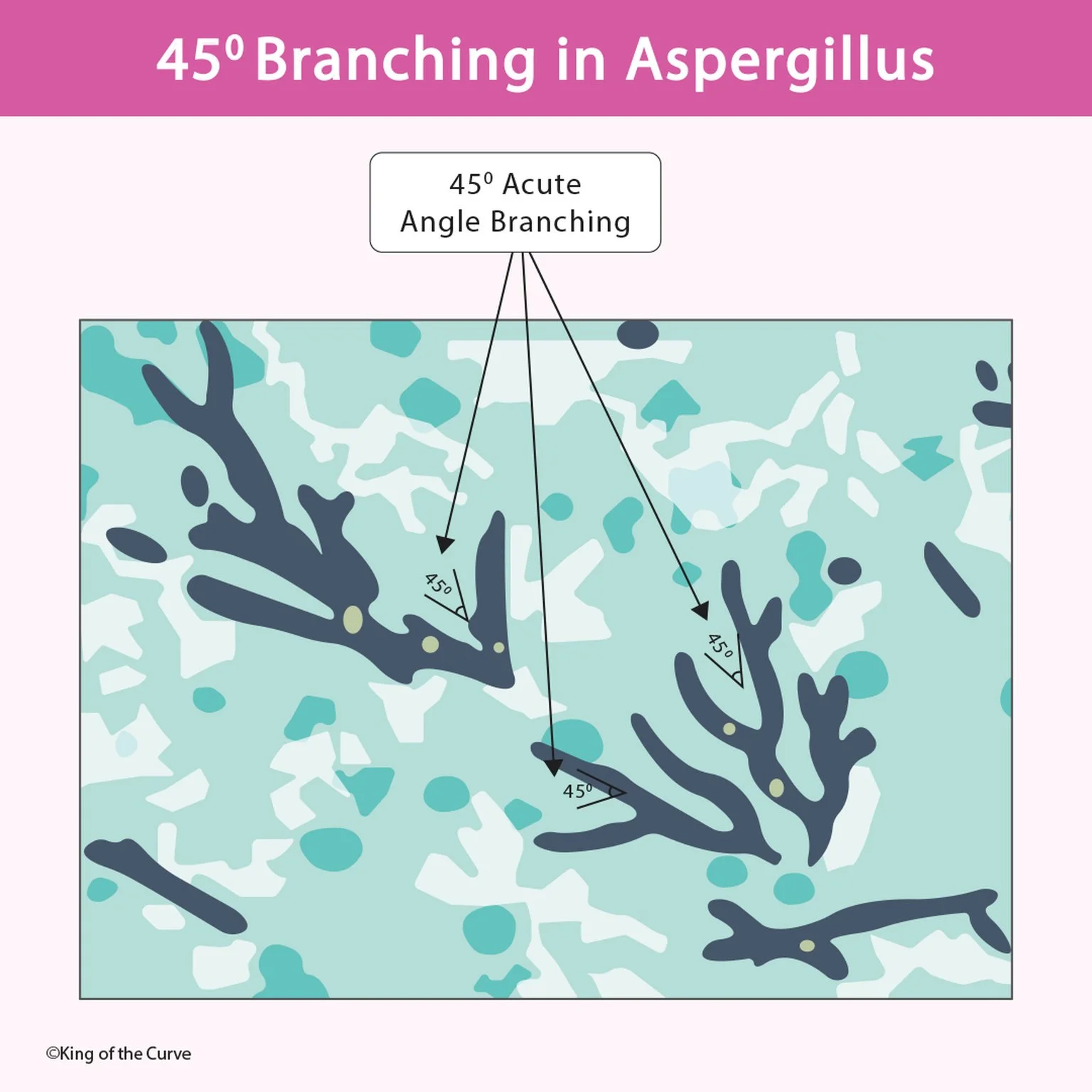
Aspergillus is a mold recognized in tissue by narrow, septate hyphae that typically branch at acute angles, often around 45°. This pattern provides a useful clue in fungal identification. Recognizing the branching angle alongside other structural features helps distinguish it from other molds.
🍄 Understanding Hyphae and Septa
Hyphae are thread-like fungal structures, while septa are internal cross-walls that divide them into compartments. Aspergillus typically has regularly septate hyphae with a relatively uniform width. These features are most useful when assessed together with the branching pattern.
🌿 What Is Dichotomous Branching?
Dichotomous branching occurs when a fungal filament divides into two branches. Aspergillus commonly displays this pattern, producing repeated forks as its hyphae grow. In tissue sections, the appearance can vary depending on how the filaments are cut and viewed.
🧠 Remember: Aspergillus Means Acute
A simple memory aid is “A for Aspergillus, A for Acute.” Acute angles measure less than 90°, making this association helpful during revision. However, 45° is a characteristic description rather than an exact requirement for every branch seen in a specimen.
📊 Aspergillus vs. Mucorales
Comparing Aspergillus with Mucorales helps reinforce the distinction. Mucorales, which include Mucor and Rhizopus, generally have broader, irregular hyphae with few or no visible septa. The table summarizes their typical appearances, while recognizing that real tissue specimens can vary.
| Feature | Aspergillus | Mucorales |
|---|---|---|
| Hyphal appearance | Narrow, relatively uniform | Broad, irregular, ribbon-like |
| Septation | Regularly septate | Few or no visible septa |
| Typical branching | Acute angles, often around 45° | Irregular, often approaching 90° |
| Memory aid | Acute and septate | Broad and sparsely septate |
🫁 How Aspergillus Enters the Body
Aspergillus spores occur in the environment and can enter the respiratory tract when inhaled. Most people do not become ill after exposure. However, people with weakened immune systems or underlying lung disease are more vulnerable to Aspergillus-related illness.
🛡️ Who Is at Risk for Invasive Aspergillosis?
Invasive aspergillosis is a particular concern in people with prolonged low neutrophil counts, certain blood cancers, or organ and stem cell transplants. High-dose corticosteroids and other immunosuppressive treatments can also increase risk. In susceptible patients, infection may spread beyond the lungs to other organs.
🔍 How Laboratory Tests Identify Aspergillus
Laboratories examine specimens for fungal structures and may use culture to grow and identify the organism. Additional tests can detect fungal components, such as galactomannan, or Aspergillus genetic material through PCR. Test selection and interpretation depend on the specimen and the patient’s clinical situation.
🧪 Why Branching Alone Cannot Confirm Diagnosis
Acute-angle branching supports suspicion of Aspergillus, but microscopy alone may not provide definitive identification. Clinicians combine fungal appearance with symptoms, risk factors, imaging, and supporting laboratory findings. The most reliable interpretation considers the complete pattern rather than treating a 45° branch as proof of infection.

Frequently Asked Questions (FAQs)
-
Aim for 4-6 focused hours, ensuring you incorporate breaks to avoid burnout.
-
Practice mindfulness techniques, take practice exams under realistic conditions, and maintain a balanced lifestyle.
-
Set short-term goals, seek support from mentors, and reward yourself for small achievements.
-
Regular exercise improves focus, reduces stress, and enhances overall mental clarity.
-
KOTC offers personalized learning tools, gamification features, and adaptive question banks to help students stay on track without burnout.