
Water is one of the most important molecules in chemistry because it can act as both an acid and a base. This property, known as amphoteric behavior, plays an essential role in chemical reactions, biological processes, and maintaining pH balance.
🧪 What Is Amphoteric Behavior?
An amphoteric substance can act as either an acid or a base depending on the substance with which it reacts.
According to Brønsted–Lowry theory, acids donate protons (H⁺), while bases accept protons.
Water is amphoteric because it can perform both functions. It accepts protons when reacting with stronger acids and donates protons when reacting with suitable bases.
Water is also called amphiprotic, meaning it can specifically donate or accept hydrogen ions.
MCAT Tip: Remember that acid–base behavior depends on proton transfer, not simply the identity of a molecule.
💧 Water Acting as a Base: Accepting Protons
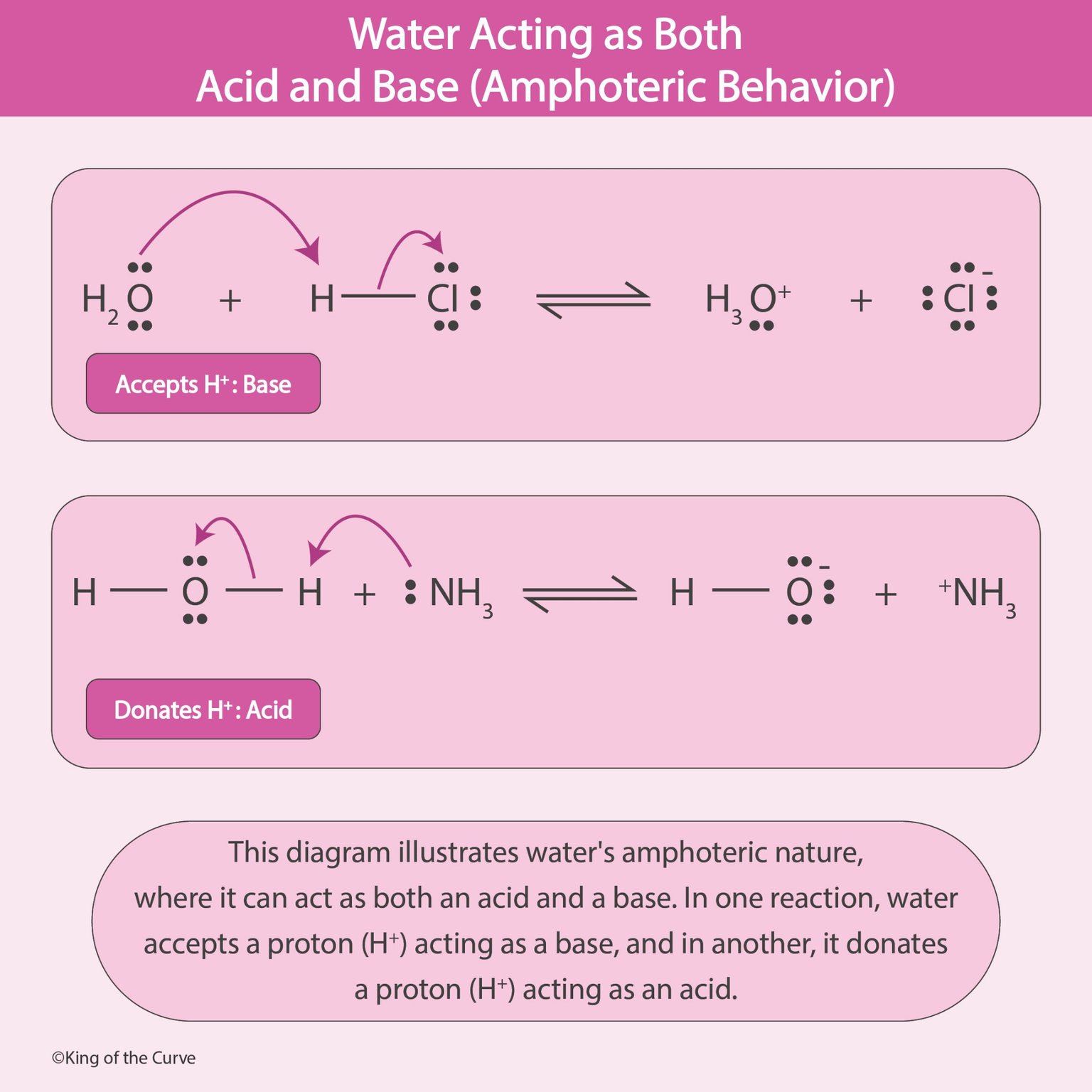
When water reacts with hydrochloric acid (HCl), it acts as a Brønsted–Lowry base.
Hydrochloric acid donates a proton, which water accepts to form hydronium (H₃O⁺). The remaining chloride ion (Cl⁻) becomes the conjugate base of hydrochloric acid.
Water can accept the proton because its oxygen atom contains lone pairs of electrons that participate in bond formation.
Key concept: When water accepts H⁺, it acts as a base and forms hydronium.
⚗️ Water Acting as an Acid: Donating Protons
Water can also act as an acid when it reacts with ammonia (NH₃).
In this reaction, ammonia accepts a proton from water and becomes ammonium (NH₄⁺). Water loses that proton and forms hydroxide (OH⁻).
Because water donates a proton, it functions as a Brønsted–Lowry acid.
This demonstrates why water cannot always be classified exclusively as an acid or a base.
MCAT Tip: Water forms OH⁻ when it donates a proton and H₃O⁺ when it accepts one.
🔬 How Proton Transfer Works
Acid–base reactions involve the transfer of protons between molecules.
Although protons are transferred, electron pairs control the formation and breaking of chemical bonds.
When water acts as a base, a lone pair on oxygen forms a bond with the incoming proton.
When water acts as an acid, the electrons from the broken oxygen–hydrogen bond remain on oxygen.
In reaction mechanisms, curved arrows indicate electron-pair movement rather than proton movement.
Understanding this distinction is important for interpreting organic chemistry mechanisms on the MCAT.
🔄 Conjugate Acid–Base Pairs
Every Brønsted–Lowry acid–base reaction involves conjugate acid–base pairs.
An acid becomes its conjugate base after donating a proton. A base becomes its conjugate acid after accepting a proton.
For water, the two important conjugate species are hydronium and hydroxide.
Hydronium (H₃O⁺) is the conjugate acid of water, while hydroxide (OH⁻) is its conjugate base.
These relationships help explain why water participates in many reversible acid–base reactions.
High-yield rule: Conjugate acid–base pairs differ by exactly one proton.
⚖️ Autoionization of Water and pH
Water can react with itself through a process called autoionization.
During this process, one water molecule donates a proton while another accepts it, producing hydronium and hydroxide ions.
The equilibrium is described by the ion-product constant of water, known as Kw.
At 25°C, Kw equals 1.0 × 10⁻¹⁴.
In pure water at this temperature, hydronium and hydroxide concentrations are equal, each measuring 1.0 × 10⁻⁷ M.
This results in a neutral pH of 7.
MCAT Tip: Neutral solutions have equal concentrations of hydronium and hydroxide. Neutral pH is not always exactly 7 because Kw changes with temperature.
🧬 Why Amphoteric Behavior Matters in Biology
Water's ability to donate and accept protons is essential for maintaining chemical balance in biological systems.
Proton-transfer reactions occur during enzyme activity, amino acid ionization, metabolism, and cellular signaling.
Water also provides the environment in which biological buffer systems regulate pH.
One important example is the bicarbonate buffer system, which helps maintain blood pH through reversible reactions involving carbon dioxide, carbonic acid, and bicarbonate.
These processes connect acid–base chemistry with respiratory physiology, kidney function, and homeostasis.
Understanding amphoteric behavior therefore strengthens both chemistry and biology knowledge for the MCAT.
📊 Water Acting as an Acid vs. Base: MCAT Comparison
The following table summarizes the major differences between water's two acid–base roles.
| Property | Water as an Acid | Water as a Base |
|---|---|---|
| Brønsted–Lowry role | Proton donor | Proton acceptor |
| Proton transfer | Loses H⁺ | Gains H⁺ |
| Product formed | Hydroxide (OH⁻) | Hydronium (H₃O⁺) |
| Example reactant | Ammonia (NH₃) | Hydrochloric acid (HCl) |
| Conjugate species | OH⁻ | H₃O⁺ |
| Key mechanism | Proton donation | Proton acceptance |
The easiest way to identify water's role is to determine whether it gains or loses a proton during the reaction.
🎯 MCAT High-Yield Summary: Remember Water's Dual Role
Water is amphoteric because it can function as both an acid and a base.
When water accepts a proton, it behaves as a base and forms hydronium. When water donates a proton, it behaves as an acid and forms hydroxide.

Frequently Asked Questions (FAQs)
-
Aim for 4-6 focused hours, ensuring you incorporate breaks to avoid burnout.
-
Practice mindfulness techniques, take practice exams under realistic conditions, and maintain a balanced lifestyle.
-
Set short-term goals, seek support from mentors, and reward yourself for small achievements.
-
Regular exercise improves focus, reduces stress, and enhances overall mental clarity.
-
KOTC offers personalized learning tools, gamification features, and adaptive question banks to help students stay on track without burnout.