
Understanding wavefront propagation is essential for mastering wave motion, optics, interference, and diffraction on the MCAT. Wavefronts help us visualize how waves travel through space, how energy moves, and why waves change direction when entering different media. This guide explains wavefronts, their relationship to wave rays, and the principles that govern wave behavior.
🌊 What Is Wavefront Propagation?
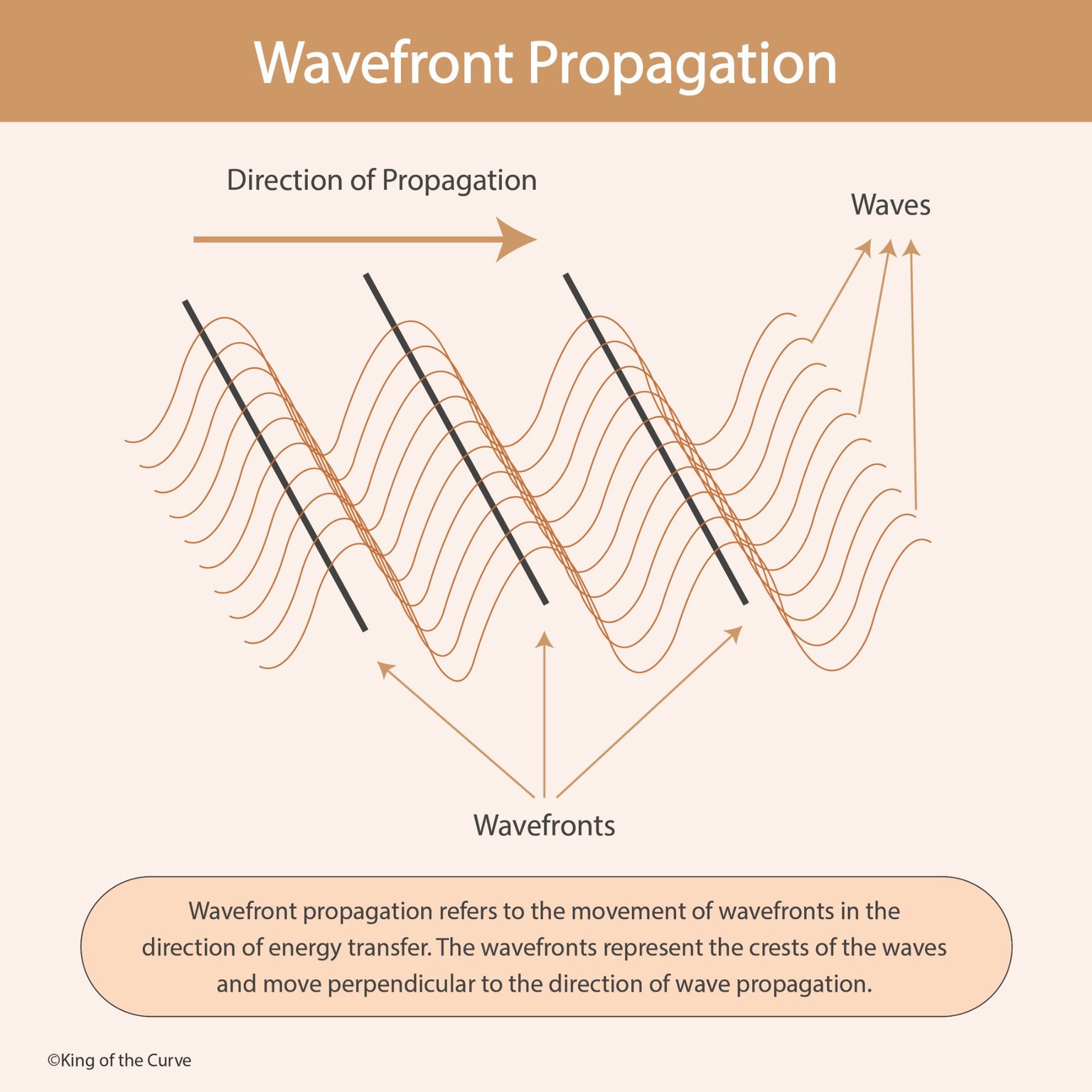
A wavefront is a line or surface connecting points on a wave that are at the same phase of oscillation. For example, a wavefront can connect neighboring crests. Wavefront propagation describes how these equal-phase surfaces advance as a wave travels. In a uniform, isotropic medium, the direction of wave propagation is perpendicular to the wavefront.
📐 Wavefronts vs. Wave Rays
Wavefronts and wave rays represent different aspects of wave motion. Wavefronts show equal-phase positions, while rays indicate the direction of propagation. For a plane wave traveling through a uniform medium, rays are perpendicular to the wavefronts. This distinction is especially important in geometric optics, where light rays help explain reflection, refraction, and image formation.
⚡ How Wavefronts Transfer Energy
Waves transport energy without requiring matter to move along with the wave over large distances. In a transverse mechanical wave, particles oscillate perpendicular to the direction of propagation. In a longitudinal wave, particles oscillate parallel to the propagation direction. In a uniform, nonabsorbing medium, wave energy travels with the wave, while individual particles generally oscillate around their equilibrium positions.
🔬 Huygens’ Principle Explained
Huygens’ principle states that every point on a wavefront can be treated as a source of secondary wavelets. The new wavefront is constructed as the forward envelope of these wavelets. This principle helps explain reflection, refraction, and diffraction. It also provides an intuitive way to understand how a wavefront changes shape as it travels through different regions.
📊 Types of Wavefronts
Wavefronts can have different shapes depending on the source and the propagation geometry.
| Wavefront Type | Shape | Typical Example | Key Characteristic |
|---|---|---|---|
| Plane | Flat, parallel surfaces | Approximate distant light source | Parallel rays |
| Spherical | Expanding spherical surfaces | Point light source in a uniform medium | Radially spreading rays |
| Cylindrical | Expanding cylindrical surfaces | Idealized line source | Radial spreading perpendicular to the source axis |
For MCAT questions, remember that wavefronts are surfaces of constant phase, not necessarily physical crests that can be seen directly.
🧮 Wavefront Speed, Frequency, and Wavelength
The fundamental wave equation relates wave speed, frequency, and wavelength:
v = fλ
Where:
v = wave speed (m/s)
f = frequency (Hz)
λ = wavelength (m)
For example, if a wave has a frequency of 50 Hz and a wavelength of 2 m:
v = (50)(2)= 100 m/s
This equation applies to periodic waves and is especially useful for MCAT calculations involving sound, light, and other wave phenomena.
🔄 Reflection and Refraction of Wavefronts
When a wave encounters a boundary, its direction may change. During reflection, the angle of incidence equals the angle of reflection, measured relative to the normal. During refraction, the wave changes speed as it enters a different medium, which can change its direction. For light, Snell’s law describes this relationship:
n₁ sin θ₁ = n₂ sin θ₂
The frequency remains constant when light crosses a stationary boundary, but its speed and wavelength can change.
🌈 Diffraction and Interference
Diffraction occurs when waves spread around obstacles or through openings. It becomes especially noticeable when the opening size is comparable to the wavelength. Interference occurs when overlapping waves combine according to the principle of superposition. Constructive interference happens when waves reinforce each other, while destructive interference occurs when they partially or completely cancel. Wavefront diagrams help visualize both effects.
🧠 MCAT High-Yield Takeaways
For MCAT physics, remember that wavefronts connect points of equal phase, rays are perpendicular to wavefronts in an isotropic medium, and wave speed follows v = fλ. Huygens’ principle explains how wavefronts advance, while reflection, refraction, diffraction, and interference describe their behavior in different situations. One important clarification: wavefronts are not limited to crests, and the direction of wavefront motion is perpendicular to the wavefront itself in a uniform, isotropic medium.

Frequently Asked Questions (FAQs)
-
Aim for 4-6 focused hours, ensuring you incorporate breaks to avoid burnout.
-
Practice mindfulness techniques, take practice exams under realistic conditions, and maintain a balanced lifestyle.
-
Set short-term goals, seek support from mentors, and reward yourself for small achievements.
-
Regular exercise improves focus, reduces stress, and enhances overall mental clarity.
-
KOTC offers personalized learning tools, gamification features, and adaptive question banks to help students stay on track without burnout.