
Waves are essential to understanding physics concepts tested on the MCAT, including sound, light, electromagnetic radiation, and energy transfer. Every wave has measurable properties that describe how it moves and carries energy. The most important are wavelength, amplitude, frequency, period, crests, and troughs. Understanding these components helps students interpret wave diagrams, solve equations, and recognize the relationship between wave speed and frequency.
🌊 What Is a Wave in Physics?
A wave is a disturbance that transfers energy from one location to another without requiring a net transfer of matter. Mechanical waves, such as sound and water waves, require a medium, while electromagnetic waves, including visible light and X-rays, can travel through a vacuum.
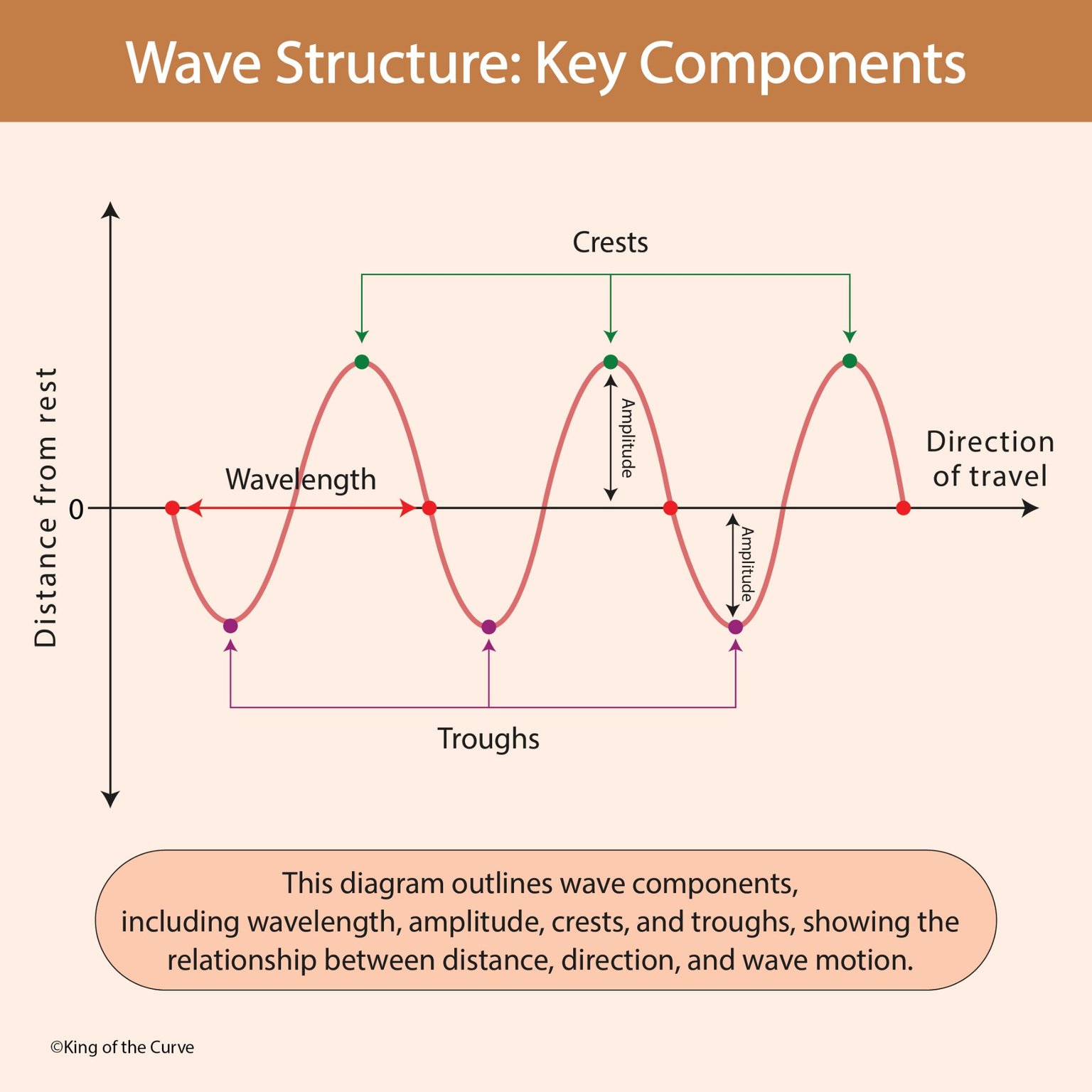
Waves can be classified as transverse or longitudinal. In a transverse wave, oscillations occur perpendicular to the direction of propagation. In a longitudinal wave, oscillations occur parallel to the direction of propagation. The infographic illustrates a transverse wave, making it useful for identifying the basic components of wave motion.
📏 Understanding Wavelength (λ)
Wavelength, represented by the Greek letter lambda (λ), is the distance between two consecutive points in the same phase of a wave. It can be measured from one crest to the next crest or from one trough to the next trough.
Wavelength is measured in meters (m) and is related to wave speed and frequency through the equation:
v = f λ
Where:
v = wave speed (m/s)
f = frequency (Hz)
λ = wavelength (m)
For a wave traveling at a constant speed, increasing frequency decreases wavelength. This inverse relationship is especially important when studying electromagnetic radiation and sound waves.
📈 What Is Wave Amplitude?
Amplitude is the maximum displacement of a point on a wave from its equilibrium position. In the infographic, amplitude is represented by the vertical distance from the central equilibrium line to either a crest or a trough.
For many waves, the energy transferred increases with the square of the amplitude. In a fixed medium under appropriate conditions, doubling the amplitude can increase the wave's intensity by a factor of four.
E ∝ A2
Here, I represents intensity and A represents amplitude. For sound waves, greater amplitude generally corresponds to greater intensity, while for light waves, intensity is also related to the amplitude of the electromagnetic field.
⛰️ Crests and Troughs: Highest and Lowest Points
A crest is the point of maximum positive displacement from equilibrium, while a trough is the point of maximum negative displacement. These features help identify complete wave cycles and measure wavelength.
The vertical distance between a crest and its neighboring trough is twice the amplitude, assuming a symmetric sinusoidal wave. Meanwhile, the horizontal distance from a crest to the next trough is half a wavelength.
Crest-to-trough distance = λ/2
This refers to horizontal separation along the direction of propagation, not vertical displacement.
⏱️ Frequency and Period: How Fast Does a Wave Oscillate?
Frequency describes the number of complete oscillations occurring per second and is measured in hertz (Hz). The period, represented by T, is the time required to complete one oscillation.
These quantities are reciprocals:
f = 1/T
T = 1/f
For example, if a wave completes five oscillations every second, its frequency is 5 Hz and its period is 0.2 seconds. Frequency is determined by the source of the wave, while the wavelength depends on the propagation speed in the medium.
🚀 Wave Speed and the Direction of Propagation
Wave speed describes how quickly a disturbance travels through a medium or through space. The relationship between speed, frequency, and wavelength is:
v = f λ
Consider a wave with a frequency of 20 Hz and a wavelength of 3 meters:
v = (20)(3) = 60 m/s
The wave travels at 60 meters per second. For electromagnetic waves in a vacuum, the propagation speed is approximately 3.00 x 10^8 m/s.
MCAT Tip: The direction of wave propagation is not necessarily the direction in which particles of the medium oscillate. In transverse waves, these directions are perpendicular.
🔬 Key Wave Properties: MCAT Comparison Table
The following table summarizes the most important wave quantities and their relationships.
| Wave Property | Definition | Formula or Relationship | SI Unit |
|---|---|---|---|
| Wavelength (λ) | Distance between successive points in phase | λ = v/f | m |
| Amplitude (A) | Maximum displacement from equilibrium | Maximum displacement | m for displacement waves |
| Frequency (f) | Number of cycles per second | f = 1/T | Hz |
| Period (T) | Time for one complete cycle | T = 1/f | s |
| Wave Speed (v) | Speed of wave propagation | v = fλ | m/s |
| Crest | Maximum positive displacement | +A | m for displacement waves |
| Trough | Maximum negative displacement | −A | m for displacement waves |
These definitions are particularly useful for interpreting wave diagrams and solving MCAT physics problems.
🔬 How Wave Properties Apply to Sound and Light
Sound waves are typically longitudinal pressure waves that travel through a material medium. Their frequency determines perceived pitch, while their intensity contributes to perceived loudness. Light consists of transverse electromagnetic waves, with frequency determining photon energy and wavelength determining position in the electromagnetic spectrum.
The energy of a photon is calculated using Planck's equation:
E = hf = hc/λ
Where h is Planck's constant and c is the speed of light in a vacuum. Higher-frequency light has greater photon energy, while longer-wavelength light has lower photon energy. This relationship is fundamental to understanding absorption spectroscopy, atomic transitions, and electromagnetic radiation on the MCAT.
🎯 MCAT High-Yield Summary: Remember the Wave Basics
Understanding wave structure becomes easier when you connect each property to its physical meaning. Wavelength measures spatial repetition, amplitude measures maximum displacement, frequency measures oscillations per second, and period measures the duration of one cycle.
Remember the three essential relationships:
v = fλ
f = 1/T
E = hf
These equations help solve MCAT questions involving wave propagation, sound, light, and electromagnetic energy. Practice identifying crests, troughs, and amplitudes directly from graphs, and always check whether the horizontal axis represents position or time.

Frequently Asked Questions (FAQs)
-
Aim for 4-6 focused hours, ensuring you incorporate breaks to avoid burnout.
-
Practice mindfulness techniques, take practice exams under realistic conditions, and maintain a balanced lifestyle.
-
Set short-term goals, seek support from mentors, and reward yourself for small achievements.
-
Regular exercise improves focus, reduces stress, and enhances overall mental clarity.
-
KOTC offers personalized learning tools, gamification features, and adaptive question banks to help students stay on track without burnout.