
Social status plays an important role in shaping how individuals interact with society. In sociology, achieved status and ascribed status describe two different ways people occupy positions within a social structure.
🏆 What Is Achieved Status?
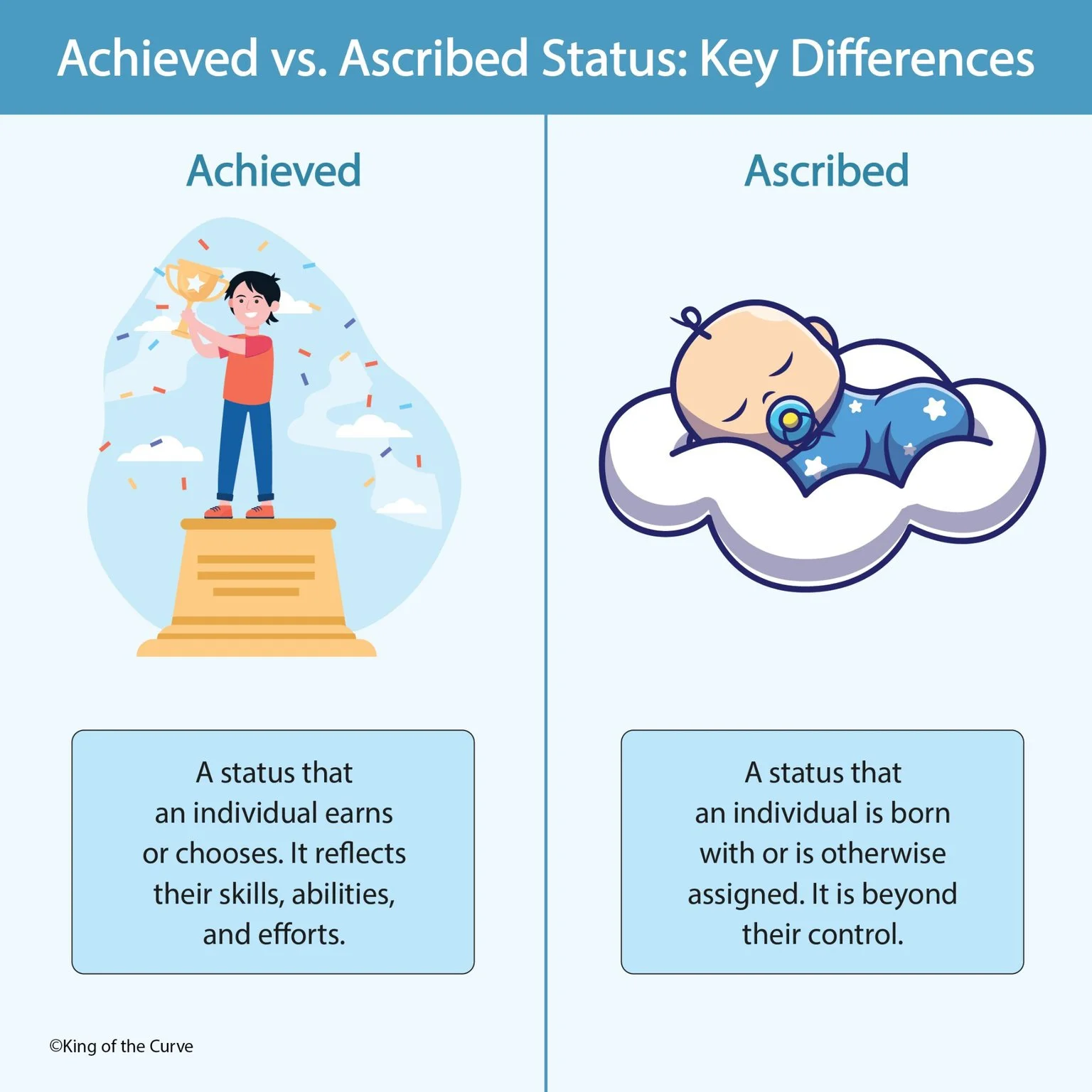
Achieved status refers to a social position that an individual earns, chooses, or obtains through personal actions, qualifications, or accomplishments.
Examples include becoming a physician, earning a college degree, winning a competition, or obtaining a leadership position.
Achieved statuses often reflect education, training, effort, and personal decisions. However, opportunities to obtain them can also be influenced by socioeconomic conditions and access to resources.
MCAT Tip: Achieved status is associated with accomplishment or choice, but it does not necessarily mean success is determined entirely by individual effort.
👶 What Is Ascribed Status?
Ascribed status refers to a social position assigned to an individual without being earned through personal achievement.
These statuses may be assigned at birth or acquired involuntarily later in life.
Examples include being born into a particular family, having a specific birth order, or being assigned a social category based on age or ancestry.
Ascribed statuses can influence social expectations, access to opportunities, and interactions with institutions.
Key distinction: Ascribed status is assigned rather than earned or voluntarily chosen.
⚖️ Achieved vs. Ascribed Status: Understanding the Difference
The primary difference between achieved and ascribed status is how an individual obtains the social position.
Achieved status is generally associated with personal accomplishments or choices, while ascribed status is assigned independently of those achievements.
For example, becoming a medical student is an achieved status because it involves educational qualifications and admission. Being someone's firstborn child is an ascribed status because it results from family circumstances rather than individual accomplishment.
Both types of status can shape a person's identity, responsibilities, and position within society.
🧠 How Social Status Influences Identity
Individuals occupy multiple social statuses simultaneously, and these positions contribute to their social identity.
A person may be a student, sibling, employee, and community volunteer at the same time.
Each status carries expectations about appropriate behavior, known as social roles.
For example, a physician is expected to provide medical care, while a student is expected to participate in educational activities.
These expectations influence how individuals behave and how others interact with them.
Understanding the relationship between status and role is especially important for MCAT sociology questions.
🏛️ Social Stratification and Status
Social stratification refers to the organization of society into hierarchical groups based on factors such as wealth, power, and prestige.
Both achieved and ascribed statuses can influence an individual's position within these hierarchies.
For example, occupational achievement may contribute to higher socioeconomic status, while family background can affect access to educational opportunities.
Ascribed characteristics may also influence how individuals are treated within social institutions.
MCAT Connection: Social stratification helps explain why individuals do not always have equal opportunities to achieve similar social positions.
📈 Achieved Status and Social Mobility
Social mobility describes movement between positions within a social hierarchy.
Achieved statuses can contribute to upward or downward mobility through changes in education, occupation, income, or professional standing.
For example, someone who obtains specialized training and enters a higher-paying profession may experience upward socioeconomic mobility.
However, social mobility is influenced by structural factors, including educational access, economic resources, discrimination, and social networks.
This illustrates an important sociological principle: individual choices operate within broader social structures.
🔄 Status Sets, Role Conflict, and Role Strain
A status set includes all the social statuses occupied by an individual.
Each status has associated roles, and these expectations may sometimes compete.
Role conflict occurs when expectations from two or more statuses interfere with one another. For example, a medical student who is also a parent may struggle to balance academic responsibilities with childcare.
Role strain occurs when competing expectations arise within a single status, such as a physician managing several demanding responsibilities associated with patient care.
These distinctions frequently appear in MCAT Psych/Soc questions.
📊 Achieved vs. Ascribed Status: High-Yield MCAT Comparison
The following table summarizes the major differences between achieved and ascribed status.
| Feature | Achieved Status | Ascribed Status |
|---|---|---|
| Definition | Social position earned, chosen, or obtained through individual actions | Social position assigned without personal achievement |
| How it is obtained | Through accomplishments, qualifications, or choices | Through birth or involuntary social assignment |
| Individual control | Often involves some personal agency | Generally little or no control over assignment |
| Examples | Physician, college graduate, elected leader | Birth order, family background, age category |
| Relationship to mobility | Can contribute to social mobility | Can influence opportunities for mobility |
| Social significance | Often associated with accomplishments and acquired roles | Often associated with inherited or assigned social positions |
Key takeaway: Achieved status emphasizes how a position is obtained through action or choice, while ascribed status emphasizes assignment independent of personal accomplishment.
🎯 MCAT High-Yield Summary: Remember the Difference
Achieved and ascribed status are foundational concepts in sociology because they explain how individuals obtain positions within society.
Remember these distinctions:
Achieved = Accomplished or chosen
Ascribed = Assigned
Status = Social position
Role = Expected behavior associated with that position

Frequently Asked Questions (FAQs)
-
Aim for 4-6 focused hours, ensuring you incorporate breaks to avoid burnout.
-
Practice mindfulness techniques, take practice exams under realistic conditions, and maintain a balanced lifestyle.
-
Set short-term goals, seek support from mentors, and reward yourself for small achievements.
-
Regular exercise improves focus, reduces stress, and enhances overall mental clarity.
-
KOTC offers personalized learning tools, gamification features, and adaptive question banks to help students stay on track without burnout.