
Understanding VSEPR theory and molecular geometry is essential for MCAT general chemistry. The three-dimensional arrangement of atoms influences molecular polarity, intermolecular forces, chemical reactivity, and biological interactions.
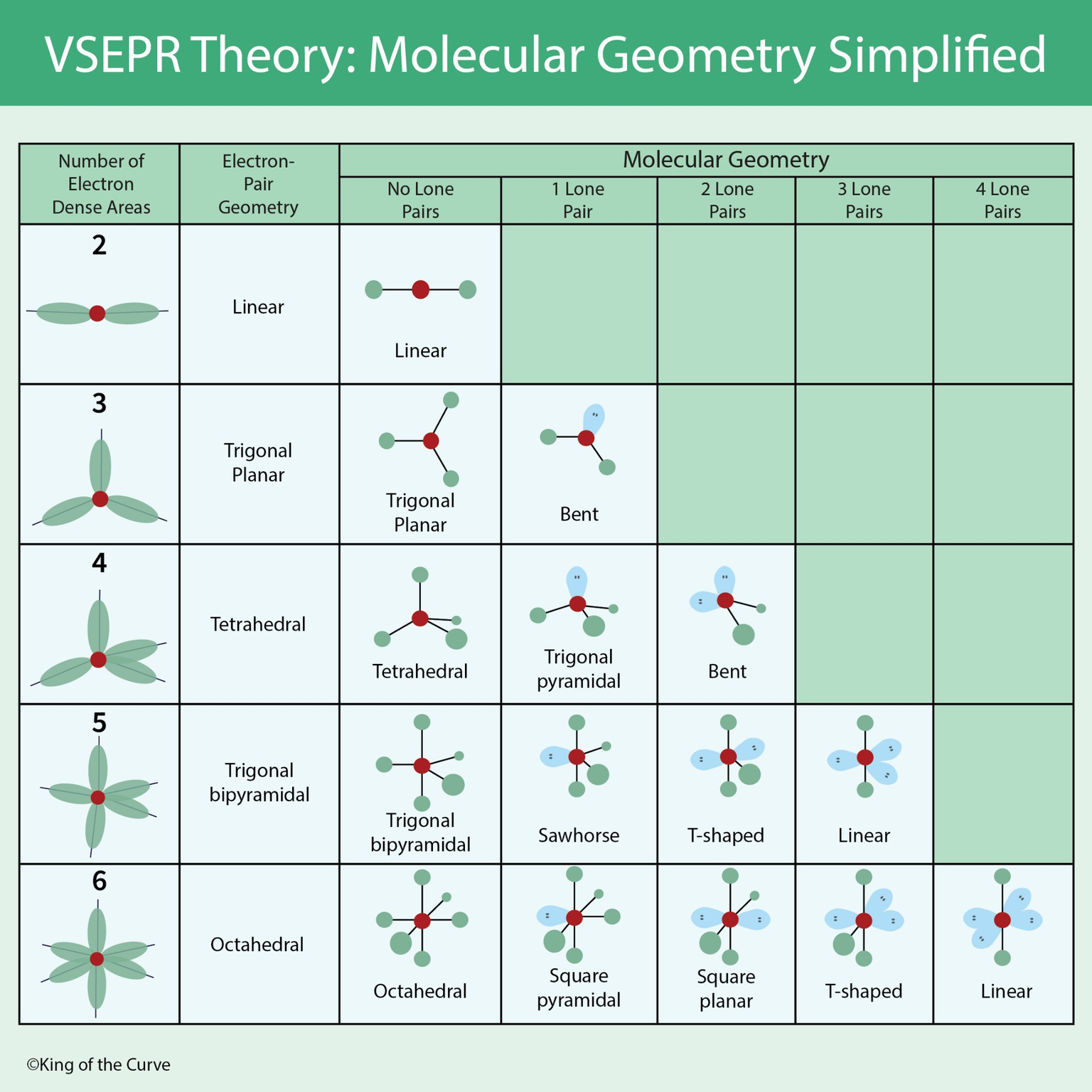
⚛️ What Is VSEPR Theory?
VSEPR theory is based on a simple principle: electron domains around a central atom arrange themselves to minimize repulsion.
An electron domain is a region of electron density surrounding the central atom. It may consist of a single bond, double bond, triple bond, or lone pair.
When determining molecular geometry, remember that multiple bonds count as one electron domain, even though they contain more than one shared electron pair.
For example, carbon dioxide (CO₂) has two electron domains around carbon because each C=O double bond counts as one domain. Its electron-pair geometry and molecular geometry are both linear.
VSEPR theory is especially useful for predicting the shapes of molecules with two to six electron domains around a central atom.
🔬 Electron-Pair Geometry vs. Molecular Geometry
One of the most important MCAT distinctions is the difference between electron-pair geometry and molecular geometry.
Electron-pair geometry describes the arrangement of all electron domains around a central atom, including bonds and lone pairs.
Molecular geometry describes the spatial arrangement of bonded atoms, excluding lone pairs from the named shape.
For example, ammonia (NH₃) has four electron domains around nitrogen: three bonding domains and one lone pair.
Its electron-pair geometry is tetrahedral, but its molecular geometry is trigonal pyramidal.
Water (H₂O) also has a tetrahedral electron-pair geometry. However, because oxygen has two bonding domains and two lone pairs, its molecular geometry is bent.
MCAT Tip: Electron-pair geometry counts both bonds and lone pairs; molecular geometry describes the arrangement of atoms.
📐 Two and Three Electron Domains: Linear, Trigonal Planar, and Bent
Molecules with two electron domains generally adopt a linear geometry, with a bond angle of 180°.
A classic example is carbon dioxide (CO₂), where the central carbon atom has two bonding domains and no lone pairs.
Molecules with three electron domains have trigonal planar electron-pair geometry, with ideal bond angles of 120°.
Boron trifluoride (BF₃) is an example of trigonal planar molecular geometry because boron has three bonding domains and no lone pairs.
When a central atom has two bonding domains and one lone pair, the molecular geometry becomes bent, as seen in sulfur dioxide (SO₂). Its bond angle is approximately 119°, slightly smaller than the ideal 120°.
The key concept is that lone pairs change molecular shape even when the electron-domain geometry remains the same.
🔺 Four Electron Domains: Tetrahedral, Trigonal Pyramidal, and Bent
Four electron domains produce a tetrahedral electron-pair geometry, with an ideal bond angle of approximately 109.5°.
Methane (CH₄) is the classic tetrahedral molecule because carbon forms four single bonds and has no lone pairs.
Ammonia (NH₃) has three bonding domains and one lone pair, producing a trigonal pyramidal shape with bond angles of approximately 107°.
Water (H₂O) contains two bonding domains and two lone pairs, producing a bent molecular geometry with a bond angle of approximately 104.5°.
These differences result from the stronger repulsive effects of lone pairs.
The typical repulsion order is:
Lone Pair–Lone Pair
Lone Pair–Bond Pair
Bond Pair–Bond Pair
This explains why the H–O–H angle in water is smaller than the ideal tetrahedral angle.
🔷 Five Electron Domains: Trigonal Bipyramidal Geometry
Five electron domains form a trigonal bipyramidal electron-pair geometry.
This arrangement contains three equatorial positions separated by 120° and two axial positions perpendicular to the equatorial plane. Axial–equatorial bond angles are 90°.
Phosphorus pentachloride (PCl₅) is a classic example of trigonal bipyramidal molecular geometry.
When lone pairs are present, they preferentially occupy equatorial positions because these positions experience fewer 90° interactions.
This produces several molecular shapes:
One lone pair: Seesaw, as in SF₄.
Two lone pairs: T-shaped, as in ClF₃.
Three lone pairs: Linear, as in XeF₂.
The MCAT may ask why lone pairs preferentially occupy equatorial positions. The answer is that this arrangement minimizes electron-domain repulsion.
🧊 Six Electron Domains: Octahedral and Related Shapes
Six electron domains produce an octahedral electron-pair geometry, with ideal adjacent bond angles of 90°.
Sulfur hexafluoride (SF₆) is an example of octahedral molecular geometry because sulfur has six bonding domains and no lone pairs.
With one lone pair, the molecular geometry becomes square pyramidal, as seen in BrF₅.
With two lone pairs, the most favorable arrangement places them opposite each other, producing a square planar molecular geometry, as seen in XeF₄.
Three lone pairs can produce a T-shaped molecular geometry, while four lone pairs produce a linear arrangement.
For the MCAT, the most commonly tested six-domain shapes are octahedral, square pyramidal, and square planar.
📊 VSEPR Molecular Geometry: High-Yield MCAT Table
The following table summarizes the most important molecular geometries, lone-pair arrangements, ideal bond angles, and examples.
| Electron Domains | Lone Pairs | Molecular Geometry | Typical Bond Angles | Example |
|---|---|---|---|---|
| 2 | 0 | Linear | 180° | CO2 |
| 3 | 0 | Trigonal Planar | 120° | BF3 |
| 3 | 1 | Bent | Slightly below 120° | SO2 |
| 4 | 0 | Tetrahedral | 109.5° | CH4 |
| 4 | 1 | Trigonal Pyramidal | ~107° | NH3 |
| 4 | 2 | Bent | ~104.5° | H2O |
| 5 | 0 | Trigonal Bipyramidal | 90°, 120°, 180° | PCl5 |
| 5 | 1 | Seesaw | Distorted 90°, 120°, 180° | SF4 |
| 5 | 2 | T-Shaped | Approximately 90°, 180° | ClF3 |
| 5 | 3 | Linear | 180° | XeF2 |
| 6 | 0 | Octahedral | 90°, 180° | SF6 |
| 6 | 1 | Square Pyramidal | Approximately 90°, 180° | BrF5 |
| 6 | 2 | Square Planar | 90°, 180° | XeF4 |
Note: Bond angles are idealized or approximate. Actual angles may differ because of lone-pair repulsion, multiple bonds, and substituent effects.
High-yield rule: Always determine the number of electron domains before predicting molecular geometry.
🧲 How Molecular Geometry Affects Molecular Polarity
Molecular geometry is essential for determining whether a molecule has a net dipole moment.
A molecule can contain polar bonds but still be nonpolar if its bond dipoles cancel because of symmetry.
For example, carbon dioxide (CO₂) contains polar C=O bonds, but its linear geometry causes the bond dipoles to cancel, making the molecule nonpolar.
Water (H₂O), on the other hand, has polar O–H bonds and a bent molecular geometry. Its bond dipoles do not cancel, so water is polar.
Similarly, BF₃ is nonpolar because of its symmetric trigonal planar arrangement, whereas NH₃ is polar because of its trigonal pyramidal geometry.
For MCAT questions, examine both bond polarity and molecular symmetry before deciding whether a molecule is polar.
🎯 How to Solve VSEPR Questions on the MCAT
A reliable approach to molecular geometry questions is to use the Lewis structure and AXE notation.
In AXE notation, A represents the central atom, X represents the number of bonded atoms, and E represents the number of lone pairs on the central atom.
For example, NH₃ is AX₃E, while H₂O is AX₂E₂.

Frequently Asked Questions (FAQs)
-
Aim for 4-6 focused hours, ensuring you incorporate breaks to avoid burnout.
-
Practice mindfulness techniques, take practice exams under realistic conditions, and maintain a balanced lifestyle.
-
Set short-term goals, seek support from mentors, and reward yourself for small achievements.
-
Regular exercise improves focus, reduces stress, and enhances overall mental clarity.
-
KOTC offers personalized learning tools, gamification features, and adaptive question banks to help students stay on track without burnout.