
🧪 Understanding pKa in Chemistry: Acid Strength Made Simple
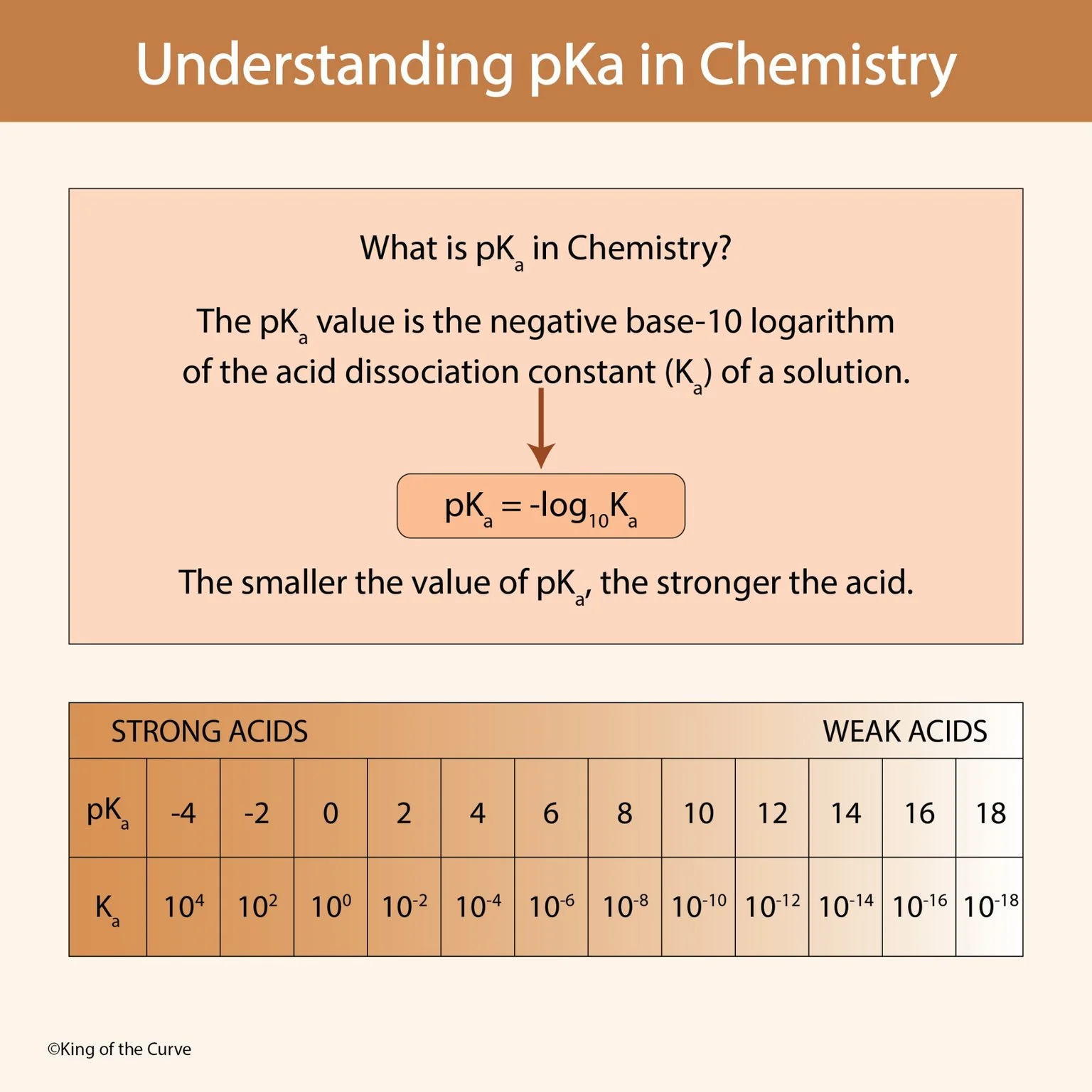
The pKa of an acid is a numerical measure related to its tendency to donate a proton (H⁺). It is derived from the acid dissociation constant, Ka, and provides a convenient way to compare the strengths of different acids.
🔢 The pKa Equation
The relationship between pKa and Ka is:
pKa = −log₁₀(Ka)
Because the relationship is logarithmic, a change of 1 pKa unit corresponds to a tenfold change in Ka. For example, an acid with a pKa of 2 has a Ka that is 10 times larger than an acid with a pKa of 3.
💪 pKa and Acid Strength
A lower pKa means a stronger acid, while a higher pKa generally indicates a weaker acid. Stronger acids dissociate more extensively in solution and have larger Ka values. Therefore, Ka increases as pKa decreases.
🔄 Understanding Acid Dissociation
For a general acid HA, dissociation can be represented as:
HA ⇌ H⁺ + A⁻
The acid dissociation constant is:
Ka = [H⁺][A⁻] / [HA]
A larger Ka indicates that equilibrium favors the dissociated products more strongly.
📊 Comparing pKa and Ka
| 🧪 pKa | ⚖️ Relative Ka | 📌 Interpretation |
|---|---|---|
| Low | Large | Stronger acid |
| High | Small | Weaker acid |
| ↓ by 1 | ×10 larger | Greater tendency to dissociate |
| ↑ by 1 | ÷10 | Lower tendency to dissociate |
⚖️ pH vs. pKa
pH and pKa are not the same thing. pH describes the hydrogen-ion activity of a solution, whereas pKa is a property associated with an acid–base equilibrium under specified conditions. Comparing pH with pKa helps predict which protonation state predominates.
🧬 The Henderson–Hasselbalch Equation
For a weak acid and its conjugate base, the relationship can be written as:
pH = pKa + log([A⁻]/[HA])
When pH = pKa, the concentrations of the protonated and deprotonated forms are equal: [HA] = [A⁻]. This is especially important when studying buffers.
🧠 Why pKa Matters for the MCAT
MCAT questions may use pKa to test acid–base equilibria, buffers, amino acids, proteins, titration curves, and protonation states. A useful rule is: when pH < pKa, the protonated form tends to predominate; when pH > pKa, the deprotonated form tends to predominate.
⭐ High-Yield MCAT Takeaway
Remember: low pKa = stronger acid = larger Ka. Each one-unit decrease in pKa represents a tenfold increase in Ka. Connecting pH, pKa, protonation, and conjugate acid–base pairs makes many MCAT acid–base questions much easier to approach.

Frequently Asked Questions (FAQs)
-
Aim for 4-6 focused hours, ensuring you incorporate breaks to avoid burnout.
-
Practice mindfulness techniques, take practice exams under realistic conditions, and maintain a balanced lifestyle.
-
Set short-term goals, seek support from mentors, and reward yourself for small achievements.
-
Regular exercise improves focus, reduces stress, and enhances overall mental clarity.
-
KOTC offers personalized learning tools, gamification features, and adaptive question banks to help students stay on track without burnout.