
🧪 Polyprotic Acids: Understanding Stepwise Dissociation for the MCAT
Polyprotic acids are acids capable of donating more than one proton (H⁺) per molecule. Unlike monoprotic acids, which have only one ionizable proton, polyprotic acids release their protons through a series of separate dissociation steps. Understanding this process is especially useful for MCAT questions involving acid–base equilibria, pKₐ values, buffers, and titration curves.
🔬 Diprotic vs. Triprotic Acids
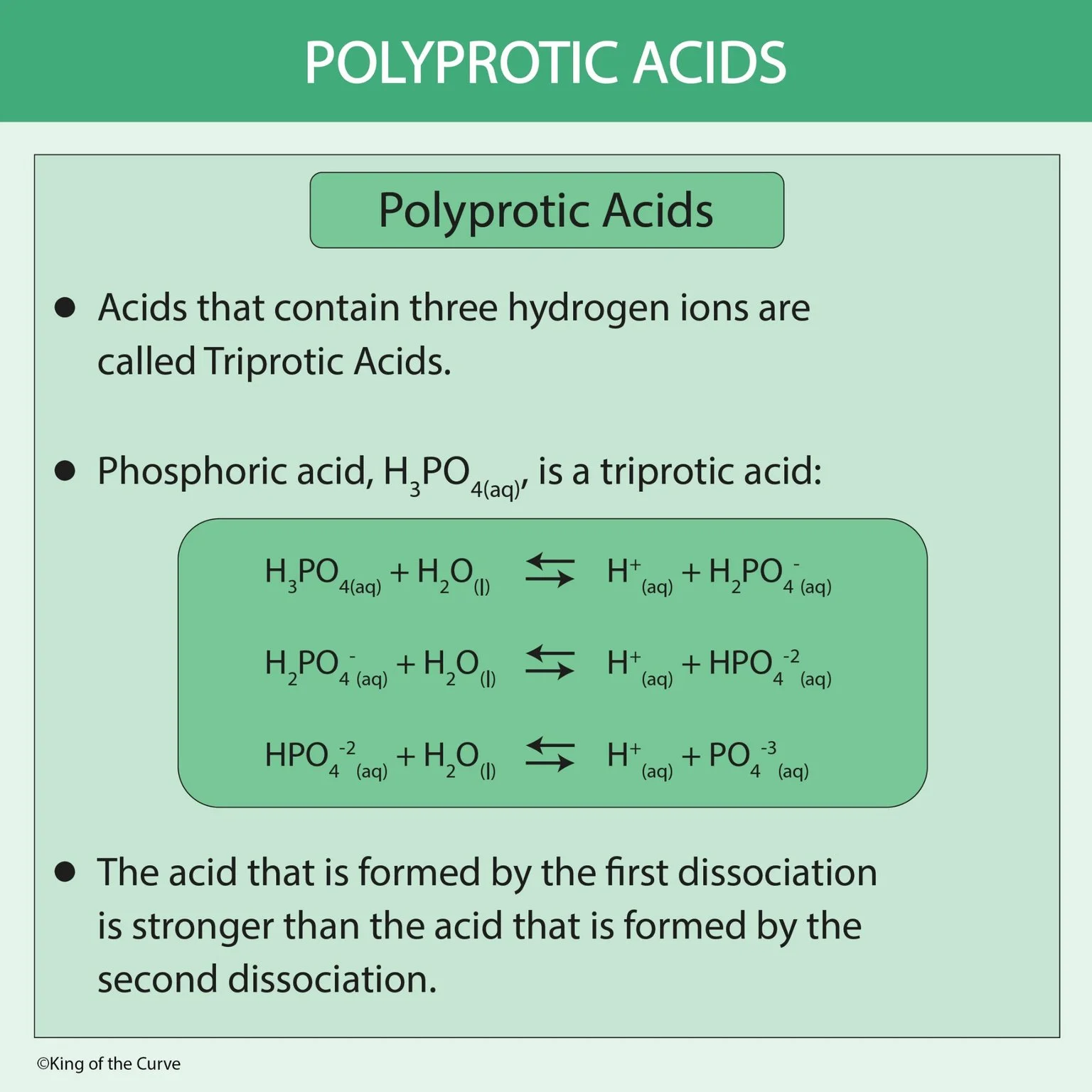
Polyprotic acids can be classified according to the number of ionizable protons they can donate. A diprotic acid can donate two protons, while a triprotic acid can donate three. Phosphoric acid, H₃PO₄, is a classic triprotic acid because it can lose three protons through three successive equilibria.
🧬 Stepwise Dissociation of Phosphoric Acid
Phosphoric acid does not release all three protons simultaneously. Instead, it dissociates step by step: H₃PO₄ → H₂PO₄⁻ → HPO₄²⁻ → PO₄³⁻. Each step removes one proton and produces a progressively more negatively charged species.
📉 Why Each Proton Becomes Harder to Remove
Successive proton loss becomes less favorable. After the first proton leaves, the remaining species carries a negative charge, making removal of another positively charged proton progressively more difficult. Therefore, for a triprotic acid, the acid dissociation constants generally follow Kₐ₁ > Kₐ₂ > Kₐ₃.
📊 The pKₐ Relationship
Because pKₐ = −log(Kₐ), the relationship reverses when expressed using pKₐ values: pKₐ₁ < pKₐ₂ < pKₐ₃. A smaller pKₐ indicates a stronger acid and a greater tendency to donate a proton. This relationship is a useful shortcut when comparing the individual dissociation steps of a polyprotic acid.
🧠 Conjugate Acid–Base Species
Intermediate species in polyprotic systems can often act as both acids and bases. For example, H₂PO₄⁻ can donate H⁺ to become HPO₄²⁻ or accept H⁺ to reform H₃PO₄. A species capable of acting as either an acid or a base is called amphiprotic.
🧫 Polyprotic Acids and Buffers
The multiple dissociation equilibria of polyprotic acids allow them to form different buffer systems. A conjugate acid–base pair provides its strongest buffering action when the solution's pH is close to the relevant pKₐ. This principle connects polyprotic acids directly to the Henderson–Hasselbalch equation.
📈 Polyprotic Acid Titration Curves
When a polyprotic acid is titrated with a strong base, its titration curve can contain multiple buffering regions and equivalence points, provided the successive pKₐ values are sufficiently separated. Each region corresponds to another stage of proton removal. MCAT questions may ask students to connect these regions with the appropriate protonation state.
🎯 MCAT High-Yield Takeaway
Remember the central pattern: polyprotic acids donate multiple protons sequentially, not all at once. For typical successive dissociations, Kₐ₁ > Kₐ₂ > Kₐ₃ and therefore pKₐ₁ < pKₐ₂ < pKₐ₃. For phosphoric acid, track the sequence H₃PO₄ → H₂PO₄⁻ → HPO₄²⁻ → PO₄³⁻ to quickly solve equilibrium, buffer, and titration questions.

Frequently Asked Questions (FAQs)
-
Aim for 4-6 focused hours, ensuring you incorporate breaks to avoid burnout.
-
Practice mindfulness techniques, take practice exams under realistic conditions, and maintain a balanced lifestyle.
-
Set short-term goals, seek support from mentors, and reward yourself for small achievements.
-
Regular exercise improves focus, reduces stress, and enhances overall mental clarity.
-
KOTC offers personalized learning tools, gamification features, and adaptive question banks to help students stay on track without burnout.