
💧 Understanding Pascal’s Principle: Force, Pressure, and Hydraulic Systems
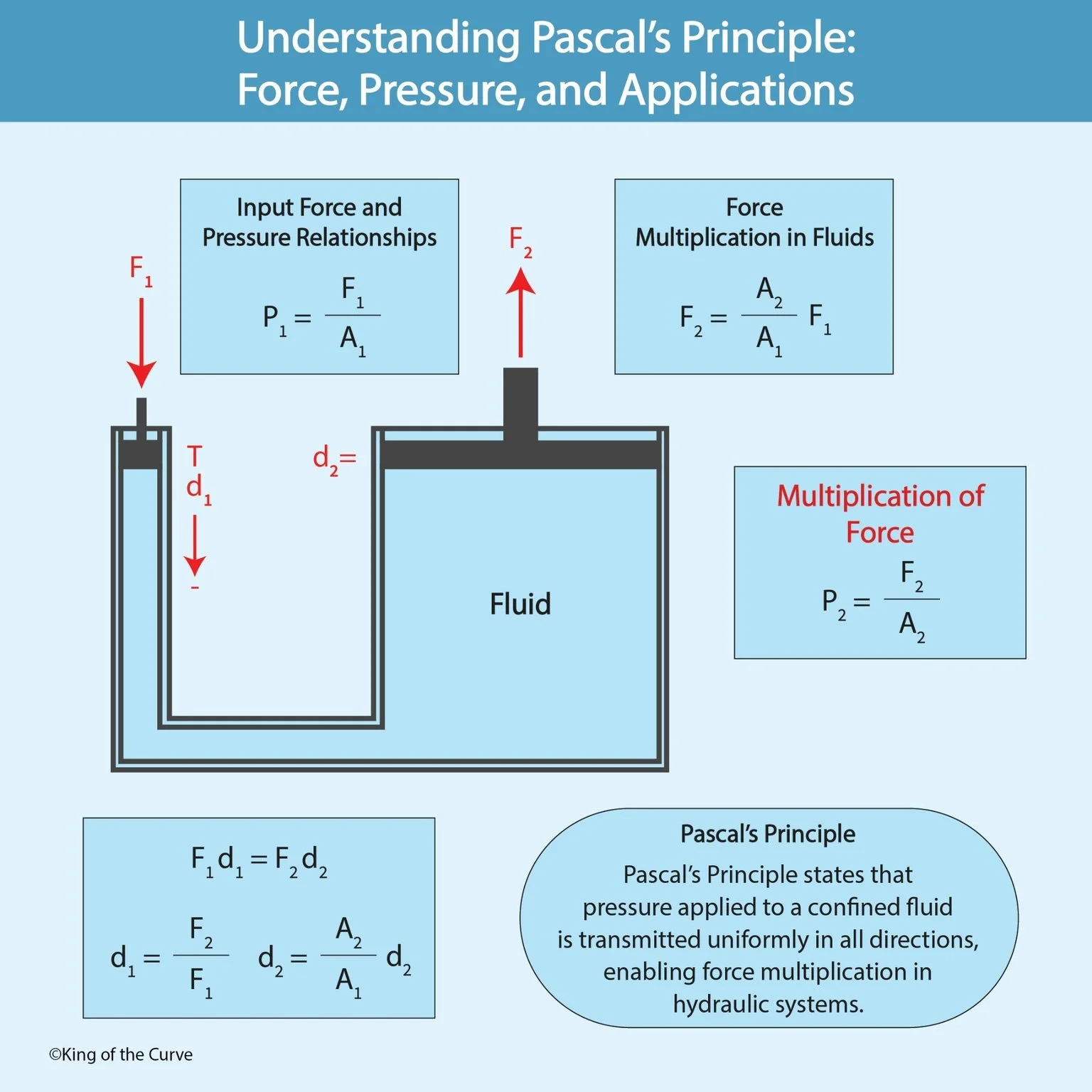
Pascal’s principle describes how pressure behaves in a confined fluid. When pressure is applied to an enclosed, essentially incompressible fluid, the pressure change is transmitted throughout the fluid. This principle explains how hydraulic systems can use a relatively small input force to produce a much larger output force.
📐 Pressure, Force, and Area
Pressure is defined as force divided by area:
P = F/A
Pressure is measured in pascals (Pa), where 1 Pa = 1 N/m². For a piston with area A₁ and applied force F₁, the pressure produced is P₁ = F₁/A₁.
⚖️ Pressure Transmission in a Hydraulic System
For an ideal hydraulic system with pistons at the same elevation, Pascal’s principle gives:
P₁ = P₂
Therefore:
F₁/A₁ = F₂/A₂
This relationship is one of the most important equations to recognize when solving MCAT fluid-mechanics problems.
💪 How Hydraulic Force Multiplication Works
Rearranging the pressure relationship gives:
F₂ = F₁(A₂/A₁)
If the output piston has a larger cross-sectional area than the input piston, the output force is larger. This is why hydraulic systems can lift heavy objects even when the applied input force is relatively small.
🔄 Force Comes With a Distance Trade-Off
Hydraulic systems multiply force, but they do not create energy. In an ideal system, conservation of work gives:
F₁d₁ = F₂d₂
So when the output force is increased, the larger piston moves a shorter distance than the smaller piston.
📏 Piston Area and Displacement
Because the fluid is approximately incompressible, the displaced volumes must also match:
A₁d₁ = A₂d₂
Therefore:
d₂ = (A₁/A₂)d₁
A large output piston produces greater force but moves through a smaller distance.
🚗 Real-World Applications
Pascal’s principle is used in hydraulic brakes, hydraulic lifts, car jacks, construction equipment, and other hydraulic machinery. These devices use pressure transmission and differences in piston area to achieve mechanical advantage.
🧠 Pascal’s Principle on the MCAT
MCAT questions may combine Pascal’s principle with pressure, force, area, work, energy conservation, and fluid statics. Pay close attention to piston areas and heights. If two points in the fluid are at different elevations, hydrostatic pressure differences may also need to be considered.
⭐ High-Yield MCAT Takeaway
Remember the chain: P = F/A → P₁ = P₂ → F₁/A₁ = F₂/A₂ for the standard same-height hydraulic-piston setup. A larger output area means a larger output force, while conservation of volume means the larger piston travels a shorter distance. This force–distance trade-off is the key to understanding hydraulic mechanical advantage.

Frequently Asked Questions (FAQs)
-
Aim for 4-6 focused hours, ensuring you incorporate breaks to avoid burnout.
-
Practice mindfulness techniques, take practice exams under realistic conditions, and maintain a balanced lifestyle.
-
Set short-term goals, seek support from mentors, and reward yourself for small achievements.
-
Regular exercise improves focus, reduces stress, and enhances overall mental clarity.
-
KOTC offers personalized learning tools, gamification features, and adaptive question banks to help students stay on track without burnout.