
🌊 Comparison of Transverse and Longitudinal Waves
Waves are fundamental to understanding many physical phenomena from sound and light to ocean motion. Two primary types of waves are transverse waves and longitudinal waves, each with distinct characteristics and behaviors.
🔵 What Is a Transverse Wave?
A transverse wave is a wave in which the motion of particles is perpendicular to the direction the wave travels.
📌 Key Features:
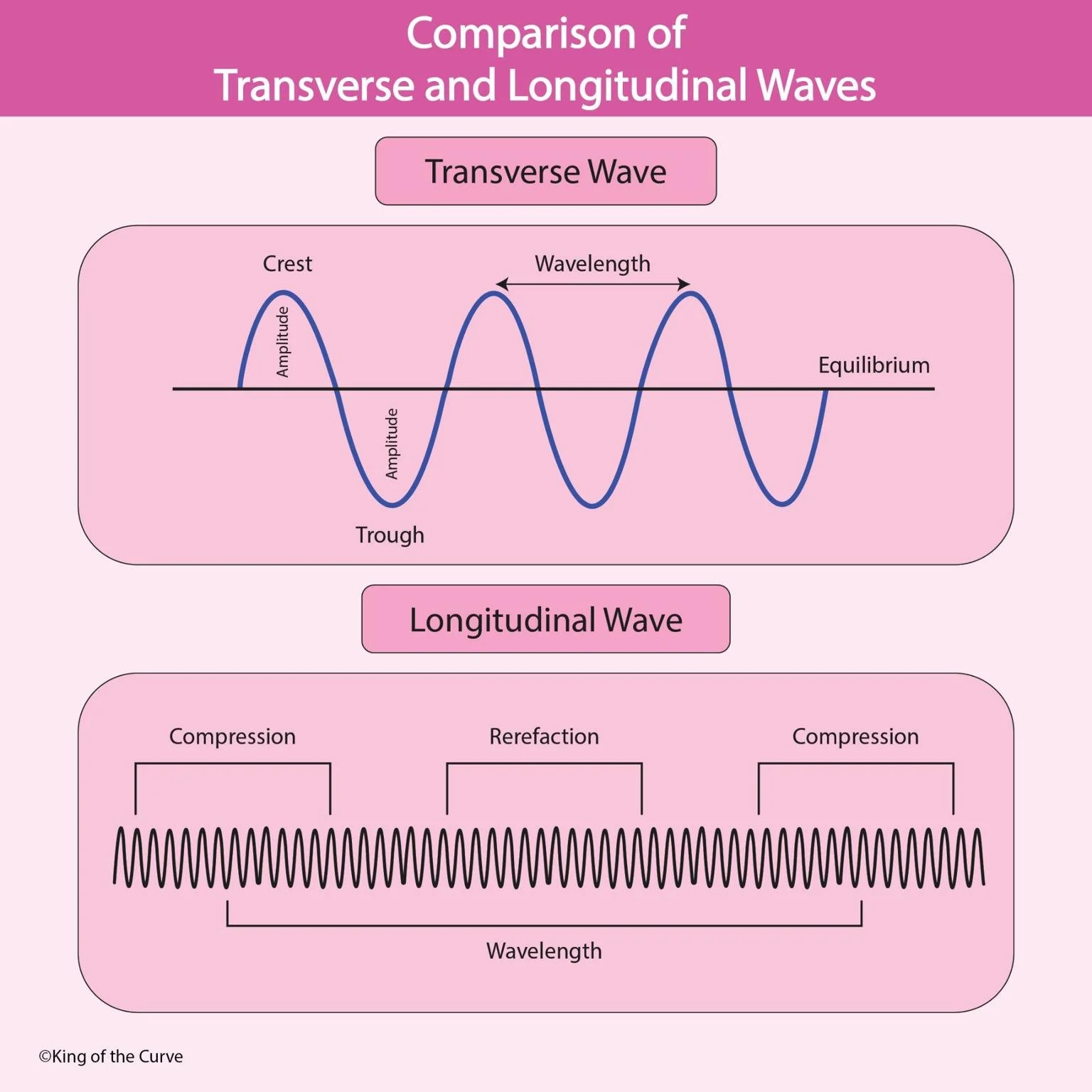
Crest: The highest point of the wave
Trough: The lowest point of the wave
Amplitude: The height from the equilibrium line to a crest or trough
Wavelength: The distance between two consecutive crests (or troughs)
Equilibrium: The resting position of the medium
🌍 Examples:
Light waves (electromagnetic waves)
Water waves
Waves on a string
💡 Visualization:
In the diagram, the wave moves horizontally while particles move up and down—this is the defining feature of transverse waves.
🔴 What Is a Longitudinal Wave?
A longitudinal wave is a wave in which the motion of particles is parallel to the direction the wave travels.
📌 Key Features:
Compression: Regions where particles are close together
Rarefaction: Regions where particles are spread apart
Wavelength: Distance between two compressions or two rarefactions
🌍 Examples:
Sound waves
Pressure waves in fluids
Seismic P-waves
💡 Visualization:
In the diagram, particles move back and forth in the same direction as the wave—creating alternating compressions and rarefactions.
🌌 Wave Propagation and Medium Requirements
Understanding the distinction between transverse and longitudinal waves also helps explain how different types of energy interact with matter. For example, transverse electromagnetic waves, such as light, can travel through a vacuum, whereas longitudinal waves, like sound, require a medium (solid, liquid, or gas) to propagate. This difference is crucial in fields like astronomy, where light from distant stars reaches us through empty space, while sound cannot.
🔬 Behavior of Waves in Different Conditions
Additionally, these wave types behave differently when encountering obstacles or boundaries. Transverse waves can exhibit polarization, a property not seen in longitudinal waves, which is important in technologies like sunglasses and optical filters. On the other hand, longitudinal waves are highly sensitive to changes in medium density, which is why sound travels faster in solids than in gases. Recognizing these behaviors allows scientists and engineers to apply wave principles in real-world applications, from medical imaging to communication systems.
⚖️ Transverse vs Longitudinal Waves (Quick Comparison)
| Feature | Transverse Waves | Longitudinal Waves |
|---|---|---|
| Particle Motion | Perpendicular to wave direction | Parallel to wave direction |
| Main Parts | Crest & Trough | Compression & Rarefaction |
| Amplitude | Vertical displacement | Density/pressure variation |
| Wavelength | Crest to crest | Compression to compression |
| Examples | Light, water waves | Sound waves |
🧠 Why This Matters
Understanding these wave types is crucial in:
Physics and engineering
Medical imaging (e.g., ultrasound)
Communication technologies
Earth science (seismic waves)
📌 Final Thoughts
Both transverse and longitudinal waves are essential for describing how energy moves through different media. While they differ in particle motion and structure, they share common properties like wavelength and energy transfer.
Mastering these concepts helps build a strong foundation in physics and prepares you for exams like the MCAT or other science-based tests.

Frequently Asked Questions (FAQs)
-
Aim for 4-6 focused hours, ensuring you incorporate breaks to avoid burnout.
-
Practice mindfulness techniques, take practice exams under realistic conditions, and maintain a balanced lifestyle.
-
Set short-term goals, seek support from mentors, and reward yourself for small achievements.
-
Regular exercise improves focus, reduces stress, and enhances overall mental clarity.
-
KOTC offers personalized learning tools, gamification features, and adaptive question banks to help students stay on track without burnout.