
🧪 Composition of Ions in Salivary Secretion
Saliva is more than just water it’s a dynamic fluid rich in electrolytes that play crucial roles in digestion, oral health, and maintaining the chemical balance of the mouth. The composition of ions in saliva changes depending on the flow rate, and this variation reflects how salivary glands process and modify primary secretions.
🔬 How Saliva is Formed
Saliva is initially produced by acinar cells as an isotonic fluid similar to plasma. As it travels through the duct system, its composition is altered:
Sodium (Na⁺) and chloride (Cl⁻) are reabsorbed
Potassium (K⁺) and bicarbonate (HCO₃⁻) are secreted
This modification results in saliva that is typically hypotonic compared to plasma, especially at low flow rates.
📈 Effect of Flow Rate on Ion Composition
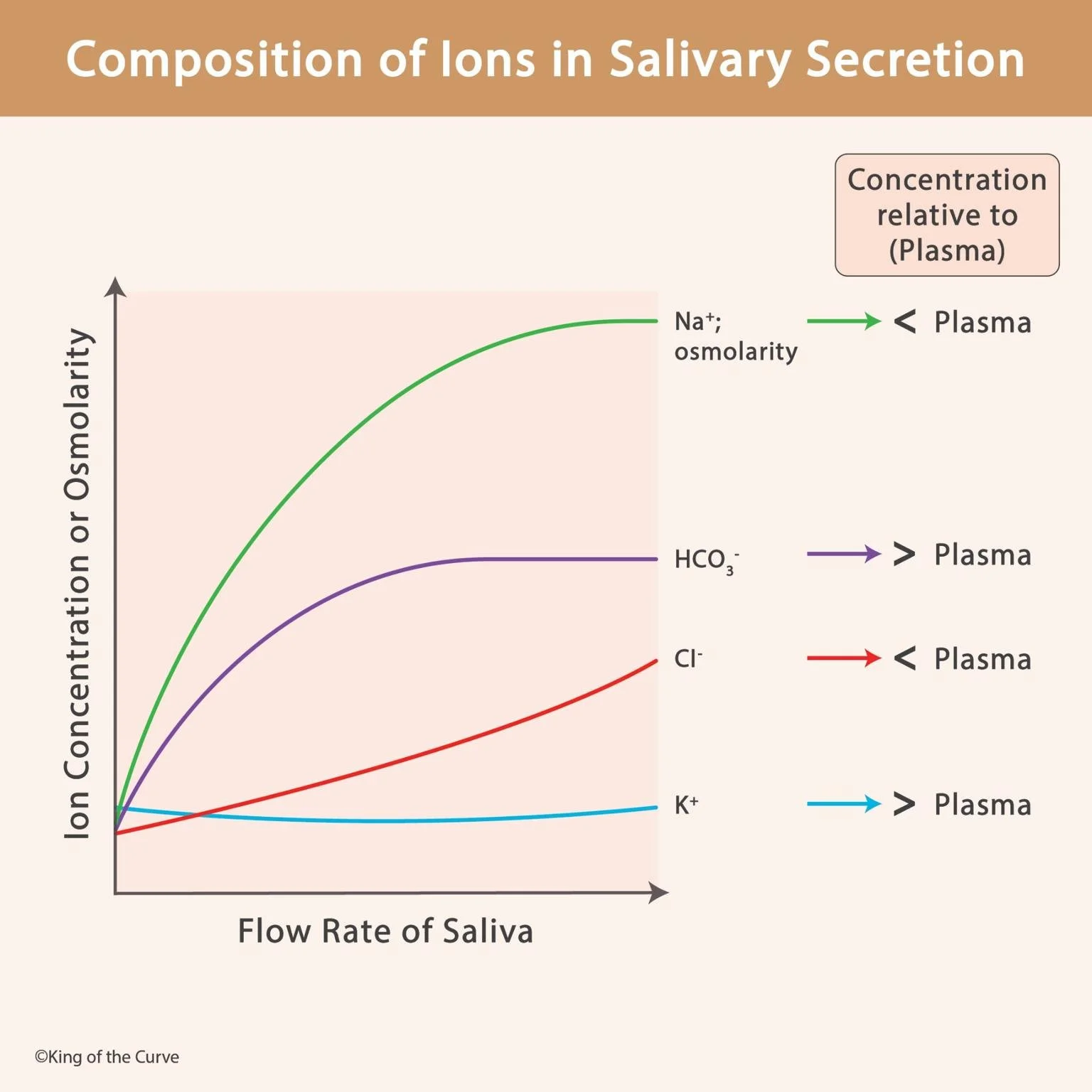
The graph shows how different ions behave as the flow rate of saliva increases:
🟢 Sodium (Na⁺) & Osmolarity
Increase significantly with higher flow rates
Still remain lower than plasma levels
At high flow, less time for reabsorption → concentration rises
🟣 Bicarbonate (HCO₃⁻)
Increases and then plateaus
Becomes higher than plasma levels
Important for buffering acids in the mouth
🔴 Chloride (Cl⁻)
Gradually increases with flow rate
Remains lower than plasma
Reflects reduced reabsorption at higher flow
🔵 Potassium (K⁺)
Slight decrease initially, then mild increase
Always higher than plasma levels
Secreted actively by ductal cells
🧬 Regulation of Salivary Ion Composition
The composition of saliva is tightly regulated by the autonomic nervous system. Parasympathetic stimulation (e.g., during eating) increases salivary flow, producing a more dilute secretion with higher sodium and bicarbonate levels. In contrast, sympathetic stimulation results in a lower volume of thicker saliva with relatively higher potassium concentration. This neural control ensures that saliva adapts quickly to physiological needs such as digestion, speech, and oral lubrication.
⚠️ Clinical Correlations
Alterations in salivary ion composition can indicate underlying health conditions. For example, reduced bicarbonate levels may impair buffering capacity, increasing the risk of dental caries. In cystic fibrosis, abnormal chloride transport affects salivary electrolyte balance. Additionally, medications like anticholinergics can reduce salivary flow, leading to dry mouth (xerostomia) and changes in ion concentration. Therefore, analyzing saliva can provide valuable insights into both oral and systemic health.
⚖️ Low vs High Flow Saliva
| Feature | Low Flow Rate | High Flow Rate |
|---|---|---|
| Na+ & Cl− | Very low | Increased |
| K+ | High | Slightly lower |
| HCO3− | Low | High |
| Osmolarity | Very hypotonic | Closer to isotonic |
🧠 Why This Matters
Understanding salivary ion composition is clinically important:
🦷 Dental health: Bicarbonate buffers acids, preventing tooth decay
🧫 Digestion: Saliva begins carbohydrate digestion and maintains pH
💊 Disease insight: Conditions like Sjogren’s syndrome or dehydration alter saliva composition
💧 Hydration status: Flow rate changes reflect systemic hydration
📌 Key Takeaway
As salivary flow rate increases, the composition of ions shifts toward plasma levels due to reduced modification in the ducts. However, saliva remains uniquely tailored to protect the oral cavity and support digestion.

Frequently Asked Questions (FAQs)
-
Aim for 4-6 focused hours, ensuring you incorporate breaks to avoid burnout.
-
Practice mindfulness techniques, take practice exams under realistic conditions, and maintain a balanced lifestyle.
-
Set short-term goals, seek support from mentors, and reward yourself for small achievements.
-
Regular exercise improves focus, reduces stress, and enhances overall mental clarity.
-
KOTC offers personalized learning tools, gamification features, and adaptive question banks to help students stay on track without burnout.