
🌈 Total Internal Reflection: A High-Yield MCAT Optics Concept
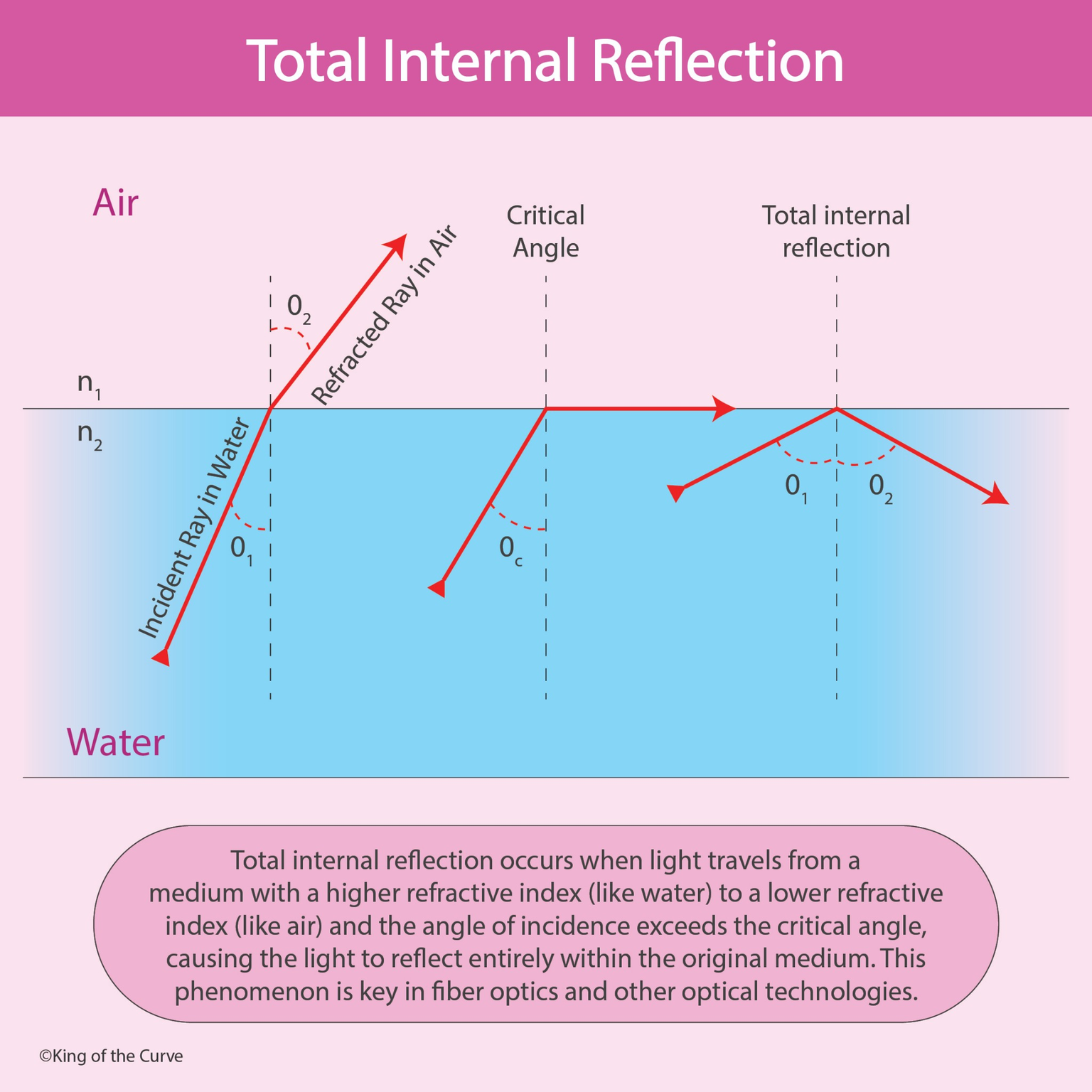
Total internal reflection (TIR) occurs when light traveling through a medium with a higher refractive index reaches a boundary with a medium of lower refractive index and is completely reflected back into the original medium. Instead of passing through the boundary, all of the light remains within the higher-index material.
💧 From Higher to Lower Refractive Index
Total internal reflection can occur only when light travels from a higher refractive index (n₁) to a lower refractive index (n₂). For example, light traveling from water into air can undergo TIR because water has a higher refractive index than air. Light traveling in the opposite direction cannot undergo total internal reflection at that boundary.
📐 Understanding the Critical Angle
The critical angle (θc) is the angle of incidence at which the refracted ray travels exactly along the boundary between the two media. At this point, the angle of refraction is 90°. The critical angle represents the threshold between refraction and total internal reflection.
🧮 Critical Angle Equation
The critical angle can be calculated using Snell’s law. When n₁ > n₂, the relationship is sin θc = n₂/n₁. Here, n₁ is the refractive index of the medium containing the incident light, while n₂ is the refractive index of the lower-index medium.
↗️ What Happens Below the Critical Angle?
When the angle of incidence is less than the critical angle, light is transmitted into the second medium and bends away from the normal when entering the lower-index medium. Some light may also be reflected at the interface, but total internal reflection does not occur.
➡️ What Happens at the Critical Angle?
When θi = θc, the refracted ray forms an angle of 90° with the normal, so it travels along the interface. This is a useful MCAT checkpoint: the critical angle is defined by the condition that the refracted angle equals 90°.
🔄 What Happens Above the Critical Angle?
When the angle of incidence becomes greater than θc, there is no propagating refracted ray into the second medium. Instead, the light undergoes total internal reflection and remains within the higher-refractive-index medium. The angle of reflection equals the angle of incidence.
📊 Total Internal Reflection Summary
| 📐 Condition | 🔬 What Happens | 🎯 Key Point |
|---|---|---|
| θi < θc | Refraction occurs | Light enters the second medium |
| θi = θc | Refracted ray travels along the boundary | θr = 90° |
| θi > θc | Total internal reflection occurs | Light remains in the original medium |
| n1 ≤ n2 | Total internal reflection cannot occur | Light must travel from higher n to lower n |
🎯 MCAT High-Yield Takeaway
Remember the two requirements for total internal reflection: light must travel from a higher refractive index to a lower refractive index, and the incident angle must exceed the critical angle. This principle explains technologies such as fiber-optic cables, where repeated total internal reflection guides light over long distances.

Frequently Asked Questions (FAQs)
-
Aim for 4-6 focused hours, ensuring you incorporate breaks to avoid burnout.
-
Practice mindfulness techniques, take practice exams under realistic conditions, and maintain a balanced lifestyle.
-
Set short-term goals, seek support from mentors, and reward yourself for small achievements.
-
Regular exercise improves focus, reduces stress, and enhances overall mental clarity.
-
KOTC offers personalized learning tools, gamification features, and adaptive question banks to help students stay on track without burnout.