
⚗️ Balancing Chemical Equations: Essential Tips for the MCAT
Chemical equations represent how reactants are transformed into products during a chemical reaction. Because matter is conserved, the number of atoms of each element must be the same on both sides of the equation. Balancing equations is therefore a fundamental chemistry skill and an important foundation for MCAT calculations.
🔢 Understand Coefficients and Subscripts
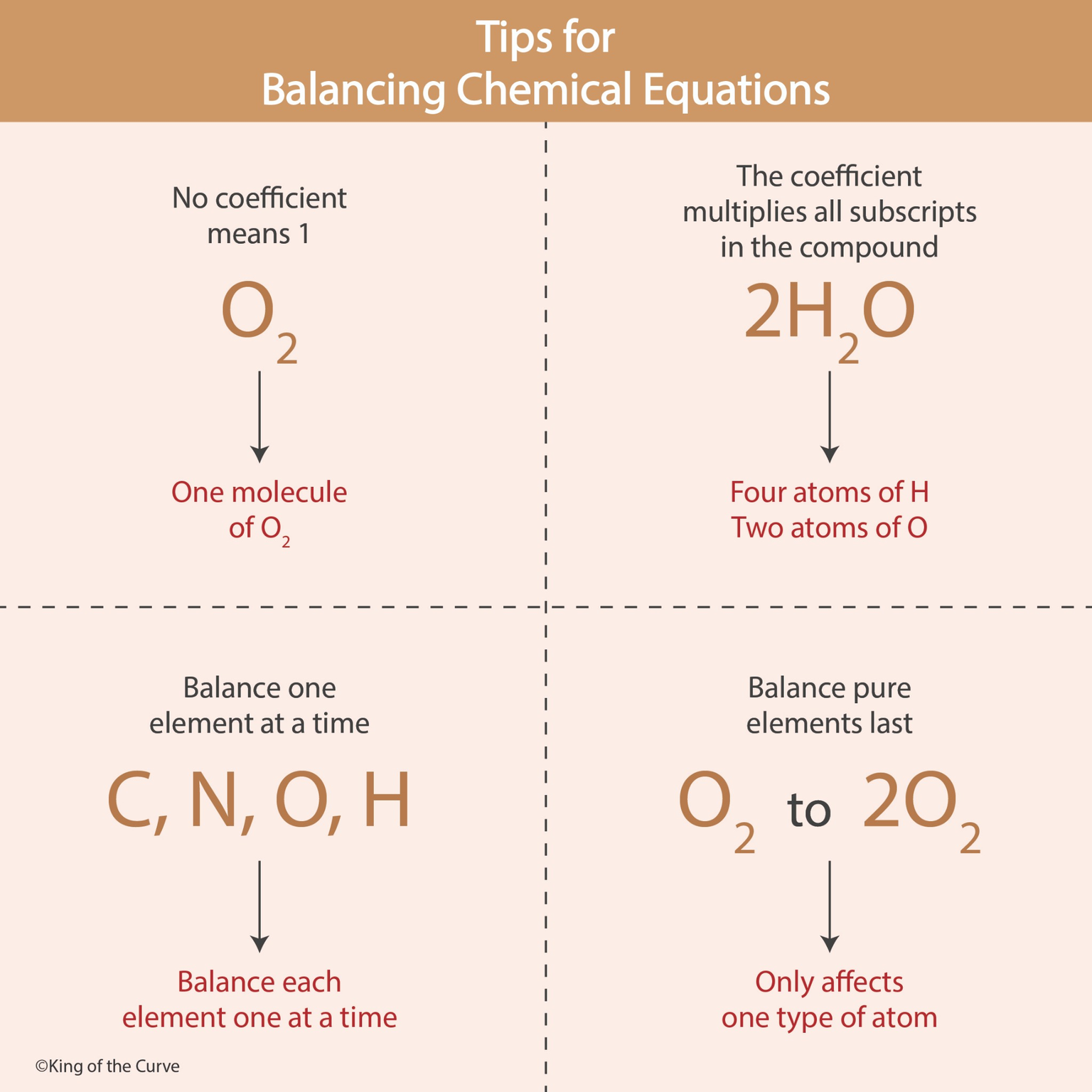
A coefficient tells you how many molecules or formula units are present, while a subscript tells you how many atoms of an element occur within one molecule or formula unit. For example, 2H₂O represents two water molecules containing a total of four hydrogen atoms and two oxygen atoms.
1️⃣ No Coefficient Means One
When a chemical formula has no visible coefficient, its coefficient is understood to be 1. For example, O₂ means one molecule of molecular oxygen. Recognizing implied coefficients helps you count atoms correctly before you begin balancing.
✖️ Coefficients Multiply the Entire Formula
A coefficient applies to every atom in the chemical formula that follows it. In 2H₂O, the coefficient 2 multiplies both H₂ and O, giving four hydrogen atoms and two oxygen atoms. This distinction between coefficients and subscripts is essential for avoiding common balancing mistakes.
⚖️ Balance One Element at a Time
A useful strategy is to choose one element and balance it before moving to the next. For many reactions involving carbon, hydrogen, and oxygen, you can often start with carbon, then balance hydrogen, and leave oxygen until later.
🔥 Leave Pure Elements Until Later
When an element appears as a pure substance, such as O₂, H₂, N₂, or a metal by itself, it is often convenient to balance it near the end. Changing its coefficient affects only that element, which can make the final balancing steps easier.
🚫 Never Change Subscripts
When balancing an equation, change coefficients only. Changing a subscript changes the chemical identity of the substance. For example, H₂O and H₂O₂ are different compounds, so converting one into the other is not a valid way to balance an equation.
📊 Quick Balancing Guide
| 🔢 Step | ⚗️ What to Do | 🎯 Key Rule |
|---|---|---|
| 1 | Write the correct formulas | Never alter subscripts |
| 2 | Count atoms on both sides | Include implied coefficients of 1 |
| 3 | Balance one element at a time | Start with convenient elements |
| 4 | Balance pure elements later | Often simplifies the process |
| 5 | Recount every atom | Both sides must match |
| 6 | Simplify coefficients | Use the lowest whole-number ratio |
🎯 MCAT High-Yield Takeaway
For the MCAT, remember the core rule: balance atoms by changing coefficients, never subscripts. Count every atom carefully, work through one element at a time, and verify the final equation. Once an equation is balanced, its coefficients also provide the stoichiometric mole ratios needed for many MCAT chemistry calculations.

Frequently Asked Questions (FAQs)
-
Aim for 4-6 focused hours, ensuring you incorporate breaks to avoid burnout.
-
Practice mindfulness techniques, take practice exams under realistic conditions, and maintain a balanced lifestyle.
-
Set short-term goals, seek support from mentors, and reward yourself for small achievements.
-
Regular exercise improves focus, reduces stress, and enhances overall mental clarity.
-
KOTC offers personalized learning tools, gamification features, and adaptive question banks to help students stay on track without burnout.