
🦋 Thyroid Hormone Synthesis Pathway: A High-Yield MCAT Guide
Thyroid hormone synthesis occurs in thyroid follicular cells and produces T3 (triiodothyronine) and T4 (thyroxine). These hormones regulate metabolic rate, growth, development, and energy use. For the MCAT, understanding the sequence from iodide uptake to hormone release is especially important.
🧲 Iodide Uptake Into Follicular Cells
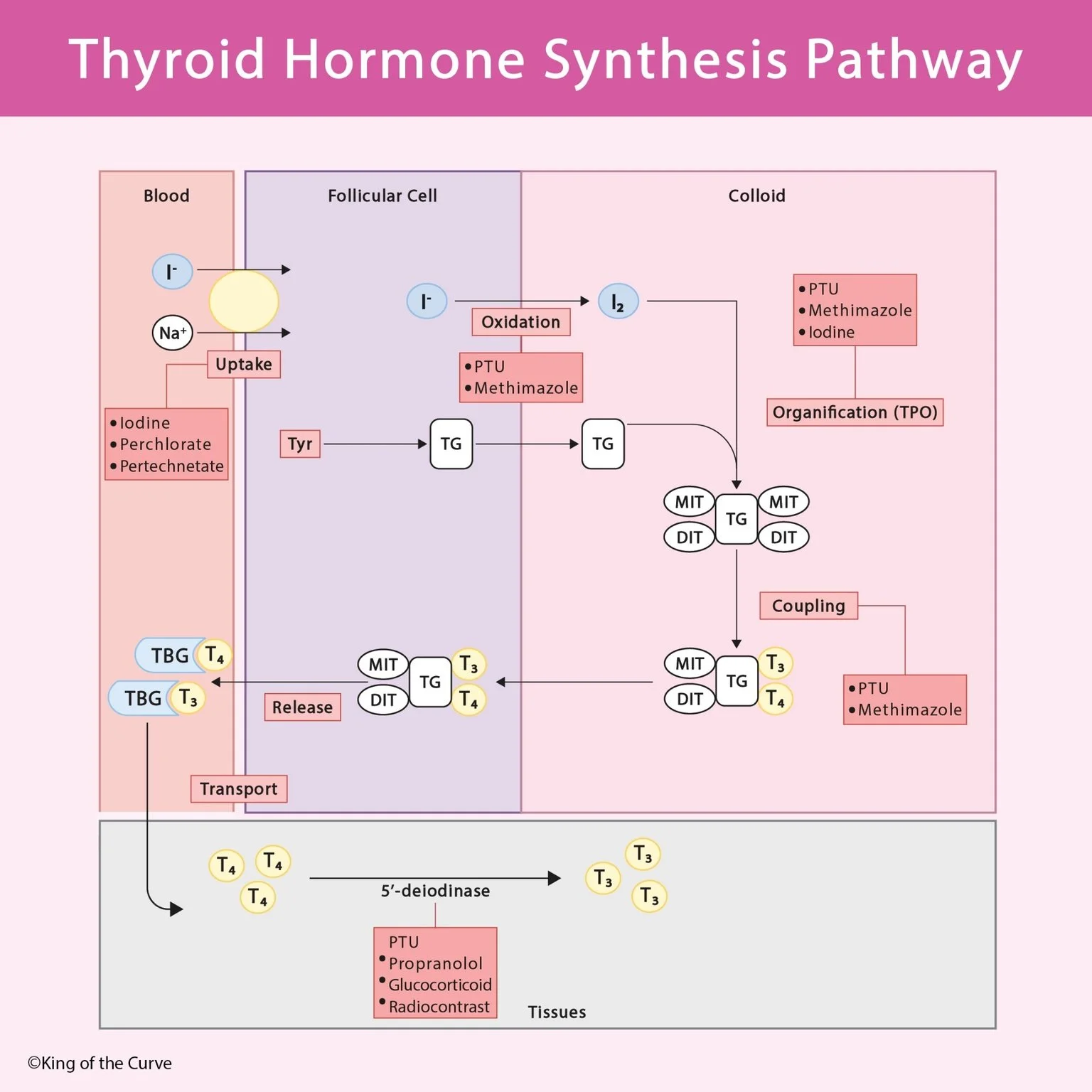
The pathway begins when iodide (I⁻) is transported from the blood into thyroid follicular cells by the sodium–iodide symporter (NIS). This transporter uses the sodium gradient to concentrate iodide inside the cell. Substances such as perchlorate can interfere with iodide uptake.
⚗️ Oxidation and Thyroid Peroxidase
Iodide is transported toward the colloid and oxidized to a reactive form by thyroid peroxidase (TPO). TPO is a key enzyme in thyroid hormone synthesis and also participates in the next major steps of the pathway. Antithyroid drugs such as propylthiouracil (PTU) and methimazole inhibit TPO-mediated reactions.
🧬 Thyroglobulin and Organification
Thyroid follicular cells produce thyroglobulin (TG), a protein rich in tyrosine residues, and release it into the colloid. During organification, iodine is attached to tyrosine residues on thyroglobulin. Addition of one iodine forms MIT (monoiodotyrosine), while addition of two forms DIT (diiodotyrosine).
🔗 Coupling Produces T3 and T4
TPO also facilitates the coupling of iodinated tyrosine residues. MIT + DIT produces T3, while DIT + DIT produces T4. These hormones remain incorporated within thyroglobulin and are stored in the colloid until the thyroid gland is stimulated to release them.
| 🦋 Step | ⚙️ Main Process | 🎯 High-Yield Point |
|---|---|---|
| Uptake | I⁻ enters the follicular cell | Na⁺/I⁻ symporter |
| Oxidation | I⁻ is oxidized | TPO-dependent |
| Organification | Iodine attaches to tyrosine residues | Forms MIT and DIT |
| Coupling | Iodotyrosines combine | MIT + DIT → T3; DIT + DIT → T4 |
| Release | T3 and T4 enter the blood | Mostly protein-bound |
🩸 Release and Transport in Blood
When stimulated by TSH, follicular cells take up iodinated thyroglobulin from the colloid and degrade it in lysosomes, releasing T3 and T4. The hormones then enter the bloodstream. Most circulating thyroid hormone is bound to proteins, particularly thyroxine-binding globulin (TBG), while only a small free fraction is biologically active.
🔄 Peripheral Conversion of T4 to T3
Although the thyroid releases primarily T4, T3 is the more biologically active hormone. In peripheral tissues, deiodinase enzymes convert T4 into T3. This allows tissues to regulate local thyroid hormone activity according to physiological needs.
💊 Drugs That Affect the Pathway
Several medications interfere with thyroid hormone production or activation. Methimazole and PTU inhibit TPO, reducing organification and coupling. PTU additionally decreases peripheral conversion of T4 to T3 by inhibiting 5′-deiodination. Certain beta-blockers and glucocorticoids can also decrease peripheral T4-to-T3 conversion in appropriate clinical contexts.
🎯 MCAT High-Yield Takeaway
Remember the sequence: iodide uptake → oxidation → organification → coupling → storage → release → peripheral conversion. A particularly useful relationship is MIT + DIT → T3 and DIT + DIT → T4. Connecting each step to its location, enzyme, and inhibitor makes thyroid hormone synthesis much easier to recognize in MCAT biology and endocrine questions.

Frequently Asked Questions (FAQs)
-
Aim for 4-6 focused hours, ensuring you incorporate breaks to avoid burnout.
-
Practice mindfulness techniques, take practice exams under realistic conditions, and maintain a balanced lifestyle.
-
Set short-term goals, seek support from mentors, and reward yourself for small achievements.
-
Regular exercise improves focus, reduces stress, and enhances overall mental clarity.
-
KOTC offers personalized learning tools, gamification features, and adaptive question banks to help students stay on track without burnout.