
🦴 Synovial Membrane: Structure and Function of Synovial Joints
Synovial joints are the most freely movable joints in the human body. They allow movements such as flexion, extension, rotation, and abduction. Common examples include the knee, elbow, shoulder, and hip. Their specialized structure helps bones move smoothly while maintaining stability.
💧 What Is the Synovial Membrane?
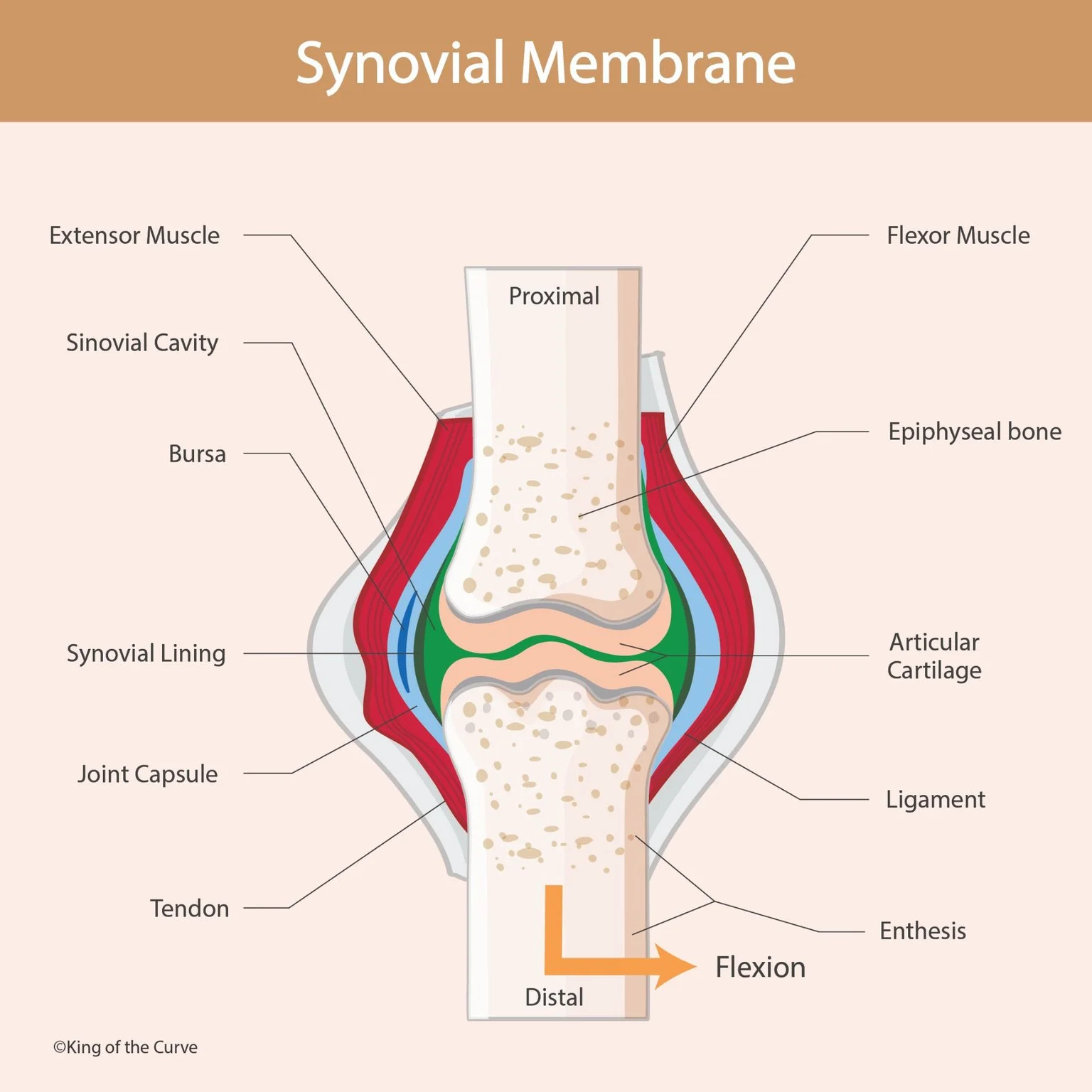
The synovial membrane, or synovium, is a specialized connective tissue that lines the inner surface of the joint capsule, except where articular cartilage covers the bone. It produces synovial fluid, which helps lubricate and support the joint.
🧴 Why Is Synovial Fluid Important?
Synovial fluid reduces friction between the articular surfaces during movement. It also helps deliver nutrients to the avascular articular cartilage and assists with shock absorption. Its lubricating properties make repeated joint movement smoother and more efficient.
🦴 Articular Cartilage Protects the Bone
The ends of bones in a synovial joint are covered by articular cartilage, typically hyaline cartilage. This smooth surface minimizes friction and distributes mechanical forces across the joint. Damage to this cartilage can interfere with normal joint movement.
🛡️ Joint Capsule and Ligaments
The joint capsule surrounds the joint and helps contain the joint cavity. Its outer fibrous layer provides mechanical stability, while the inner synovial membrane participates in maintaining the joint environment. Ligaments connect bone to bone and help limit excessive movement.
💪 Tendons, Muscles, and Movement
Muscles generate the forces required for joint movement, while tendons connect muscles to bones. Flexor muscles decrease the angle across a joint, whereas extensor muscles generally increase it. Coordinated activity between opposing muscle groups allows controlled movement.
🔵 What Is a Bursa?
A bursa is a small fluid-filled sac located where friction may occur between structures such as tendons, bones, muscles, or skin. Bursae help reduce friction during movement. Although associated with many synovial joints, a bursa is a separate structure rather than part of the synovial joint cavity itself.
📊 Key Structures of a Synovial Joint
| 🦴 Structure | 🎯 Main Function |
|---|---|
| Synovial membrane | Produces synovial fluid and lines the inner joint capsule |
| Synovial fluid | Lubricates the joint and supports cartilage nutrition |
| Articular cartilage | Reduces friction and distributes mechanical load |
| Joint capsule | Encloses and stabilizes the joint |
| Ligament | Connects bone to bone and provides stability |
| Tendon | Connects muscle to bone |
| Bursa | Reduces friction between nearby moving structures |
| Enthesis | Site where a tendon or ligament attaches to bone |
🎯 MCAT High-Yield Takeaway
For the MCAT, remember the relationship between structure and function: articular cartilage provides a low-friction surface, synovial fluid lubricates the joint, the synovial membrane produces that fluid, ligaments stabilize bone-to-bone connections, and tendons transmit muscular force to bone. Understanding these distinctions can help with questions involving the musculoskeletal system, connective tissue, and biomechanics.

Frequently Asked Questions (FAQs)
-
Aim for 4-6 focused hours, ensuring you incorporate breaks to avoid burnout.
-
Practice mindfulness techniques, take practice exams under realistic conditions, and maintain a balanced lifestyle.
-
Set short-term goals, seek support from mentors, and reward yourself for small achievements.
-
Regular exercise improves focus, reduces stress, and enhances overall mental clarity.
-
KOTC offers personalized learning tools, gamification features, and adaptive question banks to help students stay on track without burnout.