
🩸 Stages of Erythropoiesis: How Red Blood Cells Develop
Erythropoiesis is the process by which red blood cells, or erythrocytes, are produced from hematopoietic stem cells. In adults, this process occurs primarily in the red bone marrow. As developing cells progress toward mature erythrocytes, they become smaller, accumulate hemoglobin, lose their nuclei and most organelles, and become specialized for transporting oxygen throughout the body.
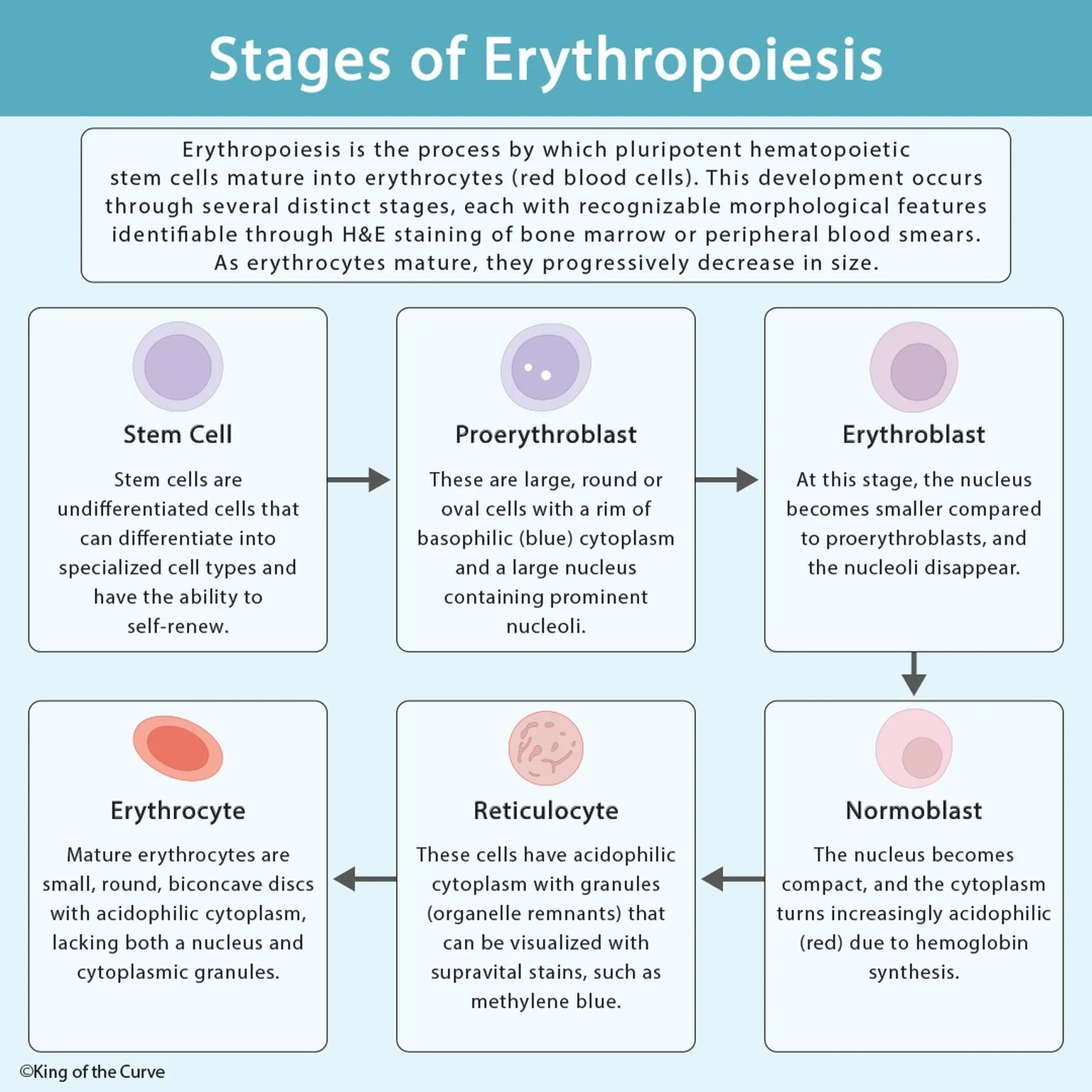
🧬 Hematopoietic Stem Cells Begin the Process
Red blood cell development begins with hematopoietic stem cells, which are multipotent cells capable of generating the different cellular components of blood. Cells committed to the erythroid lineage pass through several progenitor stages before becoming morphologically recognizable erythroblasts. This differentiation process is tightly regulated to maintain an adequate number of circulating red blood cells.
🔬 Proerythroblast: An Early Recognizable Stage
The proerythroblast is one of the earliest morphologically recognizable cells of the erythroid lineage. It is relatively large and contains a large nucleus with prominent nucleoli and basophilic cytoplasm. The blue appearance of the cytoplasm reflects its high concentration of ribosomal RNA, which supports the extensive protein synthesis required during early red blood cell development.
🔵 Erythroblasts and Hemoglobin Production
As erythroid cells mature through successive erythroblast stages, their nuclei become progressively smaller and more condensed. At the same time, hemoglobin production increases. The cytoplasm consequently changes from strongly basophilic toward a more eosinophilic or acidophilic appearance. These changes reflect the transition from an actively synthesizing precursor toward a cell specialized for oxygen transport.
🧫 Normoblast and Nuclear Condensation
Late erythroid precursors are often referred to as normoblasts, particularly the orthochromatic erythroblast stage. At this point, the nucleus is highly condensed and is eventually expelled from the cell. Hemoglobin has accumulated substantially, giving the cytoplasm an increasingly pink-red appearance. Nuclear extrusion represents one of the major final steps before the cell becomes a reticulocyte.
🔄 Reticulocyte: Almost a Mature Red Blood Cell
After nuclear extrusion, the developing cell becomes a reticulocyte. Reticulocytes no longer contain a nucleus but retain small amounts of residual ribosomal RNA and other cellular remnants. These remnants can be visualized using supravital stains, producing the reticular appearance responsible for the cell's name. Reticulocytes typically complete maturation shortly after entering the circulation.
| 🩸 Stage | 🔬 Key Characteristic | 🔄 Major Change |
|---|---|---|
| Hematopoietic stem / progenitor cell | Multipotent precursor | Commits to erythroid lineage |
| Proerythroblast | Large nucleus and basophilic cytoplasm | Active protein synthesis |
| Erythroblast stages | Progressive nuclear condensation | Hemoglobin increases |
| Normoblast / orthochromatic erythroblast | Highly condensed nucleus | Nucleus is expelled |
| Reticulocyte | No nucleus; residual RNA | Final maturation |
| Erythrocyte | Biconcave, anucleate cell | Efficient gas transport |
❤️ Mature Erythrocytes
The final product of erythropoiesis is the mature erythrocyte. Human red blood cells are biconcave discs that lack a nucleus and most organelles, including mitochondria. Their shape provides a large surface-area-to-volume ratio for gas exchange, while the absence of many intracellular structures leaves more space for hemoglobin. Mature erythrocytes therefore function primarily in the transport of oxygen and carbon dioxide.
🫁 Erythropoietin Regulates Red Blood Cell Production
A major regulator of erythropoiesis is erythropoietin (EPO), a hormone produced primarily by the kidneys in adults. Reduced tissue oxygen availability stimulates increased EPO production. EPO then acts on erythroid progenitor cells in the bone marrow, promoting their survival, proliferation, and differentiation. This creates an important physiological feedback mechanism connecting tissue oxygenation with red blood cell production.
🎯 MCAT High-Yield Takeaway
For the MCAT, focus on the overall progression: hematopoietic stem/progenitor cell → proerythroblast → erythroblast stages → normoblast/orthochromatic erythroblast → reticulocyte → mature erythrocyte. During maturation, cell size decreases, the nucleus condenses and is expelled, hemoglobin increases, and cytoplasmic basophilia decreases. Also remember the key regulatory relationship: low tissue oxygen → increased renal EPO → increased erythropoiesis in bone marrow.

Frequently Asked Questions (FAQs)
-
Aim for 4-6 focused hours, ensuring you incorporate breaks to avoid burnout.
-
Practice mindfulness techniques, take practice exams under realistic conditions, and maintain a balanced lifestyle.
-
Set short-term goals, seek support from mentors, and reward yourself for small achievements.
-
Regular exercise improves focus, reduces stress, and enhances overall mental clarity.
-
KOTC offers personalized learning tools, gamification features, and adaptive question banks to help students stay on track without burnout.