
😴 Sleep Cycles: Stages and Their Characteristics
Sleep occurs in repeating cycles made up of non-rapid eye movement (NREM) sleep and rapid eye movement (REM) sleep. Each stage has distinct patterns of brain activity, muscle tone, and physiological function. For the MCAT, understanding these stages is important because sleep connects concepts from psychology, neuroscience, hormones, memory, and consciousness.
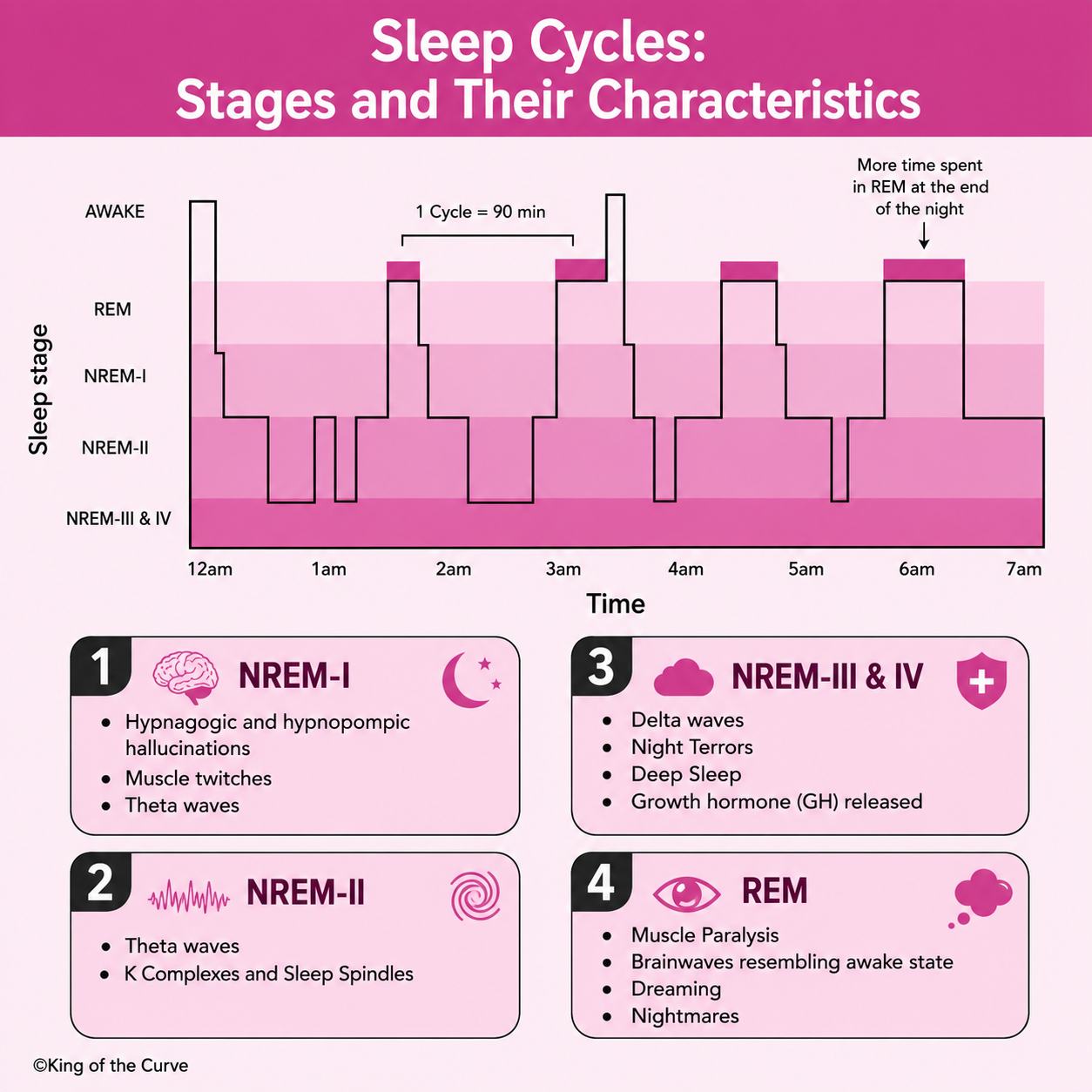
⏱️ The 90-Minute Sleep Cycle
A complete sleep cycle lasts approximately 90 minutes, although the exact duration varies. During the night, a person generally progresses from lighter NREM sleep into deeper NREM sleep before returning toward lighter sleep and entering REM. This cycle repeats several times. Deep sleep is more prominent early in the night, while REM periods become progressively longer toward morning.
🌙 NREM Stage 1: Light Sleep
NREM Stage 1 (N1) is the transition between wakefulness and sleep. Theta waves begin to appear, muscles relax, and awareness of the environment decreases. People may experience hypnagogic hallucinations or sudden muscle contractions called hypnic jerks. Because N1 is very light sleep, awakening during this stage is relatively easy.
🧠 NREM Stage 2: Sleep Spindles & K-Complexes
NREM Stage 2 (N2) represents more stable sleep and is characterized by sleep spindles and K-complexes on EEG. Sleep spindles are brief bursts of rapid neural activity, while K-complexes are large waveforms that may help protect sleep from external disturbances. For MCAT questions, the association N2 = sleep spindles + K-complexes is especially important.
🌊 NREM Stage 3: Deep Sleep
NREM Stage 3 (N3) is the deepest stage of NREM sleep and is dominated by slow, high-amplitude delta waves. Deep sleep is associated with physical restoration and increased growth hormone secretion. Parasomnias such as night terrors and sleepwalking are also strongly associated with N3. Older resources may divide deep sleep into NREM stages III and IV, but modern classification combines them into N3.
💭 REM Sleep: Dreaming & Muscle Atonia
REM sleep features rapid eye movements, vivid dreaming, and brain activity that resembles the awake state. At the same time, most skeletal muscles undergo profound relaxation known as muscle atonia, which limits movement during dreams. REM sleep contributes to processes involving learning, memory consolidation, and emotional processing.
🌅 How Sleep Changes Through the Night
Sleep architecture changes significantly from bedtime to morning. Earlier cycles contain greater amounts of deep N3 slow-wave sleep, whereas later cycles contain progressively longer periods of REM sleep. This is why vivid dreams are often remembered after waking in the morning. Brief awakenings may also occur naturally between sleep cycles.
📊 High-Yield Sleep Stage Comparison
| 😴 Stage | 🧠 Brain Activity | 🎯 Key Characteristics |
|---|---|---|
| NREM N1 | Theta waves | Light sleep, hypnagogic experiences, hypnic jerks |
| NREM N2 | Theta background | Sleep spindles, K-complexes |
| NREM N3 | Delta waves | Deep sleep, GH secretion, night terrors, sleepwalking |
| REM | Wake-like activity | Vivid dreams, rapid eye movements, muscle atonia |
🎯 MCAT High-Yield Takeaway
For MCAT questions, remember the hallmark associations: N1 → theta waves and transition into sleep; N2 → sleep spindles and K-complexes; N3 → delta waves, deep sleep, and growth hormone; REM → vivid dreaming, rapid eye movements, and muscle atonia. Also remember the nighttime pattern: deep NREM sleep dominates earlier, while REM sleep increases toward morning.

Frequently Asked Questions (FAQs)
-
Aim for 4-6 focused hours, ensuring you incorporate breaks to avoid burnout.
-
Practice mindfulness techniques, take practice exams under realistic conditions, and maintain a balanced lifestyle.
-
Set short-term goals, seek support from mentors, and reward yourself for small achievements.
-
Regular exercise improves focus, reduces stress, and enhances overall mental clarity.
-
KOTC offers personalized learning tools, gamification features, and adaptive question banks to help students stay on track without burnout.