
🧠 Short-Term and Working Memory
Short-term memory and working memory are closely related cognitive systems that allow the brain to temporarily store, manipulate, and use information. These systems are essential for reasoning, learning, language comprehension, and problem-solving in everyday life.
📌 What Is Short-Term Memory?
Short-term memory refers to the brain’s ability to hold a limited amount of information for a brief period, typically seconds to minutes. It has a restricted capacity, classically described as 7 ± 2 items, and is highly vulnerable to distraction unless actively maintained through rehearsal.
🧠 Working Memory: An Active System
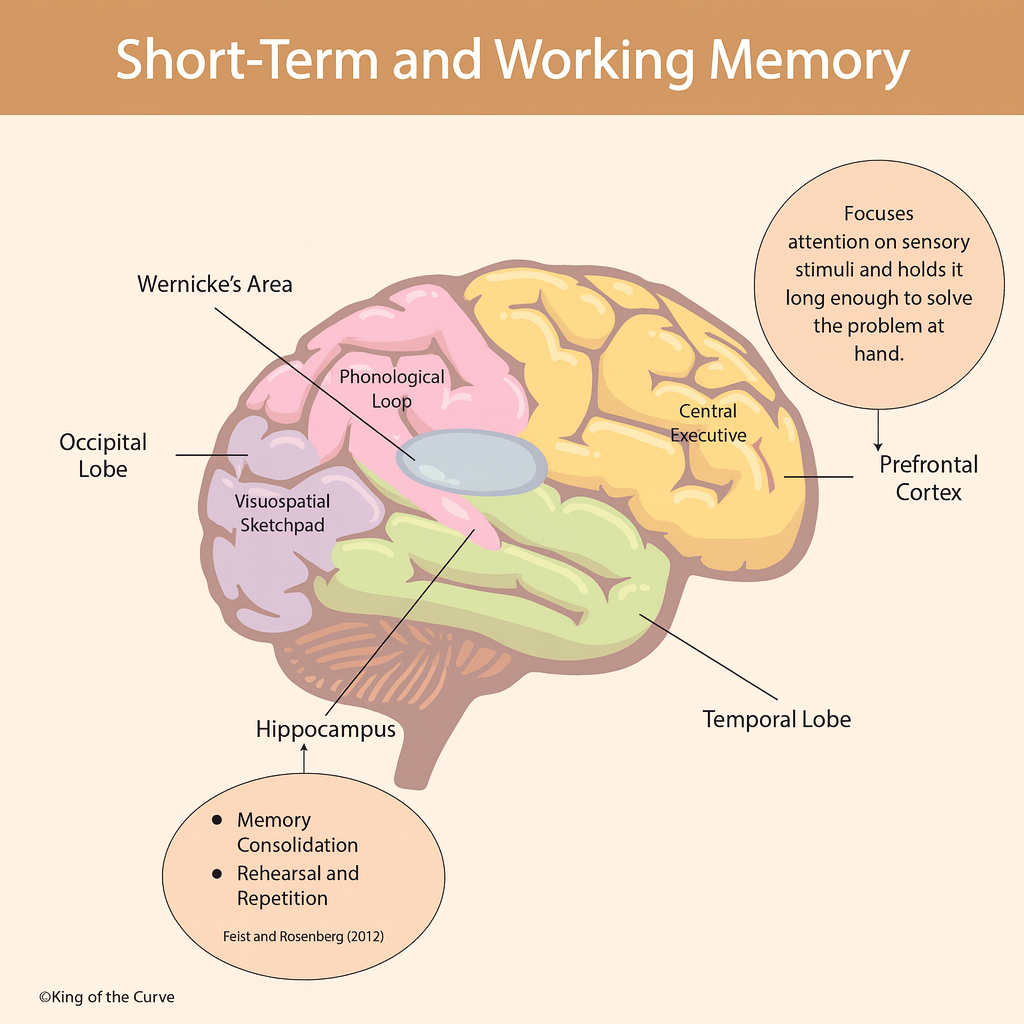
Working memory expands upon short-term memory by emphasizing active manipulation of information rather than simple storage. It allows individuals to focus attention on relevant stimuli, integrate incoming sensory input, and use stored information to solve problems or make decisions.
The prefrontal cortex plays a central role in working memory by coordinating attention, goal-directed behavior, and executive control.
🔁 Components of Working Memory
Working memory consists of multiple interacting subsystems:
Central Executive
Controls attention, allocates cognitive resources, and coordinates other memory components.Phonological Loop
Handles verbal and auditory information such as words, numbers, and language. It is closely linked to Wernicke’s area, which is involved in language comprehension.Visuospatial Sketchpad
Manages visual and spatial information, such as shapes, locations, and movement. This system is associated with the occipital lobe and posterior parietal regions.
🧩 Role of the Hippocampus
Although the hippocampus is primarily involved in long-term memory formation, it interacts with working memory during memory consolidation. Rehearsal and repetition help transfer information from short-term or working memory into long-term storage.
🧠 Brain Regions Involved
Several cortical regions contribute to short-term and working memory:
Prefrontal cortex – executive control and attention
Temporal lobe – auditory processing and language
Occipital lobe – visual processing
Hippocampus – consolidation and memory stabilization
⚠️ Clinical Relevance
Impairment of working memory is seen in conditions such as:
Attention-deficit/hyperactivity disorder (ADHD)
Schizophrenia
Traumatic brain injury
Dementia and Alzheimer’s disease
Damage to the prefrontal cortex particularly disrupts the ability to maintain attention and manipulate information.
📝 Key Takeaway
Short-term memory allows temporary storage, while working memory enables active processing and problem solving. Together, they form the foundation of higher cognitive functions, learning, and decision-making.

Frequently Asked Questions (FAQs)
-
Aim for 4-6 focused hours, ensuring you incorporate breaks to avoid burnout.
-
Practice mindfulness techniques, take practice exams under realistic conditions, and maintain a balanced lifestyle.
-
Set short-term goals, seek support from mentors, and reward yourself for small achievements.
-
Regular exercise improves focus, reduces stress, and enhances overall mental clarity.
-
KOTC offers personalized learning tools, gamification features, and adaptive question banks to help students stay on track without burnout.