
🌾 Example of Semantic Networks in a Farm Context
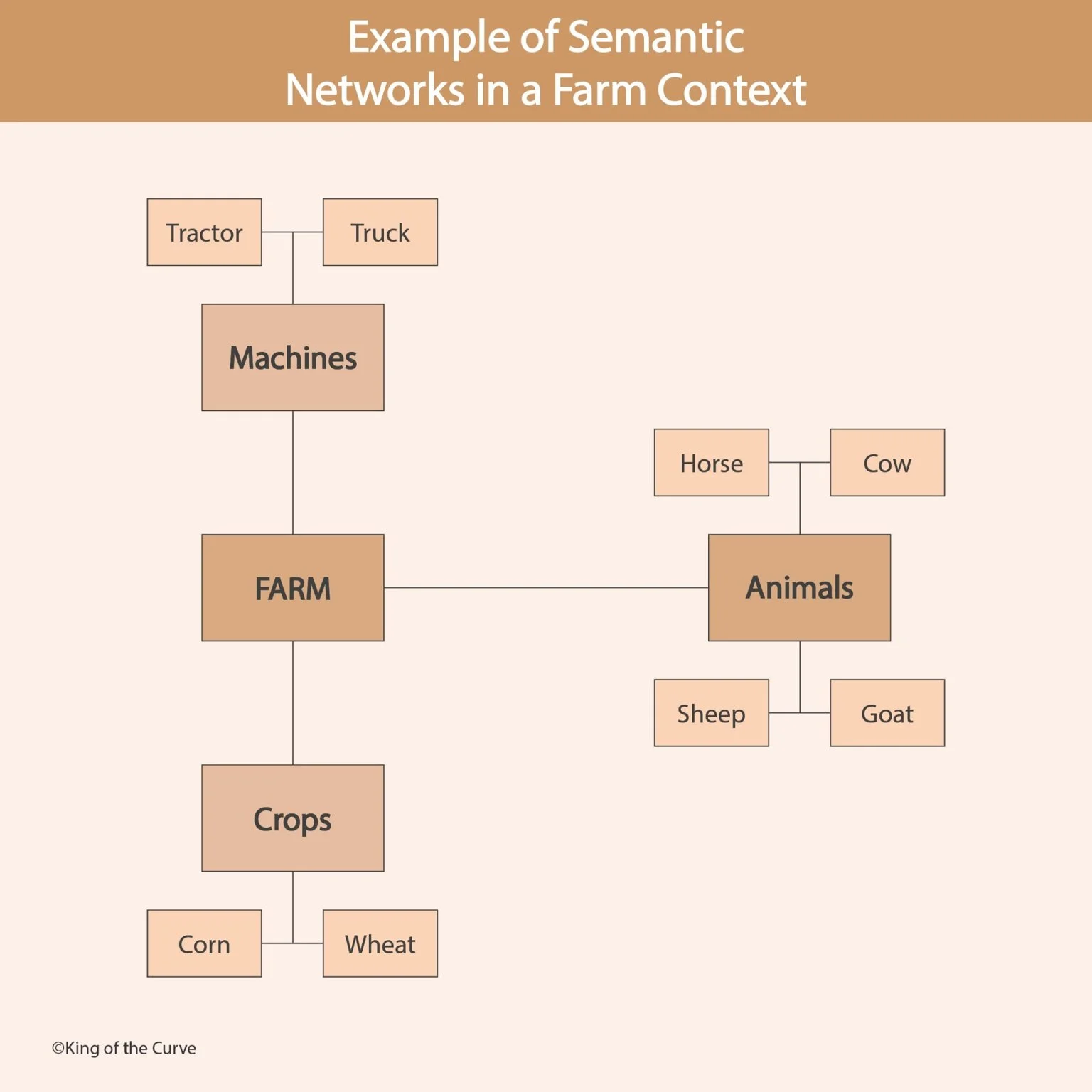
Semantic networks are visual representations of knowledge that show how concepts are connected to one another. They are commonly used in psychology, artificial intelligence, linguistics, and cognitive science to organize and understand relationships between ideas. The diagram above demonstrates a semantic network built around the concept of a farm, showing how related categories and objects are linked together.
🧠 What Is a Semantic Network?
A semantic network is a diagram made up of:
Nodes → representing concepts or objects
Links → representing relationships between those concepts
These networks help organize information in a structured and meaningful way. Instead of storing facts separately, semantic networks connect ideas based on similarity, category, or association.
In the diagram, the central concept is FARM, which connects to multiple related categories.
🚜 Machines in the Farm Network
One branch of the network focuses on Machines used on a farm. This category is linked to examples such as:
Tractor
Truck
These machines are grouped together because they share a common function related to transportation, farming operations, and agricultural work.
Semantic grouping helps the brain quickly retrieve related information. When someone thinks about “machines,” related examples like tractors and trucks are easily recalled.
🐄 Animals in the Farm Network
Another important category connected to the farm is Animals. The network includes:
Horse
Cow
Sheep
Goat
These animals are associated with farming activities such as transportation, milk production, wool production, and livestock management.
This structure demonstrates hierarchical organization, where broad categories contain more specific examples.
🌽 Crops and Agricultural Products
The diagram also includes a Crops category connected to:
Corn
Wheat
These are common agricultural products grown on farms. Associating them under one category helps show that both belong to the broader concept of farming and plant cultivation.
Semantic networks simplify complex information by visually grouping related ideas together.
🔗 Why Semantic Networks Are Important
Semantic networks are widely used because they mimic how human memory organizes information. Instead of remembering isolated facts, the brain often stores knowledge through associations and relationships.
Applications include:
Artificial intelligence
Natural language processing
Cognitive psychology
Education and learning systems
Search engines and knowledge graphs
By connecting concepts, semantic networks improve understanding, memory recall, and information retrieval.
📚 Semantic Networks in Learning
In education, semantic networks help students:
Organize ideas visually
Understand relationships between topics
Improve long-term memory retention
Simplify complex subjects
For example, a biology student might connect “Animals” to “Mammals,” “Birds,” and “Reptiles” in a similar network structure.
Visual learning techniques like this make studying more interactive and efficient.
🤖 Semantic Networks in Artificial Intelligence
Artificial intelligence systems often use semantic networks to simulate human-like understanding. AI models connect concepts and meanings to process language, answer questions, and make logical associations.
Modern technologies such as:
Virtual assistants
Recommendation systems
Knowledge graphs
Chatbots
all rely on concept relationships similar to semantic networks.
🧩 Key Takeaway
The farm semantic network demonstrates how information can be organized into connected categories and subcategories. By linking concepts like machines, animals, and crops to the central idea of a farm, semantic networks create a structured representation of knowledge that improves understanding and memory.

Frequently Asked Questions (FAQs)
-
Aim for 4-6 focused hours, ensuring you incorporate breaks to avoid burnout.
-
Practice mindfulness techniques, take practice exams under realistic conditions, and maintain a balanced lifestyle.
-
Set short-term goals, seek support from mentors, and reward yourself for small achievements.
-
Regular exercise improves focus, reduces stress, and enhances overall mental clarity.
-
KOTC offers personalized learning tools, gamification features, and adaptive question banks to help students stay on track without burnout.