
🎲 Introduction to Gambler’s Fallacy
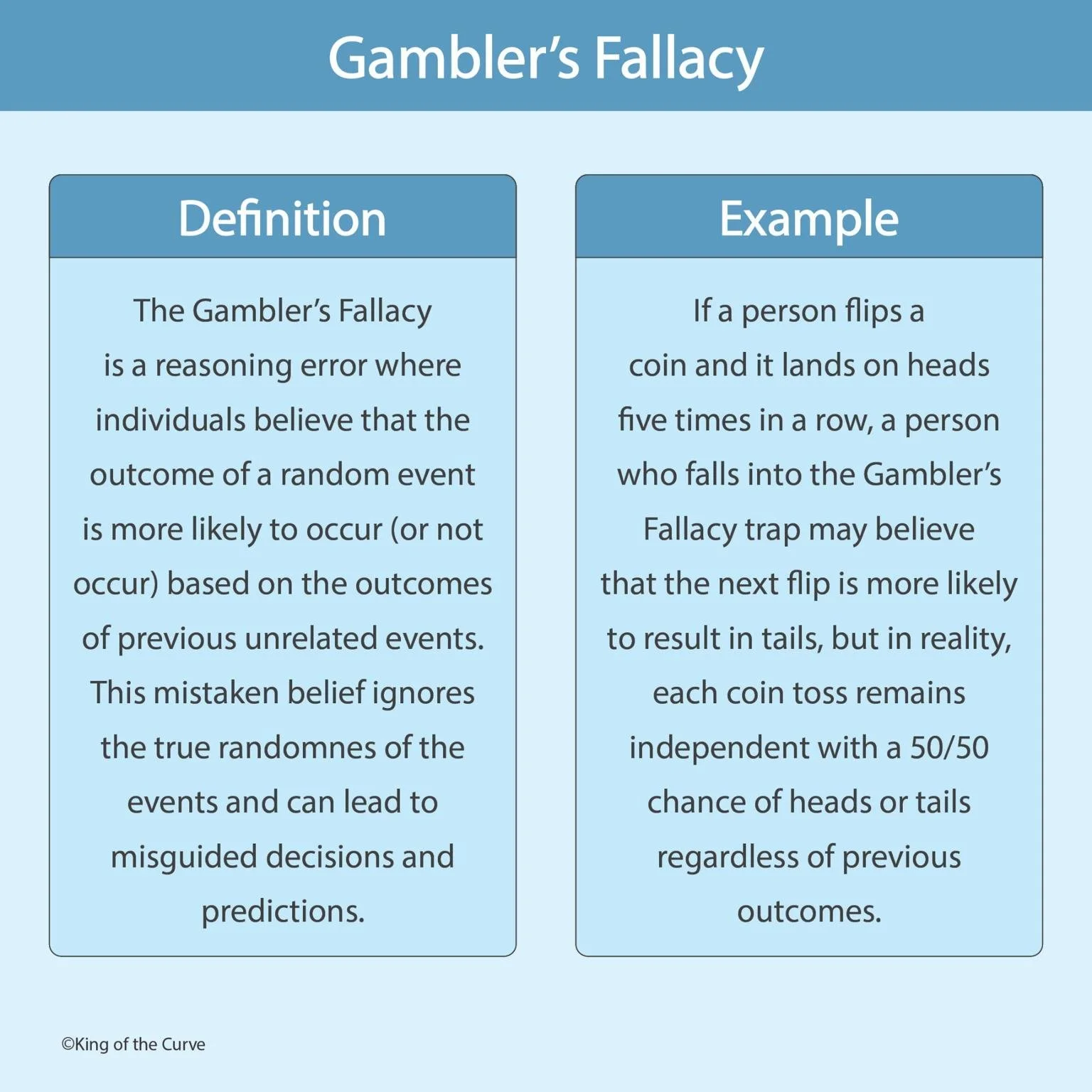
The Gambler’s Fallacy is a psychological bias in which people believe that previous outcomes of random events affect future outcomes. This mistaken belief occurs because individuals expect random events to “balance out” over time. In reality, truly random events are independent, meaning that past results do not change future probabilities. The Gambler’s Fallacy is commonly observed in gambling, investing, sports predictions, and everyday decision-making.
🧠 Understanding the Core Concept
A random event has no memory of what happened previously. For example, when flipping a fair coin, the chance of landing on heads or tails remains 50% every single time. Even if heads appears multiple times consecutively, the probability does not shift in favor of tails. People often misunderstand this because the human brain naturally searches for patterns and expects balance within short sequences of events.
🎰 Common Gambling Example
One of the most famous examples of the Gambler’s Fallacy occurs in casinos. Imagine a roulette wheel landing on red five times in a row. Many gamblers begin believing that black is more likely to appear next because they think the outcomes must eventually “even out.” However, each spin of the roulette wheel is independent, so the probability remains unchanged. This misconception frequently causes gamblers to make irrational betting decisions and lose money.
🔍 Statistical Independence and Randomness
An important concept related to the Gambler’s Fallacy is statistical independence. Independent events are outcomes that do not influence one another in any way. For example, each coin toss, dice roll, or roulette spin begins with the same probability regardless of previous results. Randomness does not follow human expectations of fairness or balance in the short term. Understanding statistical independence helps people recognize why streaks naturally occur in random sequences and prevents them from making decisions based on false assumptions or emotional reasoning.
📊 Gambler’s Fallacy vs Reality
| Situation | Gambler’s Fallacy Belief | Actual Probability Reality |
|---|---|---|
| Coin lands on heads 5 times | Tails is now more likely | Still 50% heads and 50% tails |
| Roulette lands on red repeatedly | Black is “due” next | Odds remain the same |
| Losing streak in betting | A win must happen soon | Future events are independent |
| Lottery numbers repeat | Certain numbers won’t appear again | Every draw is random |
| Stock prices fall continuously | Prices must rise immediately | Markets are unpredictable |
🧩 Why People Fall for This Bias
Humans are naturally uncomfortable with randomness. The brain prefers recognizable patterns and logical explanations, even when none exist. This tendency causes people to incorrectly assume that short-term outcomes should reflect long-term probabilities. Psychologists refer to this as a cognitive bias because emotions and intuition override mathematical reasoning. The Gambler’s Fallacy demonstrates how easily human judgment can become distorted when dealing with uncertainty.
💰 Real-Life Effects Beyond Gambling
The Gambler’s Fallacy affects more than casinos and betting games. Investors may assume a declining stock market is guaranteed to rebound quickly, while sports fans may believe a team on a losing streak is “due” for a win. In healthcare, business, and everyday life, people sometimes make poor decisions because they misunderstand probability and independence. These false assumptions can lead to unnecessary risks, financial losses, and inaccurate predictions.
✅ Importance of Understanding Gambler’s Fallacy
Learning about the Gambler’s Fallacy helps improve critical thinking and decision-making. Understanding that independent events remain independent allows people to evaluate situations more logically and avoid emotional reasoning. Whether analyzing statistics, making investments, or participating in games of chance, recognizing this bias encourages smarter choices based on evidence rather than misleading patterns. Awareness of probability principles is essential for making rational and informed decisions in both academic and real-world settings.

Frequently Asked Questions (FAQs)
-
Aim for 4-6 focused hours, ensuring you incorporate breaks to avoid burnout.
-
Practice mindfulness techniques, take practice exams under realistic conditions, and maintain a balanced lifestyle.
-
Set short-term goals, seek support from mentors, and reward yourself for small achievements.
-
Regular exercise improves focus, reduces stress, and enhances overall mental clarity.
-
KOTC offers personalized learning tools, gamification features, and adaptive question banks to help students stay on track without burnout.