
🧠 Semantic Networks: Understanding Farm Concepts
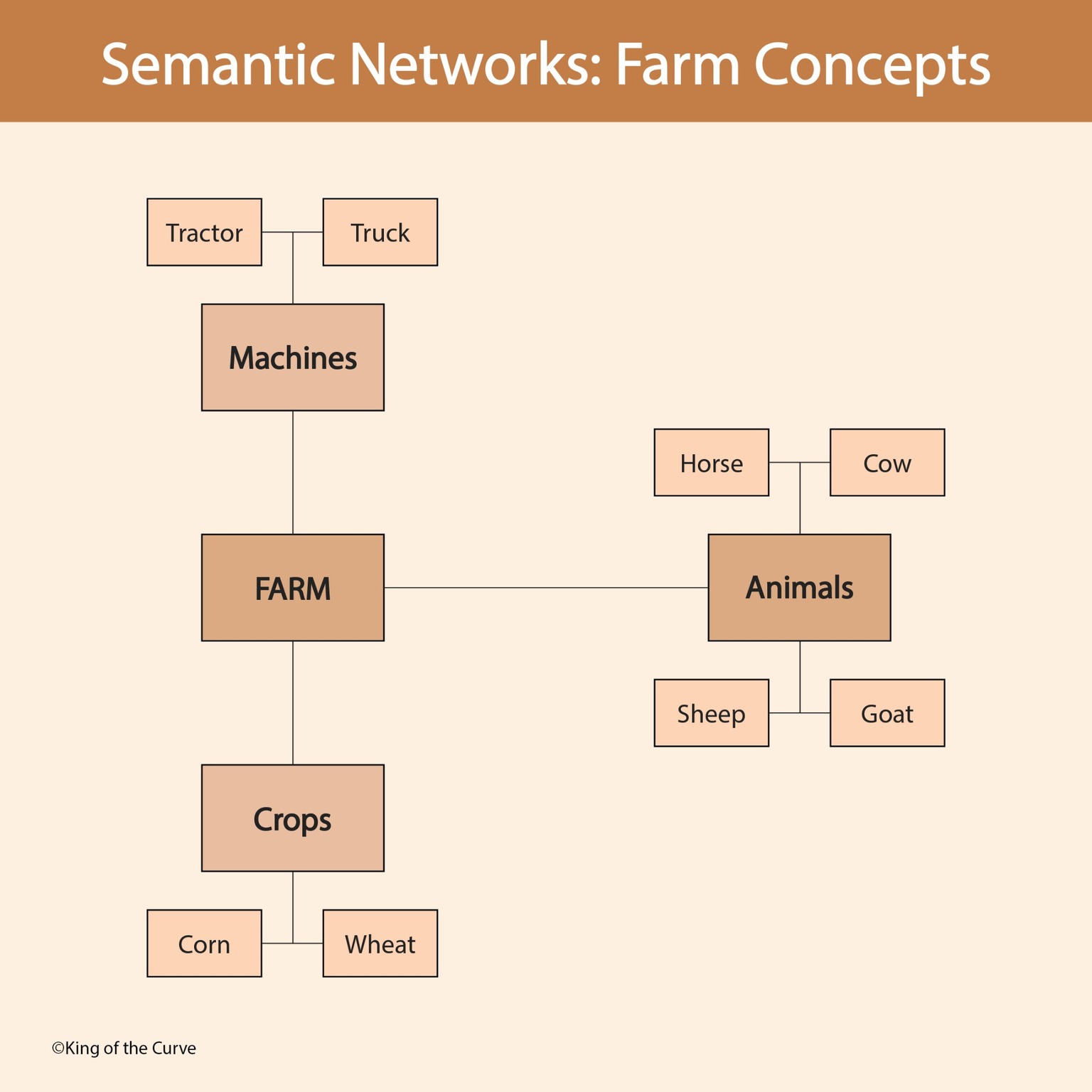
Semantic networks are a powerful way to understand how knowledge is organized in the human mind. Instead of storing information randomly, our brains connect related ideas into structured networks. The image above demonstrates this using a simple and familiar example: farm concepts.
🌾 What Is a Semantic Network?
A semantic network is a diagram that represents knowledge as interconnected concepts.
Each node represents a concept (e.g., Farm, Animals, Crops).
Each connection (link) represents a relationship between concepts.
This structure mirrors how memory organizes related ideas, making retrieval faster and more efficient.
🏡 The Central Concept: FARM
At the center of the network is FARM, the main concept.
From this central idea, three major categories branch out:
Machines
Animals
Crops
This hierarchical structure shows that these categories are directly associated with the concept of a farm.
🚜 Machines
Under Machines, we see:
Tractor
Truck
These are examples of farm-related machinery. In semantic networks, these are called subordinate concepts because they fall under a broader category.
When you hear “tractor,” your brain may activate the broader category “machines,” which then connects to “farm.” This spreading activation helps explain how associative memory works.
🐄 Animals
Under Animals, we find:
Horse
Cow
Sheep
Goat
These are examples of livestock commonly associated with farms.
Because these concepts share a category, they are closely linked. This explains why thinking about a “cow” might quickly bring to mind “sheep” or “goat.”
🌽 Crops
Under Crops, we see:
Corn
Wheat
These are agricultural products grown on farms.
Again, these concepts are grouped based on shared characteristics, making them easier to retrieve when thinking about farming.
🔗 Why Semantic Networks Matter
Semantic networks help explain:
How memory retrieval works
Why related ideas come to mind together
How categories improve learning
How spreading activation speeds up recall
For example, if someone says “farm,” your brain activates related nodes like animals, crops, and machines almost instantly.
📚 Applications in Psychology & Education
Semantic networks are used to:
Study memory organization
Explain categorization
Improve teaching strategies
Design AI knowledge systems
Understand spreading activation theory
They are especially important in cognitive psychology and learning science.
🧩 Final Thoughts
This simple farm example demonstrates a powerful cognitive principle: our knowledge is structured, not random.
Semantic networks show that learning becomes more effective when information is organized into meaningful connections. Whether studying biology, psychology, or everyday concepts, building structured associations strengthens understanding and recall.

Frequently Asked Questions (FAQs)
-
Aim for 4-6 focused hours, ensuring you incorporate breaks to avoid burnout.
-
Practice mindfulness techniques, take practice exams under realistic conditions, and maintain a balanced lifestyle.
-
Set short-term goals, seek support from mentors, and reward yourself for small achievements.
-
Regular exercise improves focus, reduces stress, and enhances overall mental clarity.
-
KOTC offers personalized learning tools, gamification features, and adaptive question banks to help students stay on track without burnout.