
🍽️ Segmentation vs Peristaltic Contraction in the Digestive System
The gastrointestinal (GI) tract uses coordinated smooth muscle contractions to move and process food. Two major types of movement are segmentation contractions and peristaltic contractions.
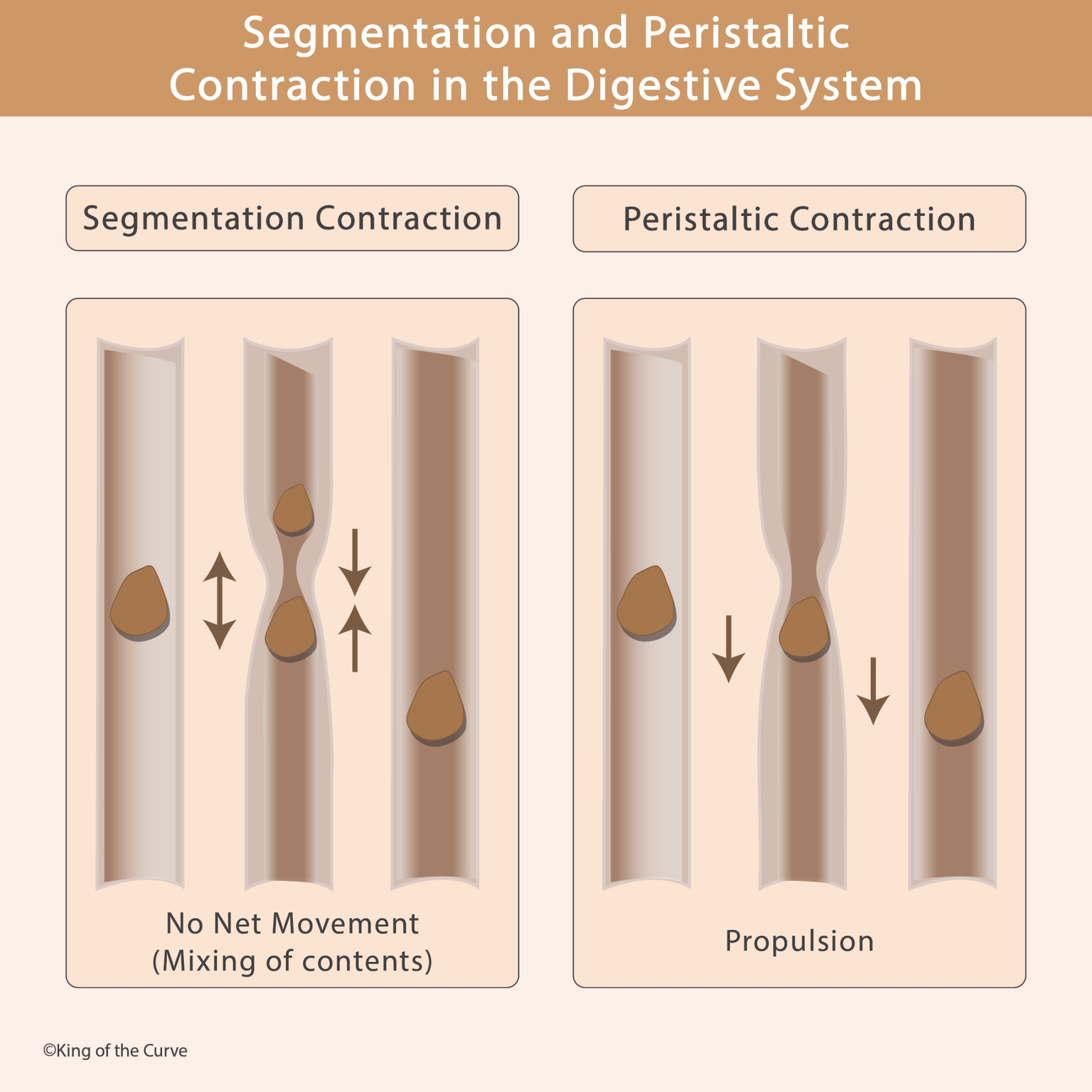
🔄 Segmentation Contraction
Segmentation is a mixing movement that occurs primarily in the small intestine.
🔍 What Happens?
Circular smooth muscles contract at spaced intervals.
The intestinal contents are pushed back and forth.
There is no net forward movement.
The main purpose is mixing.
🎯 Function
Segmentation:
Mixes chyme with digestive enzymes.
Increases contact between nutrients and the intestinal wall.
Enhances absorption.
Think of segmentation as “churning in place.”
➡️ Peristaltic Contraction
Peristalsis is a propulsive movement that pushes contents forward through the digestive tract.
🌊 What Happens?
Circular muscles contract behind the bolus.
Longitudinal muscles contract ahead of it.
The bolus is pushed forward in one direction.
This creates a wave-like motion.
🚀 Function
Peristalsis:
Moves food from the esophagus to the stomach.
Propels chyme through the intestines.
Helps move feces toward the rectum.
Think of peristalsis as a forward-moving wave.
🧠 Key Differences
| Feature | Segmentation | Peristalsis |
|---|---|---|
| Primary Purpose | Mixing | Propulsion |
| Net Movement | None | Forward |
| Muscle Pattern | Alternating circular contractions | Coordinated circular + longitudinal contractions |
| Location | Mostly small intestine | Entire GI tract |
⚙️ Physiological Control
Both movements are controlled by:
The enteric nervous system
The myenteric (Auerbach) plexus
Parasympathetic stimulation (increases motility)
Sympathetic stimulation (decreases motility)
Peristalsis is triggered by distension of the intestinal wall, activating the peristaltic reflex.
🩺 Clinical Relevance
Disorders of GI motility can significantly affect digestion. For example, reduced peristalsis may lead to constipation or ileus, while excessive or uncoordinated contractions can cause diarrhea or abdominal cramping. Conditions such as Hirschsprung disease result from impaired enteric nervous system development, affecting normal peristaltic movement.
Understanding these mechanisms helps clinicians diagnose and manage motility-related disorders.
🧪 Why Both Movements Are Essential
Segmentation ensures that nutrients are thoroughly mixed and exposed to absorptive surfaces, maximizing digestion efficiency. Without proper mixing, even normal enzyme secretion would not be enough for optimal absorption.
Peristalsis ensures that food continues progressing through the GI tract. Without propulsion, digestion would stall, leading to discomfort, bloating, and nutrient malabsorption.
Together, these movements create a balance between processing and progression.
🎯 Summary
Segmentation mixes.
Peristalsis propels.
Both are essential for efficient digestion, nutrient absorption, and waste elimination.

Frequently Asked Questions (FAQs)
-
Aim for 4-6 focused hours, ensuring you incorporate breaks to avoid burnout.
-
Practice mindfulness techniques, take practice exams under realistic conditions, and maintain a balanced lifestyle.
-
Set short-term goals, seek support from mentors, and reward yourself for small achievements.
-
Regular exercise improves focus, reduces stress, and enhances overall mental clarity.
-
KOTC offers personalized learning tools, gamification features, and adaptive question banks to help students stay on track without burnout.