
🌊 Constructive vs Destructive Interference
Wave interference is a fundamental concept in physics that explains how waves interact when they meet. Whether in sound, light, or water waves, interference determines whether waves amplify or cancel each other. The two main types are constructive interference and destructive interference.
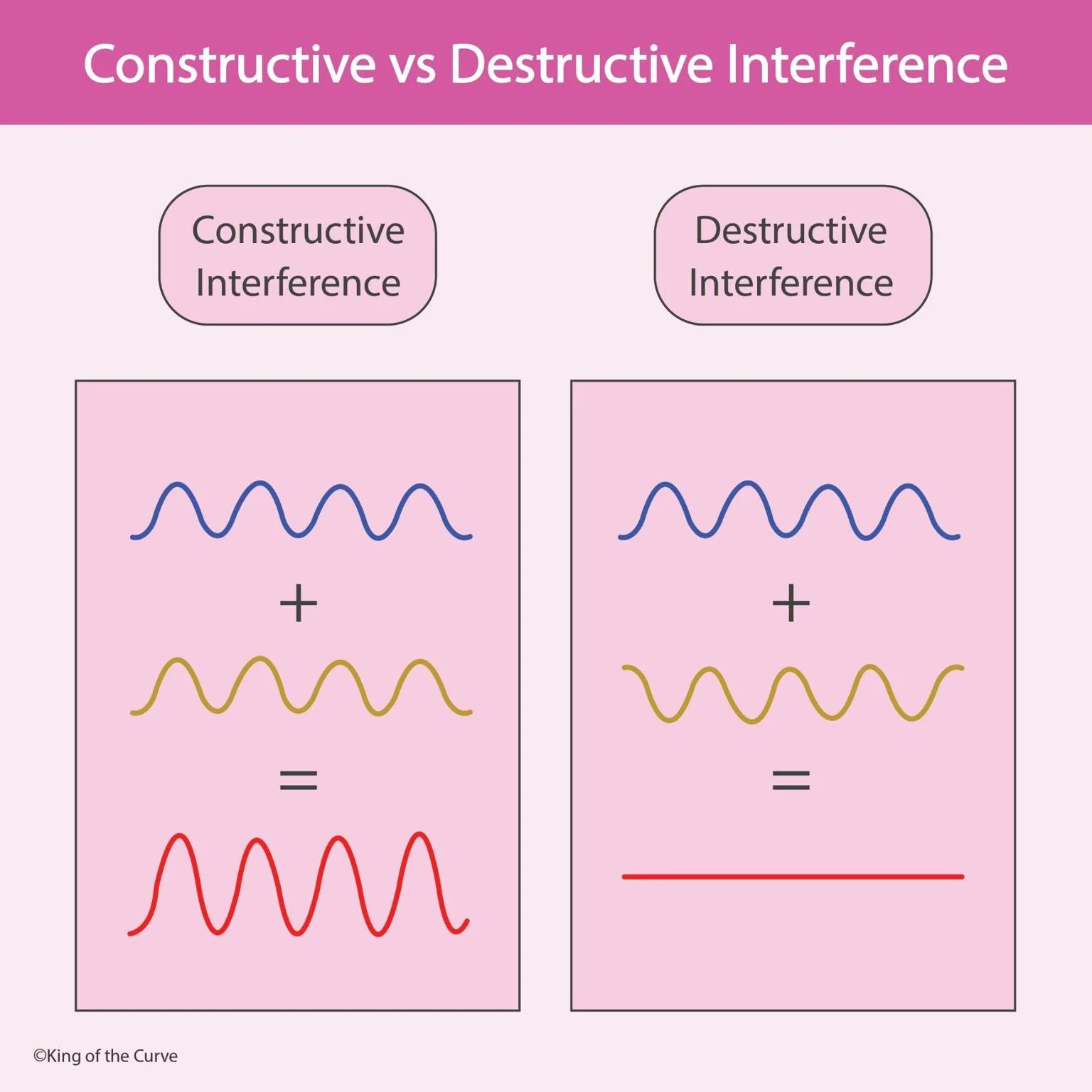
➕ Constructive Interference
Constructive interference occurs when two waves meet in phase—meaning their crests and troughs align.
🔍 What Happens?
Crest meets crest → larger crest
Trough meets trough → deeper trough
Amplitudes add together
📈 Result
A wave with greater amplitude
Increased energy and intensity
💡 Real-Life Examples
Loud sound when two speakers play the same tone in sync
Bright fringes in light interference patterns
Ocean waves combining to form larger waves
➖ Destructive Interference
Destructive interference happens when two waves meet out of phase—a crest aligns with a trough.
🔍 What Happens?
Crest cancels trough
Amplitudes subtract
📉 Result
Reduced or zero amplitude
Waves cancel each other out completely (if equal)
💡 Real-Life Examples
Noise-canceling headphones 🎧
Silence zones in sound wave interference
Dark fringes in light experiments
🔬 Conditions for Interference
For interference to occur clearly, certain conditions must be met. The waves must be coherent, meaning they have a constant phase difference and the same frequency. They should also have similar amplitudes to produce noticeable patterns. If these conditions are not satisfied, the interference becomes irregular and less predictable. This is why controlled setups, such as in laboratory experiments with lasers or sound waves, are often used to demonstrate interference patterns effectively.
🌍 Applications in Real Life and Technology
Wave interference plays a critical role in modern technology and natural phenomena. In medical imaging, techniques like ultrasound rely on wave interactions to create detailed internal images. In telecommunications, engineers manage interference to ensure clear signal transmission. Even in everyday life, interference affects how we perceive sound in large halls or stadiums. By understanding and controlling interference, scientists and engineers can enhance performance in systems ranging from audio devices to advanced optical instruments.
⚖️ Key Differences
| Feature | Constructive Interference | Destructive Interference |
|---|---|---|
| Phase Relationship | In phase | Out of phase |
| Amplitude | Increases | Decreases or zero |
| Energy Effect | Amplification | Cancellation |
| Resulting Wave | Stronger wave | Weaker or flat line |
🧠 Why It Matters
Understanding interference is essential in many fields:
🔊 Audio engineering: improving sound quality
🔬 Optics: lasers, holography, and diffraction
📡 Telecommunications: signal clarity and interference control
🎧 Technology: noise cancellation systems
📌 Key Takeaway
When waves meet, they don’t just pass through each other they interact. If they align, they amplify (constructive interference). If they oppose, they cancel out (destructive interference). This simple principle explains many everyday and advanced physical phenomena.

Frequently Asked Questions (FAQs)
-
Aim for 4-6 focused hours, ensuring you incorporate breaks to avoid burnout.
-
Practice mindfulness techniques, take practice exams under realistic conditions, and maintain a balanced lifestyle.
-
Set short-term goals, seek support from mentors, and reward yourself for small achievements.
-
Regular exercise improves focus, reduces stress, and enhances overall mental clarity.
-
KOTC offers personalized learning tools, gamification features, and adaptive question banks to help students stay on track without burnout.