
🧪 Saliva Formation in Acinar and Ductal Cells: How Saliva Becomes Hypotonic
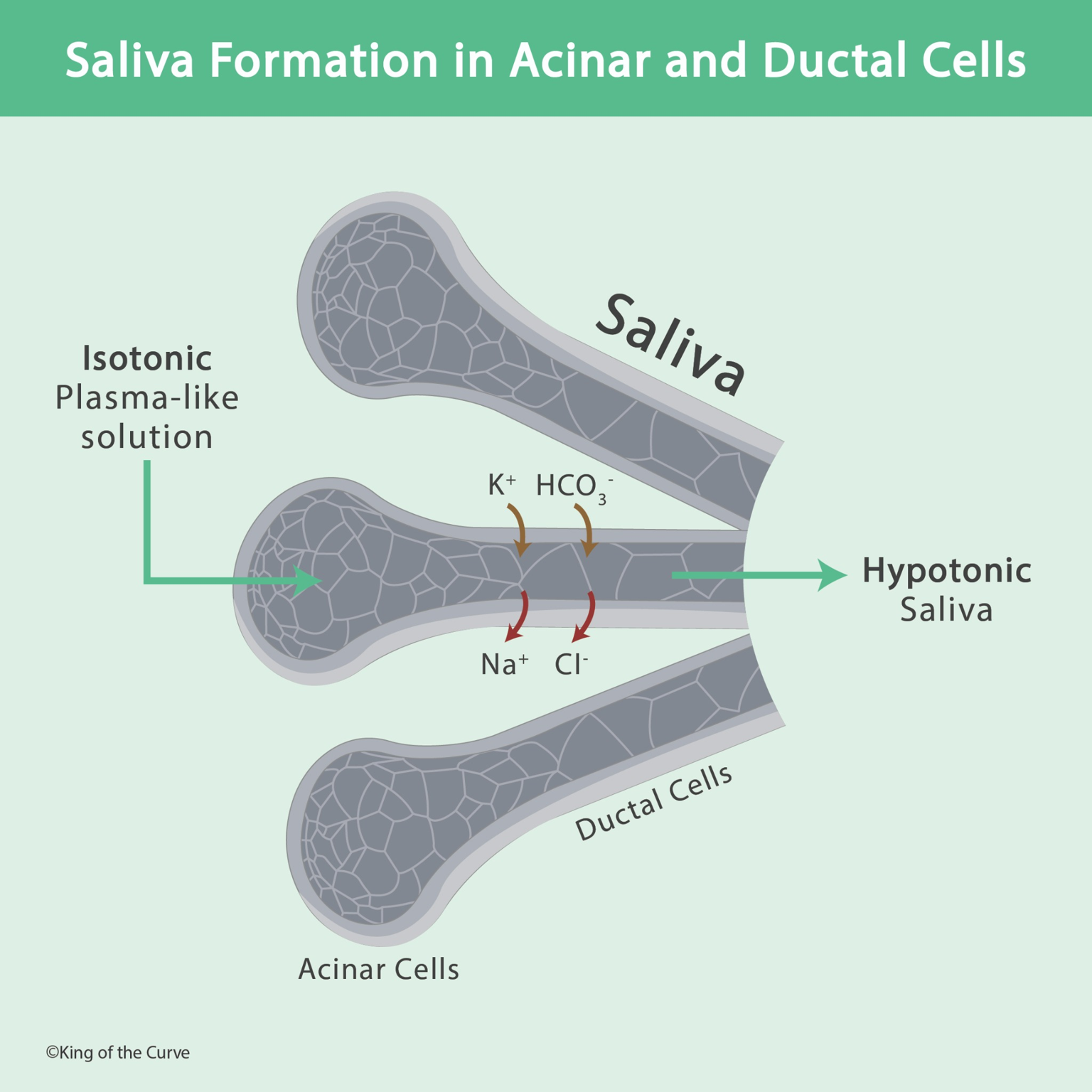
Saliva may seem simple, but its formation is a carefully regulated physiological process involving two major cell types: acinar cells and ductal cells. Together, they transform an isotonic plasma-like fluid into the hypotonic saliva that enters your mouth.
🧪 Step 1: Acinar Cells Produce Primary Saliva
Saliva formation begins in the acinar cells, which are located at the terminal ends of salivary glands.
What Happens Here?
Acinar cells secrete:
Sodium (Na⁺)
Chloride (Cl⁻)
Water (H₂O)
Small amounts of potassium (K⁺)
Bicarbonate (HCO₃⁻)
Water follows sodium and chloride due to osmotic forces.
Key Point:
The fluid produced at this stage is isotonic and plasma-like — meaning its osmolarity is similar to blood plasma.
This is called primary saliva.
🔄 Step 2: Ductal Cells Modify the Saliva
As the primary saliva flows through the ductal system, its composition changes dramatically.
Ductal Cells:
They:
Reabsorb Na⁺ and Cl⁻
Secrete K⁺ and HCO₃⁻
Are relatively impermeable to water
Because water cannot follow the reabsorbed sodium and chloride, the fluid becomes progressively more dilute.
💧 Why Final Saliva Is Hypotonic
Since:
Sodium and chloride are removed
Water stays behind
The final saliva contains fewer solutes relative to water.
This makes saliva hypotonic compared to plasma.
📊 Ion Changes Along the Duct
| Ion | Acinar Secretion | Ductal Modification | Final Saliva |
|---|---|---|---|
| Na+ | High | Reabsorbed | Low |
| Cl− | High | Reabsorbed | Low |
| K+ | Low | Secreted | Higher |
| HCO3− | Low | Secreted | Higher |
| Water | Moves freely | Cannot follow ions | Remains |
Tip: At low flow rates, ducts have more time to reabsorb Na+/Cl−, making saliva more hypotonic.
⚡ Flow Rate Matters
Saliva composition depends on flow rate.
Low Flow Rate:
More time for ductal modification
More Na⁺ and Cl⁻ reabsorbed
Saliva becomes very hypotonic
High Flow Rate:
Less time for modification
Saliva is closer to isotonic
This explains why saliva composition changes during dehydration, stress, or eating.
🧠 Clinical Connections
Understanding saliva formation is important in:
Cystic fibrosis (abnormal chloride transport)
Sjögren syndrome (autoimmune damage to salivary glands)
Dehydration
Electrolyte disorders
It is also commonly tested in:
MCAT
USMLE
Nursing exams
Physiology courses
🎯 Summary
Saliva formation involves two major steps:
Acinar cells produce isotonic primary saliva
Ductal cells reabsorb Na⁺/Cl⁻ and secrete K⁺/HCO₃⁻
Water cannot follow → final saliva becomes hypotonic
In short:
Isotonic in the acinus → Hypotonic in the mouth

Frequently Asked Questions (FAQs)
-
Aim for 4-6 focused hours, ensuring you incorporate breaks to avoid burnout.
-
Practice mindfulness techniques, take practice exams under realistic conditions, and maintain a balanced lifestyle.
-
Set short-term goals, seek support from mentors, and reward yourself for small achievements.
-
Regular exercise improves focus, reduces stress, and enhances overall mental clarity.
-
KOTC offers personalized learning tools, gamification features, and adaptive question banks to help students stay on track without burnout.