
🧪 Relative Concentrations Along the Proximal Tubule
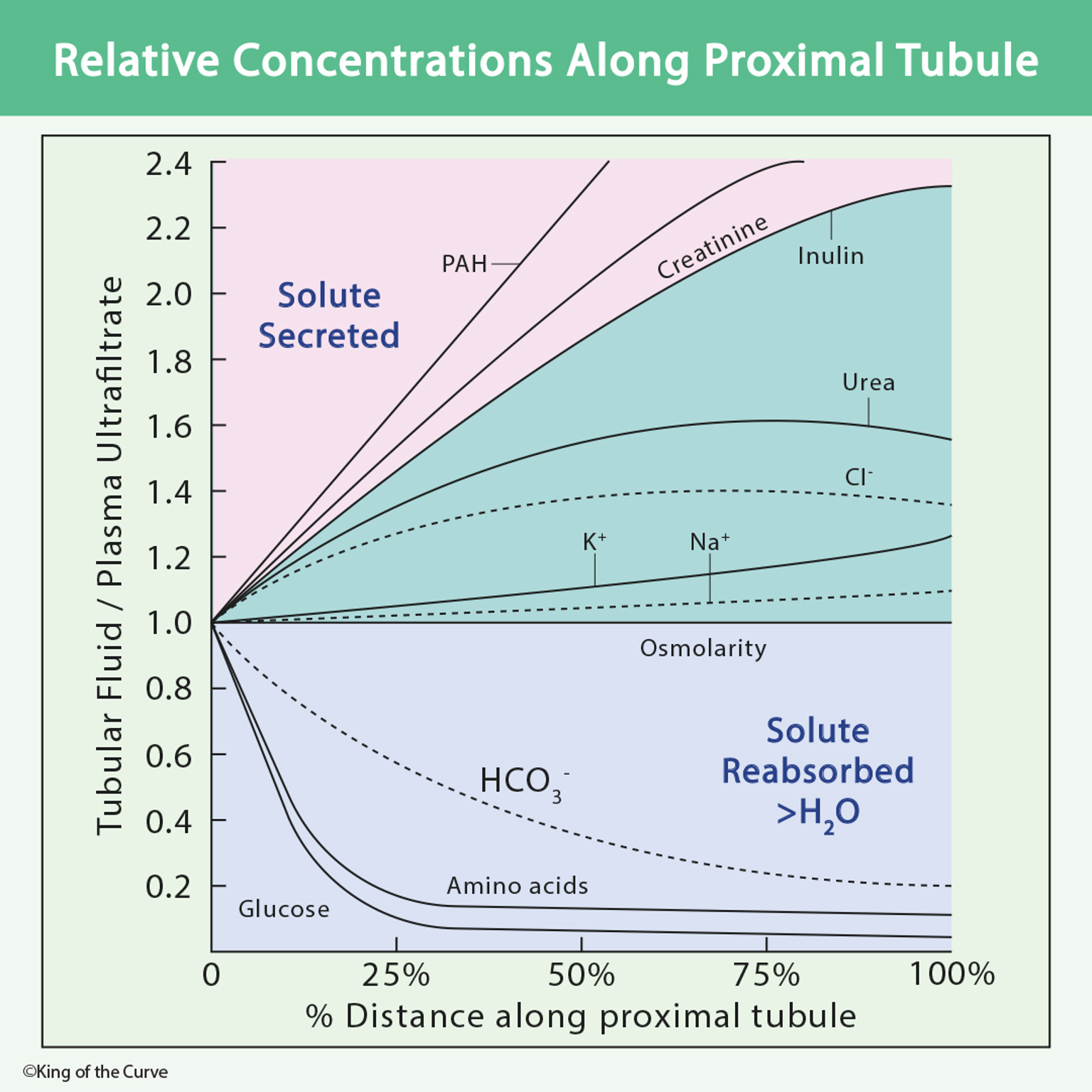
The proximal tubule plays a crucial role in reabsorbing filtered substances from the glomerulus. Although approximately 65–70% of filtered water and sodium are reabsorbed here, different solutes behave differently along its length. The graph above illustrates how the tubular fluid-to-plasma concentration ratio (TF/P) changes as fluid moves from the beginning to the end of the proximal tubule.
📊 What Does TF/P Mean?
The vertical axis represents the tubular fluid to plasma concentration ratio (TF/P):
TF/P = 1 → concentration equals plasma
TF/P > 1 → solute becomes more concentrated in tubular fluid
TF/P < 1 → solute is being reabsorbed faster than water
The horizontal axis shows distance along the proximal tubule (0–100%).
💧 Osmolarity Stays Constant
Notice that osmolarity remains at 1 throughout the proximal tubule.
This happens because:
Water reabsorption closely follows solute reabsorption
The proximal tubule is highly permeable to water
Reabsorption here is isosmotic
Even though large volumes of fluid are reabsorbed, tubular fluid osmolarity stays nearly equal to plasma.
🍬 Glucose and Amino Acids: Rapid Reabsorption
Glucose and amino acids rapidly drop toward zero early in the proximal tubule.
This occurs because:
They are reabsorbed via secondary active transport
Transporters (e.g., SGLT for glucose) are highly efficient
Under normal conditions, they are almost completely reabsorbed
A TF/P ratio approaching zero indicates reabsorption faster than water.
Clinically, if glucose appears in urine, it suggests that the transport maximum (Tm) has been exceeded, such as in diabetes mellitus.
🧂 Bicarbonate (HCO₃⁻): Preferential Reabsorption
Bicarbonate concentration falls progressively along the proximal tubule.
Why?
HCO₃⁻ is reabsorbed efficiently
Water reabsorption is proportional but slightly slower initially
The TF/P ratio drops below 1
This process is essential for acid-base balance.
⚖️ Sodium and Potassium: Near Isosmotic Behavior
Sodium (Na⁺) stays close to a TF/P of 1.
Although Na⁺ is heavily reabsorbed:
Water follows closely
Its concentration does not change dramatically
Potassium (K⁺) behaves similarly but may rise slightly due to water reabsorption and paracellular movement.
🧪 Chloride and Urea: Concentration Increases
Chloride (Cl⁻) and urea show TF/P ratios greater than 1 in the later proximal tubule.
This happens because:
Water is reabsorbed early
These solutes lag behind initially
Their relative concentration rises
Later, Cl⁻ reabsorption increases due to concentration gradients.
Urea becomes more concentrated as water leaves, even though some urea is also reabsorbed.
📈 Inulin and Creatinine: Markers of Filtration
Inulin and creatinine steadily increase in concentration.
Why?
They are filtered
They are not reabsorbed (inulin)
Creatinine is slightly secreted
Because water is reabsorbed but these substances remain in the tubule, their concentration rises.
This is why inulin is the gold standard for measuring GFR (glomerular filtration rate).
🚀 PAH: Actively Secreted
Para-aminohippuric acid (PAH) increases steeply above all other solutes.
This is because:
It is filtered
It is actively secreted into the tubule
Its TF/P ratio increases dramatically, making it useful for estimating renal plasma flow (RPF).
🧠 Key Concept: Solute Reabsorbed More Than Water vs. Less Than Water
The graph visually divides solutes into two major patterns:
🔽 Solutes Reabsorbed More Than Water
Glucose
Amino acids
Bicarbonate
TF/P < 1
🔼 Solutes Reabsorbed Less Than Water (or Secreted)
Inulin
Creatinine
PAH
Urea
Chloride
TF/P > 1
This distinction is heavily tested in renal physiology exams.
🏥 Clinical Relevance
Understanding proximal tubule handling explains:
Glucosuria in diabetes
Metabolic acidosis from impaired bicarbonate reabsorption
Effects of diuretics
Interpretation of GFR and RPF measurements
The proximal tubule is not simply a passive reabsorption site it is a highly regulated and metabolically active segment critical to maintaining homeostasis.

Frequently Asked Questions (FAQs)
-
Aim for 4-6 focused hours, ensuring you incorporate breaks to avoid burnout.
-
Practice mindfulness techniques, take practice exams under realistic conditions, and maintain a balanced lifestyle.
-
Set short-term goals, seek support from mentors, and reward yourself for small achievements.
-
Regular exercise improves focus, reduces stress, and enhances overall mental clarity.
-
KOTC offers personalized learning tools, gamification features, and adaptive question banks to help students stay on track without burnout.