
🔹 Introduction: Why Saliva Matters
Saliva is essential for digestion, lubrication, speech, taste, and antimicrobial protection. It contains water, electrolytes, mucus, enzymes such as amylase, and immune components like IgA. Because these functions must quickly adjust to changing conditions, salivary secretion is tightly regulated by the autonomic nervous system.
🔹 1. Dual Autonomic Control
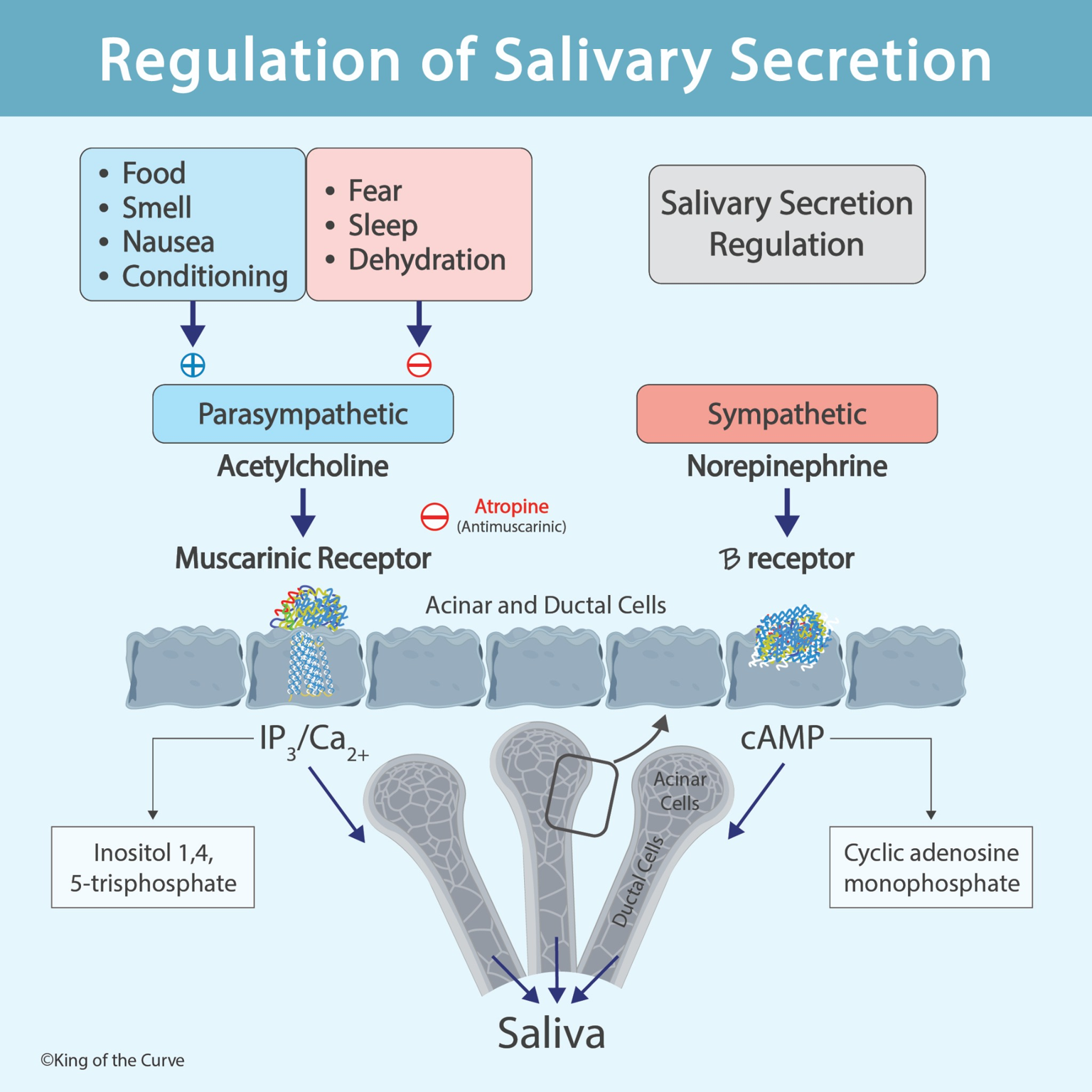
Salivary glands are controlled by both the parasympathetic and sympathetic nervous systems. Unlike many organs, both systems stimulate secretion—but they produce different qualities of saliva. The balance between these pathways determines whether saliva is watery or protein-rich.
🔹 2. Parasympathetic Pathway: The Primary Driver
The parasympathetic system plays the dominant role in salivary secretion. It releases acetylcholine (ACh), which binds to muscarinic (M₃) receptors on acinar and ductal cells. This pathway produces a strong increase in salivary flow.
🔹 3. IP₃/Ca²⁺ Signaling Mechanism
Activation of muscarinic receptors triggers a Gq protein pathway, increasing inositol 1,4,5-trisphosphate (IP₃) and intracellular calcium (Ca²⁺). Elevated Ca²⁺ stimulates fluid and electrolyte secretion, resulting in a large volume of watery saliva. Drugs like atropine block muscarinic receptors and reduce salivation, leading to dry mouth.
🔹 4. Sympathetic Pathway: Modulating Composition
The sympathetic system releases norepinephrine, which binds to β-adrenergic receptors. This activates a Gs pathway, increasing cyclic adenosine monophosphate (cAMP). Although sympathetic stimulation does increase secretion, it produces smaller amounts of thicker, protein-rich saliva.
🔹 5. cAMP Signaling and Protein Secretion
Elevated cAMP enhances protein secretion from acinar cells. This explains why stress or fear may cause the sensation of dry mouth—saliva becomes more viscous and less abundant despite ongoing stimulation.
🔹 6. Stimuli Influencing Salivation
Salivation increases with food intake, smell, nausea, and conditioned reflexes. It decreases during sleep, dehydration, or fear. These responses reflect changes in autonomic activity.
🔹 7. Functional Anatomy of Salivary Glands
Acinar cells produce the primary isotonic fluid, while ductal cells modify electrolyte content. Sodium and chloride are reabsorbed, and potassium and bicarbonate are secreted, making final saliva hypotonic compared to plasma.
📊 Summary Table: Regulation of Salivary Secretion
| Feature | Parasympathetic | Sympathetic |
|---|---|---|
| Neurotransmitter | Acetylcholine | Norepinephrine |
| Receptor | Muscarinic (M3) | β-adrenergic |
| G-Protein | Gq | Gs |
| Second Messenger | ↑ IP3 / ↑ Ca2+ | ↑ cAMP |
| Volume of Saliva | High | Low to moderate |
| Consistency | Watery, enzyme-rich | Thick, protein-rich |
| Drug Example | Atropine (blocks) | β-blockers (reduce response) |

Frequently Asked Questions (FAQs)
-
Aim for 4-6 focused hours, ensuring you incorporate breaks to avoid burnout.
-
Practice mindfulness techniques, take practice exams under realistic conditions, and maintain a balanced lifestyle.
-
Set short-term goals, seek support from mentors, and reward yourself for small achievements.
-
Regular exercise improves focus, reduces stress, and enhances overall mental clarity.
-
KOTC offers personalized learning tools, gamification features, and adaptive question banks to help students stay on track without burnout.