
🧪 Regulation of Gastric Acid Secretion
Gastric acid (hydrochloric acid, HCl) is secreted by parietal cells in the stomach and plays a critical role in digestion. It activates pepsinogen to pepsin, denatures proteins, and helps kill ingested pathogens. Because excessive acid can damage the gastric mucosa, its secretion is tightly regulated by neural, hormonal, and paracrine mechanisms.
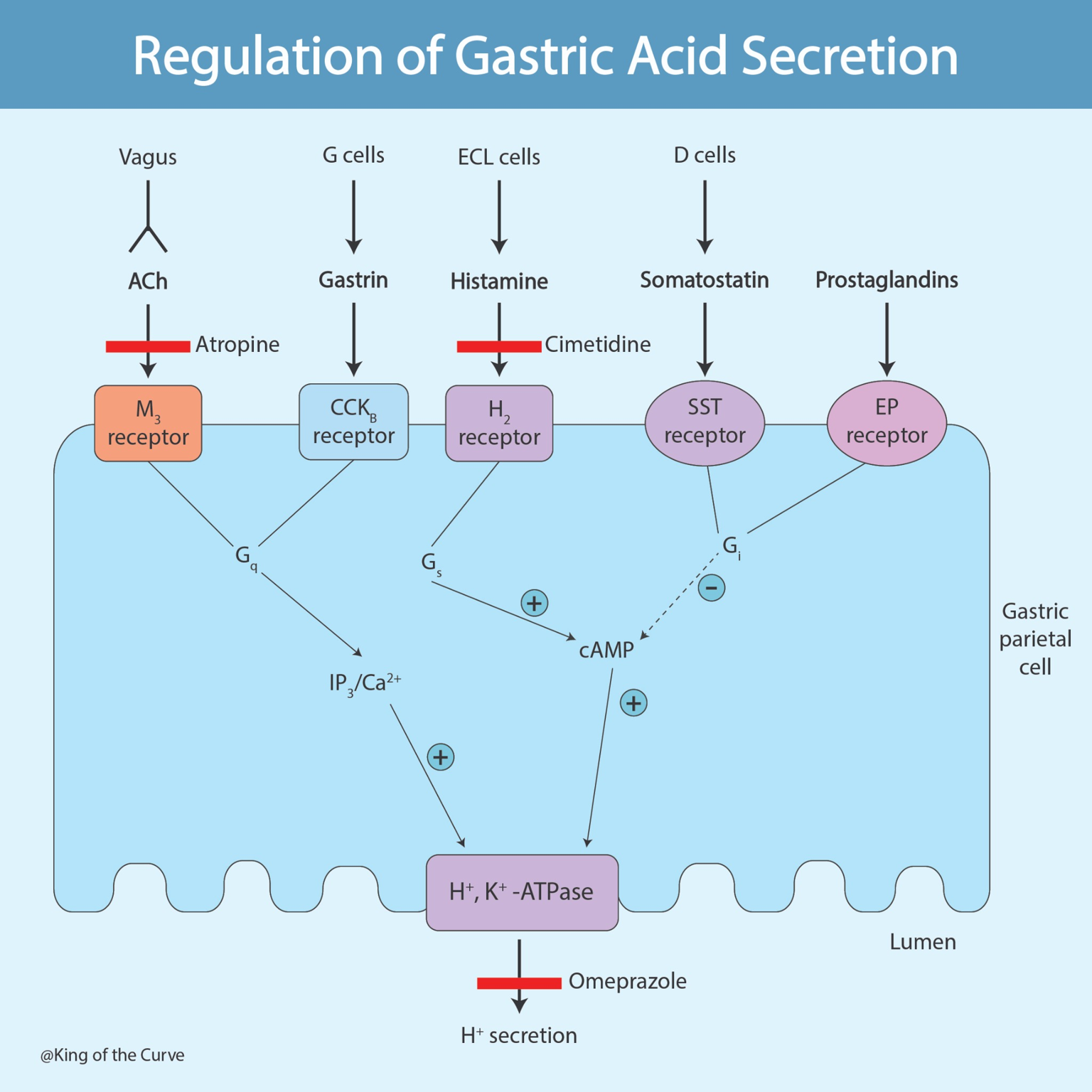
1️⃣ The Central Role of the Parietal Cell
The gastric parietal cell is the final effector in acid secretion. Acid production occurs through the H⁺/K⁺-ATPase proton pump located on the apical membrane facing the lumen. This pump exchanges intracellular hydrogen ions (H⁺) for luminal potassium ions (K⁺), leading to acid secretion into the stomach.
2️⃣ Neural Stimulation: The Vagus Nerve and Acetylcholine
The vagus nerve stimulates acid secretion through the release of acetylcholine (ACh). ACh binds to M₃ muscarinic receptors on parietal cells, activating the Gq signaling pathway. This increases IP₃ and intracellular Ca²⁺ levels, stimulating the proton pump. Atropine can block this pathway by inhibiting M₃ receptors.
3️⃣ Hormonal Regulation: Gastrin
G cells in the stomach secrete gastrin in response to food intake. Gastrin binds to CCK_B receptors on parietal cells, also activating the Gq pathway. This increases intracellular calcium and enhances acid secretion. Gastrin also stimulates ECL cells, amplifying acid production indirectly.
4️⃣ Paracrine Stimulation: Histamine
Enterochromaffin-like (ECL) cells release histamine, which binds to H₂ receptors on parietal cells. Unlike ACh and gastrin, histamine activates the Gs pathway, increasing cyclic AMP (cAMP). Elevated cAMP strongly stimulates the H⁺/K⁺-ATPase pump. Cimetidine, an H₂ receptor blocker, reduces acid secretion by inhibiting this pathway.
5️⃣ Inhibitory Regulation: Somatostatin
D cells release somatostatin, which inhibits acid secretion. Somatostatin binds to SST receptors coupled to Gi proteins, decreasing cAMP production. This reduces proton pump activation. Somatostatin also suppresses gastrin and histamine release, providing multilayered inhibition.
6️⃣ Protective Modulation: Prostaglandins
Prostaglandins bind to EP receptors on parietal cells and decrease cAMP via Gi signaling. This reduces acid secretion and promotes mucus and bicarbonate production. Nonsteroidal anti-inflammatory drugs (NSAIDs) decrease prostaglandin synthesis, which can increase acid injury and contribute to ulcer formation.
7️⃣ Signal Integration at the Proton Pump
All stimulatory signals (ACh, gastrin, histamine) converge at the H⁺/K⁺-ATPase proton pump. Calcium-mediated pathways (Gq) and cAMP-mediated pathways (Gs) act synergistically to maximize acid secretion. Inhibitory signals (somatostatin and prostaglandins) counterbalance these pathways to prevent excessive acid production.
8️⃣ Pharmacologic Targets
Acid secretion is a major therapeutic target in gastroenterology:
Proton pump inhibitors (PPIs) like omeprazole directly inhibit H⁺/K⁺-ATPase.
H₂ receptor blockers like cimetidine block histamine signaling.
Antimuscarinics like atropine block vagal stimulation.
PPIs are the most potent because they act at the final common pathway.
9️⃣ Clinical Relevance
Dysregulation of gastric acid secretion contributes to peptic ulcer disease, GERD, and Zollinger–Ellison syndrome (excess gastrin production). Understanding the integration of neural, hormonal, and paracrine control is essential for both clinical management and exam preparation (MCAT, USMLE, nursing exams).
📊 Summary Table: Regulation of Gastric Acid Secretion
| Regulator | Source | Receptor | G-Protein Pathway | Second Messenger | Effect on Acid Secretion | Drug Example |
|---|---|---|---|---|---|---|
| Acetylcholine (ACh) | Vagus nerve | M3 receptor | Gq | ↑ IP3 / ↑ Ca2+ | Stimulates | Atropine (blocks M3) |
| Gastrin | G cells | CCKB receptor | Gq | ↑ IP3 / ↑ Ca2+ | Stimulates | — |
| Histamine | ECL cells | H2 receptor | Gs | ↑ cAMP | Strongly stimulates | Cimetidine (H2 blocker) |
| Somatostatin | D cells | SST receptor | Gi | ↓ cAMP | Inhibits | — |
| Prostaglandins | Gastric mucosa | EP receptor | Gi | ↓ cAMP | Inhibits + protects mucosa | Misoprostol |
| H+/K+-ATPase | Parietal cell | — | — | Final common pathway | Acid secretion | Omeprazole (PPI) |

Frequently Asked Questions (FAQs)
-
Aim for 4-6 focused hours, ensuring you incorporate breaks to avoid burnout.
-
Practice mindfulness techniques, take practice exams under realistic conditions, and maintain a balanced lifestyle.
-
Set short-term goals, seek support from mentors, and reward yourself for small achievements.
-
Regular exercise improves focus, reduces stress, and enhances overall mental clarity.
-
KOTC offers personalized learning tools, gamification features, and adaptive question banks to help students stay on track without burnout.