
🧲 Pulling Systems & Free-Body Diagrams: Tension, Friction, and Acceleration
Pulling systems are a high-yield application of Newton’s laws and free-body diagrams for the MCAT. A common setup has one mass resting on a horizontal surface connected by a rope and pulley to a hanging mass. To solve these problems, identify every force on each object separately, choose a positive direction, and then apply ΣF = ma.
📦 Understanding the Two-Mass System
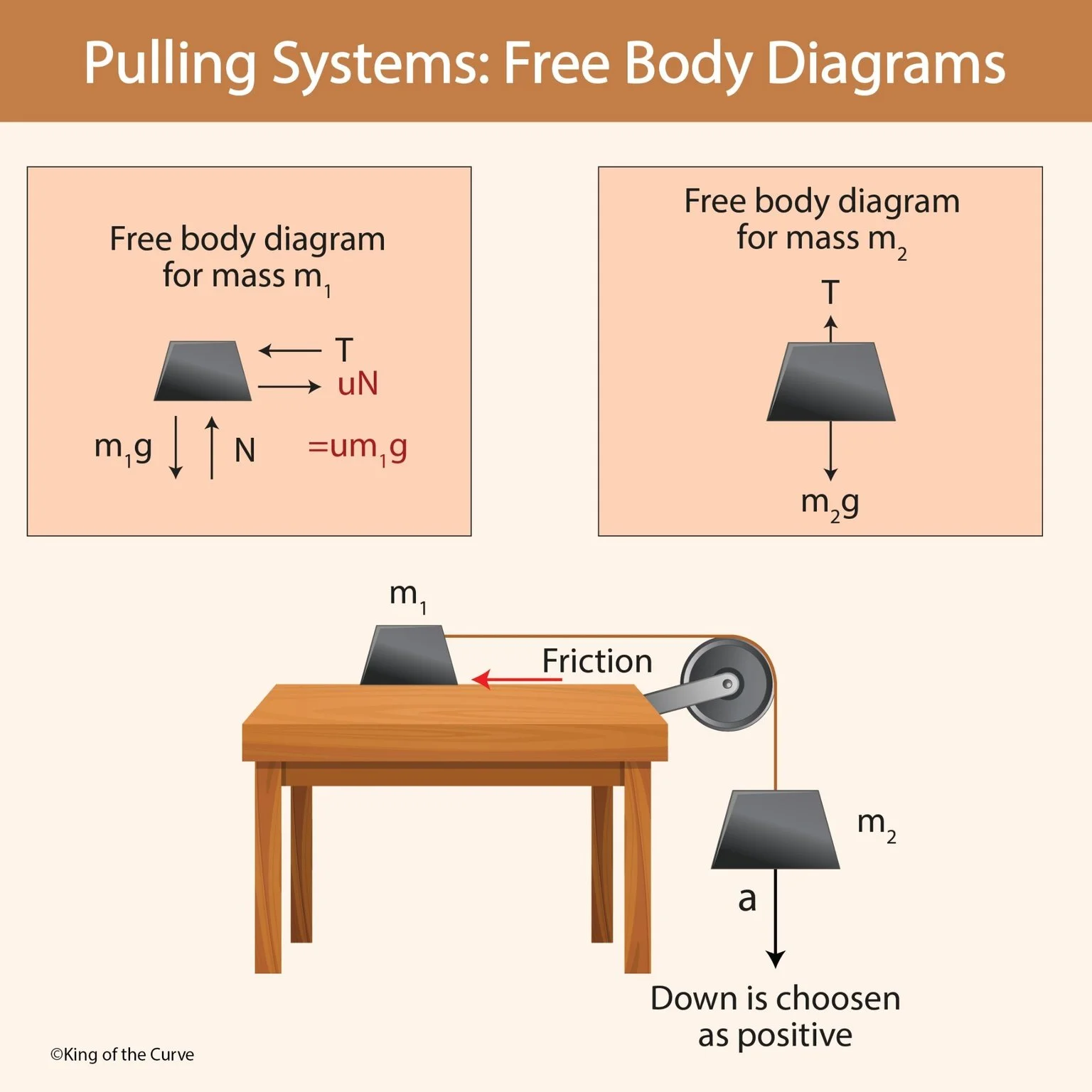
Consider a block m₁ resting on a horizontal surface and connected to a hanging block m₂. If m₂ moves downward, it pulls m₁ horizontally toward the pulley. Because the masses are connected by an ideal rope, they have the same magnitude of acceleration, while the rope transmits tension between them.
⚖️ Free-Body Diagram for m₁
The block on the table experiences several forces. Its weight m₁g acts downward, while the normal force N acts upward. Horizontally, tension T pulls the block toward the pulley while friction opposes its motion. If there is no vertical acceleration, N = m₁g.
🧱 Understanding the Friction Force
When the block is sliding, kinetic friction can be written as fₖ = μₖN. On a horizontal surface with no additional vertical forces, this becomes fₖ = μₖm₁g. Friction points opposite the block’s motion, so it reduces the net force accelerating the connected system.
🪝 Free-Body Diagram for m₂
The hanging mass has two main forces: gravity (m₂g) downward and tension (T) upward. If downward is chosen as positive and m₂ accelerates downward, Newton’s Second Law gives m₂g − T = m₂a. Choosing a consistent sign convention is essential when setting up the equations.
📊 Forces in a Pulling System
The easiest way to avoid mistakes is to analyze each mass independently before combining the equations.
| ⚙️ Component | ⬆️ / ➡️ Force | ⬇️ / ⬅️ Opposing Force | 🧮 Key Relationship |
|---|---|---|---|
| Mass m₁ | Tension, T | Friction, fₖ | T − fₖ = m₁a |
| Vertical forces on m₁ | Normal force, N | Weight, m₁g | N = m₁g |
| Mass m₂ | Weight, m₂g (chosen positive downward) |
Tension, T | m₂g − T = m₂a |
| Friction | — | Opposes motion | fₖ = μₖN |
🧮 Finding the System’s Acceleration
The two Newton’s Second Law equations can be combined to eliminate tension. For kinetic friction and downward motion of m₂, the result is a = (m₂g − μₖm₁g)/(m₁ + m₂). This equation shows that the hanging weight drives the system while friction opposes its motion.
🧠 High-Yield MCAT Strategy
MCAT pulling-system questions often test free-body diagrams, friction, tension, Newton’s Second Law, and sign conventions together. Draw each object separately, label only forces actually acting on that object, choose positive directions, and write ΣF = ma for each mass. Avoid assuming that tension equals the hanging object's weight when the system is accelerating.
🎯 Turn the Diagram Into Equations
The key is translating the picture into physics: identify forces → choose directions → write Newton’s Second Law → solve the equations together. In the KOTC visual, the hanging mass pulls the system while friction on m₁ resists the motion. Explore more high-yield MCAT physics visuals and practice at mcat.kingofthecurve.org, including KOTC’s library of 1,000+ science illustrations designed to make challenging concepts easier to understand and remember.

Frequently Asked Questions (FAQs)
-
Aim for 4-6 focused hours, ensuring you incorporate breaks to avoid burnout.
-
Practice mindfulness techniques, take practice exams under realistic conditions, and maintain a balanced lifestyle.
-
Set short-term goals, seek support from mentors, and reward yourself for small achievements.
-
Regular exercise improves focus, reduces stress, and enhances overall mental clarity.
-
KOTC offers personalized learning tools, gamification features, and adaptive question banks to help students stay on track without burnout.