
🧠 What Is the Prisoner’s Dilemma?
The Prisoner’s Dilemma is a classic concept in game theory that demonstrates how two rational individuals may fail to cooperate, even when cooperation would benefit both. It is heavily tested in MCAT psychology and sociology because it illustrates rational choice theory, strategic decision-making, and the tension between individual and group outcomes.
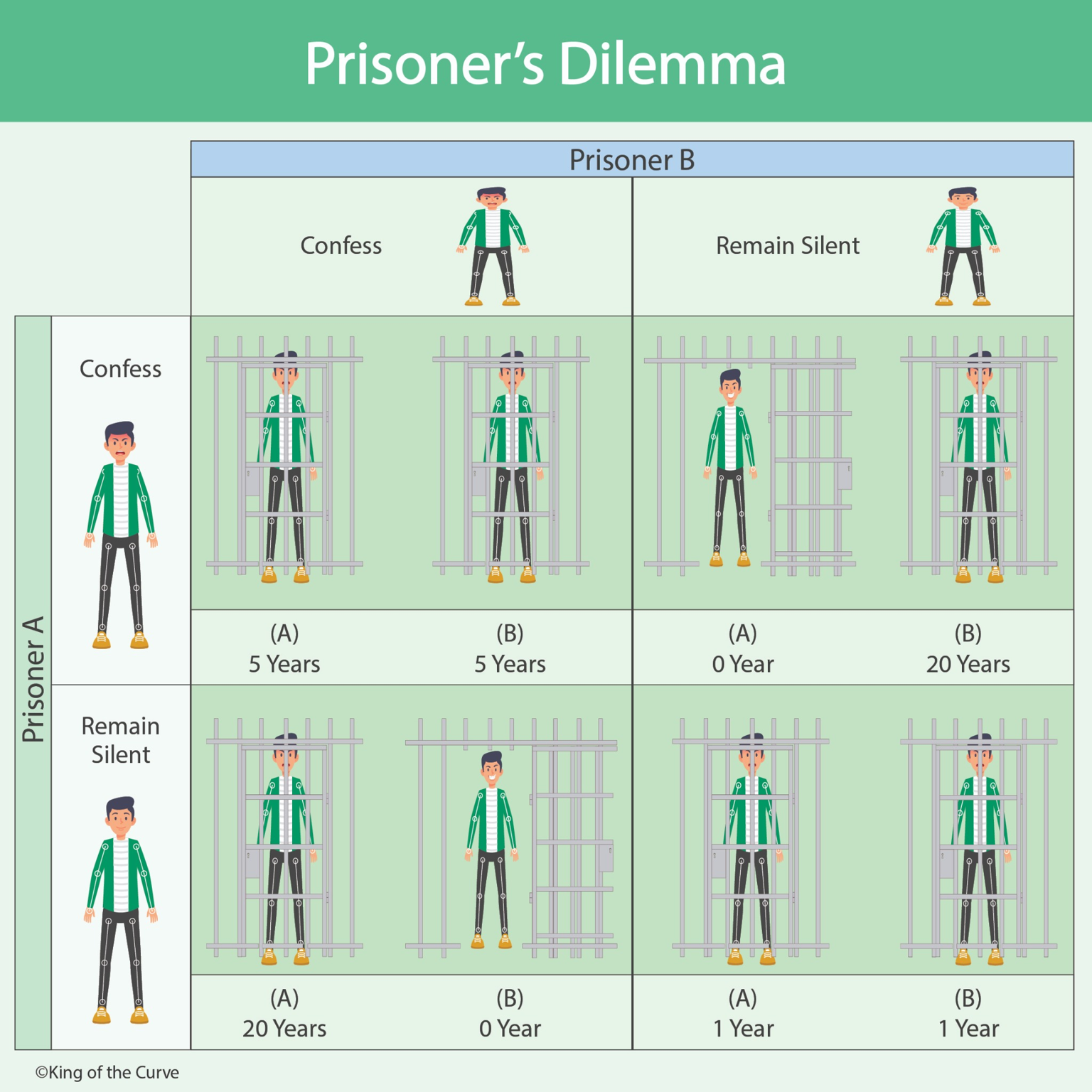
🔍 The Basic Scenario
In the traditional setup, two prisoners are arrested and questioned separately. Each prisoner has two choices: confess or remain silent. They cannot communicate with one another, and the consequences for each depend on both decisions. This creates a situation where each person must think strategically about what the other might do.
⚖️ Understanding the Choices
If both prisoners remain silent, they each receive a light sentence. If both confess, they receive a moderate sentence. However, if one confesses while the other stays silent, the confessor goes free while the silent prisoner receives a severe punishment. The outcomes are asymmetric and depend entirely on combined decisions.
📊 Payoff Matrix Explained
The structure of the dilemma is best understood through the payoff matrix below:
| Prisoner A | Prisoner B | Outcome for A | Outcome for B |
|---|---|---|---|
| Confess | Confess | 5 years | 5 years |
| Confess | Silent | 0 years | 20 years |
| Silent | Confess | 20 years | 0 years |
| Silent | Silent | 1 year | 1 year |
This table clearly shows how each decision affects both individuals.
🧩 The Dominant Strategy
A dominant strategy is a choice that leads to a better individual outcome regardless of what the other person does. In this case, confessing is dominant. If the other prisoner confesses, confessing results in 5 years instead of 20. If the other remains silent, confessing results in 0 years instead of 1. In both situations, confession appears rational.
🤝 Why Cooperation Fails
Even though both prisoners would be better off staying silent (1 year each), rational self-interest pushes them toward confession (5 years each). This demonstrates the central tension of the Prisoner’s Dilemma: individual rationality does not always lead to collective success.
📚 Why This Matters for the MCAT
The MCAT often presents this concept in applied contexts rather than naming it directly. You may see it in passages about competing businesses, international trade agreements, public health compliance, or research studies involving cooperation. Recognizing the pattern of dominant strategy versus group benefit is essential for answering these questions correctly.
🌍 Real-World Applications
The Prisoner’s Dilemma extends beyond psychology. It appears in economics, politics, environmental policy, and healthcare decision-making. Understanding this framework helps explain why groups struggle to cooperate even when mutual cooperation would produce the best outcome for everyone involved.

Frequently Asked Questions (FAQs)
-
Aim for 4-6 focused hours, ensuring you incorporate breaks to avoid burnout.
-
Practice mindfulness techniques, take practice exams under realistic conditions, and maintain a balanced lifestyle.
-
Set short-term goals, seek support from mentors, and reward yourself for small achievements.
-
Regular exercise improves focus, reduces stress, and enhances overall mental clarity.
-
KOTC offers personalized learning tools, gamification features, and adaptive question banks to help students stay on track without burnout.