
🧠 Presynaptic Regulation of Serotonin and Norepinephrine
Neurotransmitters such as serotonin (5-HT) and norepinephrine (NE) play critical roles in mood, cognition, stress response, and emotional regulation. Their activity is tightly controlled at the presynaptic neuron, where synthesis, storage, release, reuptake, and degradation are carefully regulated.
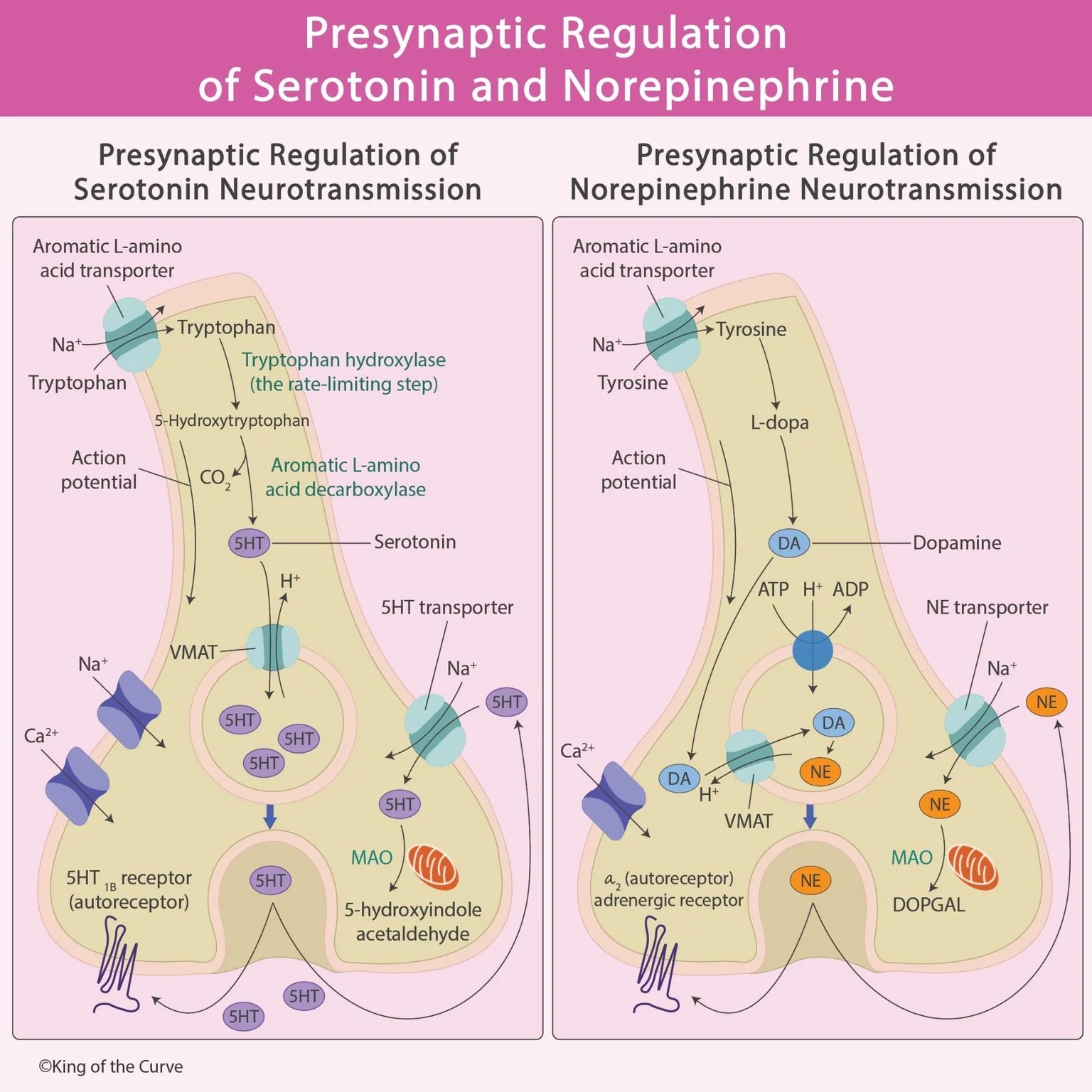
🔵 Presynaptic Regulation of Serotonin Neurotransmission
Serotonin synthesis and regulation occur through a well-defined pathway inside the presynaptic neuron.
🧪 1. Synthesis of Serotonin
Serotonin is synthesized from the amino acid tryptophan.
Step 1: Tryptophan Uptake
Tryptophan enters the neuron via the aromatic L-amino acid transporter
This process is sodium (Na⁺) dependent
Step 2: Rate-Limiting Step
Tryptophan hydroxylase converts tryptophan into 5-hydroxytryptophan (5-HTP)
This is the rate-limiting step
Step 3: Decarboxylation
Aromatic L-amino acid decarboxylase converts 5-HTP into serotonin (5-HT)
📦 2. Storage in Vesicles
Serotonin is transported into synaptic vesicles by VMAT (vesicular monoamine transporter)
Inside vesicles, serotonin is protected from enzymatic degradation
⚡ 3. Release
An action potential opens voltage-gated Ca²⁺ channels
Calcium influx triggers vesicle fusion
Serotonin is released into the synaptic cleft
🔁 4. Reuptake
Serotonin is reabsorbed by the 5-HT transporter (SERT)
This process is sodium-dependent
Reuptake is the main termination mechanism
👉 Clinical relevance: SSRIs block SERT, increasing serotonin in the synaptic cleft.
🧬 5. Autoregulation
The 5-HT₁B autoreceptor on the presynaptic neuron inhibits further serotonin release
Acts as a negative feedback mechanism
🧪 6. Metabolism
Serotonin is degraded by monoamine oxidase (MAO)
It is converted into 5-hydroxyindole acetaldehyde
🟠 Presynaptic Regulation of Norepinephrine Neurotransmission
Norepinephrine follows a similar but distinct pathway.
🧪 1. Synthesis of Norepinephrine
Norepinephrine is synthesized from tyrosine.
Step 1: Tyrosine Uptake
Tyrosine enters via aromatic L-amino acid transporter
Step 2: Conversion to L-DOPA
Tyrosine is converted into L-DOPA
Step 3: Dopamine Formation
L-DOPA is converted into dopamine (DA)
Step 4: Vesicular Conversion
Dopamine enters vesicles via VMAT
Inside vesicles, dopamine is converted into norepinephrine (NE)
⚡ 2. Release
Action potential → Ca²⁺ influx
Vesicles fuse with presynaptic membrane
Norepinephrine is released
🔁 3. Reuptake
NE is reabsorbed by the norepinephrine transporter (NET)
Sodium-dependent process
👉 Clinical relevance: SNRIs and TCAs inhibit NET, increasing norepinephrine levels.
🧬 4. Autoregulation
The α₂ adrenergic autoreceptor inhibits further NE release
Provides negative feedback control
🧪 5. Metabolism
NE is metabolized by MAO
Forms DOPGAL as an intermediate metabolite
⚖️ Key Similarities Between Serotonin and Norepinephrine Regulation
| Feature | Serotonin (5-HT) | Norepinephrine (NE) |
|---|---|---|
| Precursor | Tryptophan | Tyrosine |
| Vesicular transport | VMAT | VMAT |
| Reuptake transporter | SERT | NET |
| Autoreceptor | 5-HT₁B | α₂ |
| Degradation enzyme | MAO | MAO |
| Ca²⁺ dependent release | Yes | Yes |
💊 Clinical Importance
Presynaptic regulation explains how:
SSRIs increase serotonin
SNRIs increase serotonin and norepinephrine
MAO inhibitors prevent neurotransmitter breakdown
TCAs block reuptake transporters
Dysregulation of these pathways contributes to:
Depression
Anxiety disorders
ADHD
PTSD
Bipolar disorder
🧠 Final Thoughts
Presynaptic regulation of serotonin and norepinephrine is a tightly controlled process involving:
Synthesis
Vesicular storage
Calcium-dependent release
Reuptake
Autoreceptor feedback
Enzymatic degradation
Understanding these mechanisms is essential for grasping how antidepressants and other psychotropic medications work.

Frequently Asked Questions (FAQs)
-
Aim for 4-6 focused hours, ensuring you incorporate breaks to avoid burnout.
-
Practice mindfulness techniques, take practice exams under realistic conditions, and maintain a balanced lifestyle.
-
Set short-term goals, seek support from mentors, and reward yourself for small achievements.
-
Regular exercise improves focus, reduces stress, and enhances overall mental clarity.
-
KOTC offers personalized learning tools, gamification features, and adaptive question banks to help students stay on track without burnout.