
🔒 Prisoner’s Dilemma: Understanding Strategic Decision-Making
The Prisoner’s Dilemma is one of the most famous examples in game theory. It illustrates how two rational individuals may choose options that lead to worse outcomes for both, even when cooperation would have been mutually beneficial.
🎭 What Is the Prisoner’s Dilemma?
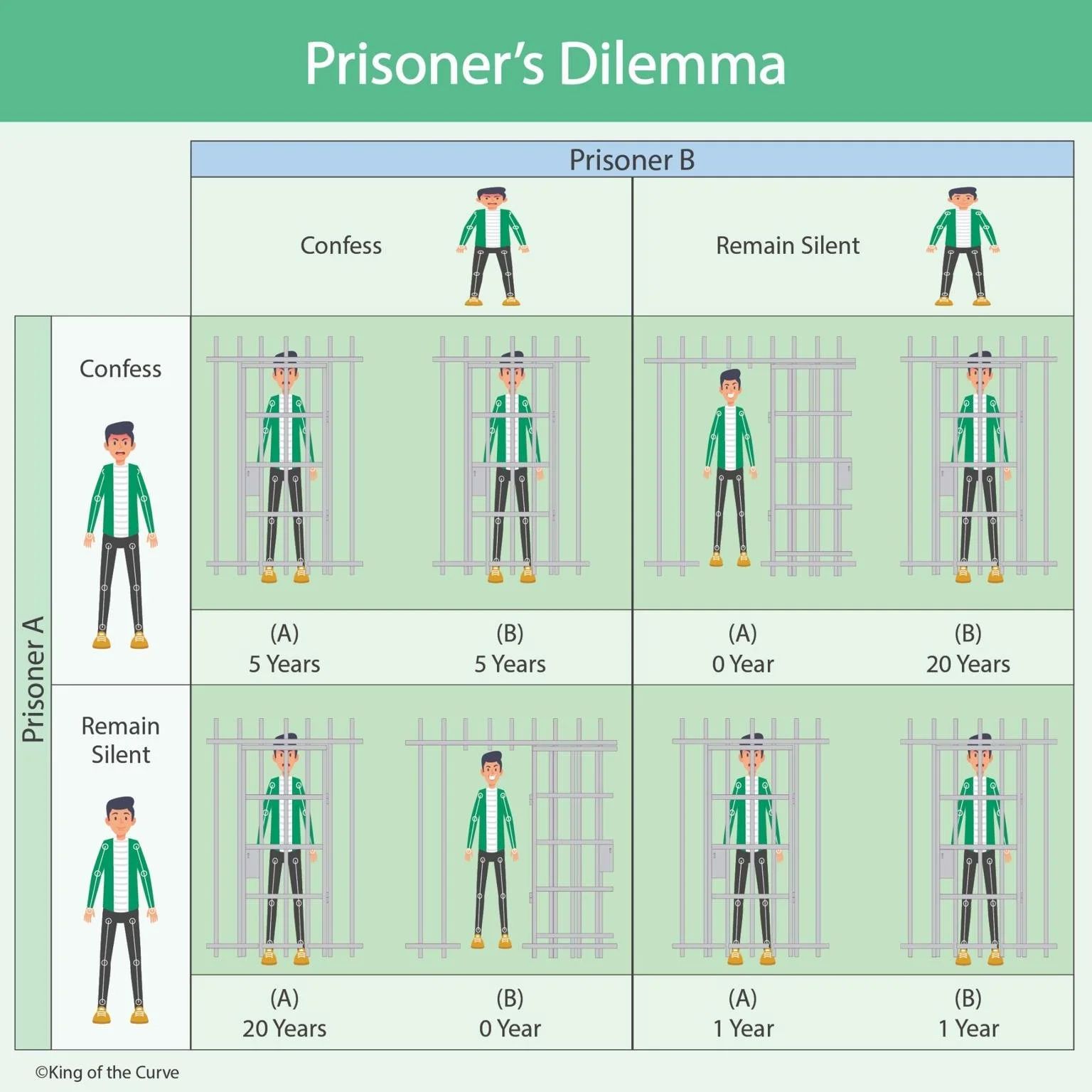
Two prisoners are held in separate rooms and given a choice:
Confess to the crime
Remain silent
Their sentences depend on both choices combined—not individually. This creates tension between self-interest and collective good.
⚖️ Outcome Scenarios
Every possible outcome is determined by the decisions made by both prisoners:
📊 Prisoner’s Dilemma Outcome Table
| Prisoner A Choice | Prisoner B Choice | Outcome for A | Outcome for B |
|---|---|---|---|
| Confess | Confess | 5 Years | 5 Years |
| Confess | Remain Silent | 0 Years | 20 Years |
| Remain Silent | Confess | 20 Years | 0 Years |
| Remain Silent | Remain Silent | 1 Year | 1 Year |
🧠 Why Confessing Becomes the Dominant Strategy
When each prisoner evaluates their options independently:
If the other confesses, the safest choice is to confess.
If the other remains silent, the best personal gain is—again—to confess.
Thus, confessing is the dominant strategy even though mutual silence gives the best joint outcome (only 1 year each).
This reveals a powerful insight:
Rational self-interest can lead to irrational group outcomes.
🌍 Real-Life Applications of the Prisoner’s Dilemma
💼 Business & Pricing Wars
Companies lowering prices try to gain advantage, but cause overall profit loss.
🌱 Environmental Agreements
Countries benefit when others reduce emissions but hesitate to do so themselves.
👥 Everyday Social Situations
Teamwork, trust, sharing resources—many real-life interactions reflect the dilemma.
⭐ Final Takeaway
The Prisoner’s Dilemma teaches us that:
Cooperation yields better collective outcomes
Lack of trust pushes individuals toward self-serving but harmful decisions
Repeated interactions and communication can encourage cooperation

Frequently Asked Questions (FAQs)
-
Aim for 4-6 focused hours, ensuring you incorporate breaks to avoid burnout.
-
Practice mindfulness techniques, take practice exams under realistic conditions, and maintain a balanced lifestyle.
-
Set short-term goals, seek support from mentors, and reward yourself for small achievements.
-
Regular exercise improves focus, reduces stress, and enhances overall mental clarity.
-
KOTC offers personalized learning tools, gamification features, and adaptive question banks to help students stay on track without burnout.