
✅ Understanding Potential Energy of a Point Charge
Electric charges interact with each other through electrostatic forces. These interactions don’t just affect motion they also affect potential energy, which tells us how much stored energy exists due to the position of charges.
In physics, understanding potential energy helps explain why charges repel, attract, and how much work is required to move them closer or farther apart.
✅ What Is Electric Potential Energy?
Electric potential energy (U) is the stored energy between two charges due to their separation.
It depends on:
The magnitude of the charges (q₁ and q₂)
The distance between them (r)
Whether the charges are like (+/+ or -/-) or opposite (+/-)
The equation is:
U=kq1q2\r
Where:
k is Coulomb’s constant
q₁ and q₂ are the charges
r is the separation distance
✅ How Distance Affects Potential Energy
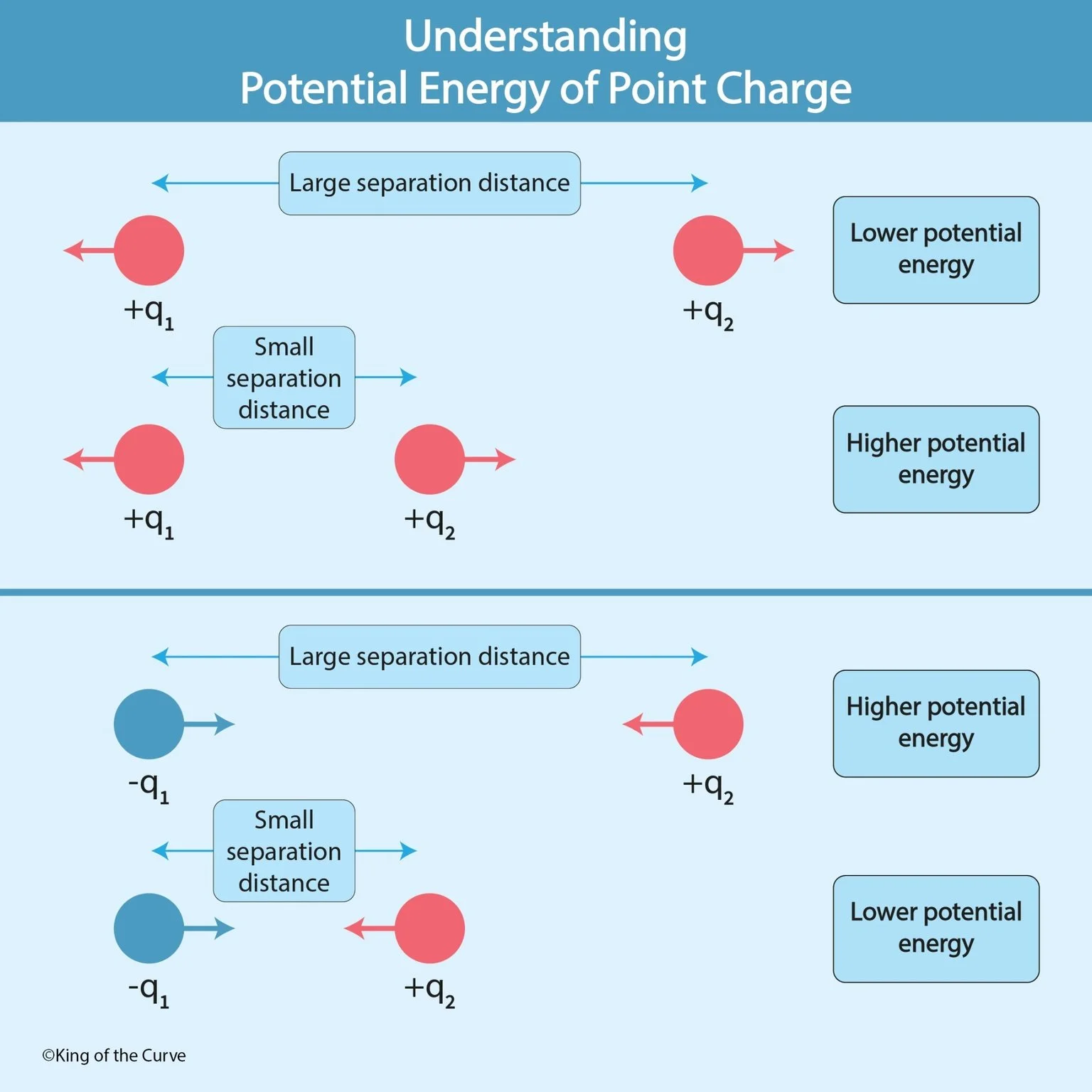
1) Like Charges (+/+ or -/-): Repulsion
When charges have the same sign, they push away from each other.
Large separation → Lower potential energy
Small separation → Higher potential energy
✅ Reason: Bringing like charges closer requires external work, increasing stored energy.
2) Opposite Charges (+/-): Attraction
When charges have opposite signs, they pull toward each other.
Large separation → Higher potential energy
Small separation → Lower potential energy
✅ Reason: Charges naturally attract and release energy as they come closer.
✅ Comparison Table (Like vs Opposite Charges)
| Feature | Like Charges (+/+ or -/-) | Opposite Charges (+/-) |
|---|---|---|
| Interaction | Repel each other | Attract each other |
| Force Direction | Push away | Pull toward |
| Large distance (r ↑) | Potential energy ↓ (lower) | Potential energy ↑ (higher) |
| Small distance (r ↓) | Potential energy ↑ (higher) | Potential energy ↓ (lower) |
| Stability | More stable when far apart | More stable when close together |
| Energy change when charges move closer | Energy increases (requires work) | Energy decreases (releases energy) |
✅ Key Concept to Remember
📌 Potential energy depends on both sign and distance:
Like charges store more energy when close
Opposite charges store less energy when close
This explains why:
Like charges tend to move apart (seeking lower energy)
Opposite charges move together (seeking lower energy)
✅ Final Takeaway
Electric potential energy represents how strongly charges interact based on their position.
The closer two charges are, the more extreme the potential energy becomes but whether it is high or low depends on whether the charges repel or attract.

Frequently Asked Questions (FAQs)
-
Aim for 4-6 focused hours, ensuring you incorporate breaks to avoid burnout.
-
Practice mindfulness techniques, take practice exams under realistic conditions, and maintain a balanced lifestyle.
-
Set short-term goals, seek support from mentors, and reward yourself for small achievements.
-
Regular exercise improves focus, reduces stress, and enhances overall mental clarity.
-
KOTC offers personalized learning tools, gamification features, and adaptive question banks to help students stay on track without burnout.