
⚡ Potential Energy Between Point Charges
Electric potential energy describes the energy stored between charged particles because of their positions relative to one another. Just as gravity creates potential energy between masses, electric charges store energy within an electric field. The amount of potential energy depends on the magnitude of the charges, the distance between them, and whether the charges are like or opposite. Understanding this relationship is fundamental for mastering electrostatics and is a high-yield concept for the MCAT.
🔋 What Is Electric Potential Energy?
Electric potential energy is the work required to bring two point charges from an infinite distance apart to a specific separation. It is represented by the equation:
U = kq1q2 / r
where U is electric potential energy, k is Coulomb's constant, q₁ and q₂ are the charges, and r is the distance between them. The sign of the energy depends on whether the charges are alike or opposite.
➕ Like Charges: Positive Potential Energy
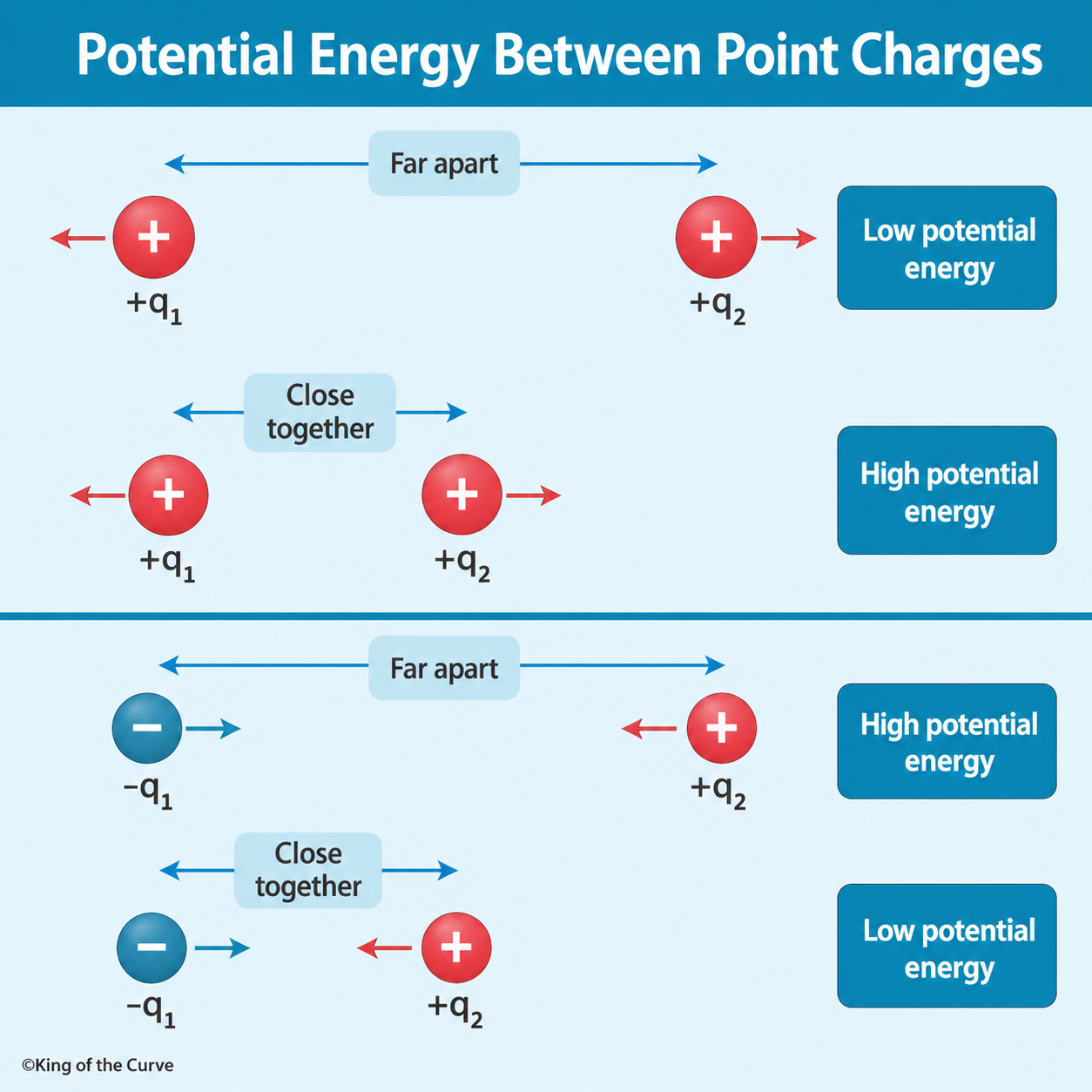
When two like charges (positive-positive or negative-negative) are near one another, they repel. Bringing them closer together requires external work against the repulsive electric force. As a result, the system stores more energy, causing the electric potential energy to increase. Therefore, like charges have low potential energy when far apart and high potential energy when close together.
➖ Opposite Charges: Negative Potential Energy
Opposite charges naturally attract one another. As they move closer together, the electric field performs work, releasing energy rather than storing it. Consequently, the system becomes more stable and the potential energy decreases. Thus, opposite charges have high potential energy when far apart and low potential energy when close together.
📏 Why Distance Matters
Distance plays a major role in determining electric potential energy because it appears in the denominator of the equation. As the separation distance r decreases, the magnitude of the potential energy increases. For like charges, the energy becomes increasingly positive, while for opposite charges, it becomes increasingly negative. Small changes in distance can therefore produce significant changes in stored energy.
⚖️ Comparing Like and Opposite Charges
The behavior of electric potential energy differs dramatically depending on the type of charges involved. Like charges resist being pushed together because they repel, while opposite charges naturally move together because they attract. These opposite behaviors explain why one configuration stores energy and the other releases energy as distance changes.
| Charge Combination | Far Apart | Close Together | Force |
|---|---|---|---|
| Positive & Positive | Low potential energy | High potential energy | Repulsive |
| Negative & Negative | Low potential energy | High potential energy | Repulsive |
| Positive & Negative | High potential energy | Low potential energy | Attractive |
🧪 Real-World Applications
Electric potential energy is important in many areas of science and engineering. It explains how ions interact in biological systems, how batteries store and release electrical energy, how electrons behave in atoms, and how electrostatic forces influence molecular structure. These principles are also essential for understanding capacitors, electric circuits, and chemical bonding.
🎯 MCAT Takeaways
For the MCAT, remember the simple rule: like charges repel and gain potential energy as they move closer together, while opposite charges attract and lose potential energy as they approach each other. Always relate the sign of the potential energy to the type of charges involved and remember that the magnitude of potential energy increases as the distance between charges decreases. Mastering these relationships makes solving electrostatics problems much easier and strengthens your understanding of electric fields and Coulomb's law.

Frequently Asked Questions (FAQs)
-
Aim for 4-6 focused hours, ensuring you incorporate breaks to avoid burnout.
-
Practice mindfulness techniques, take practice exams under realistic conditions, and maintain a balanced lifestyle.
-
Set short-term goals, seek support from mentors, and reward yourself for small achievements.
-
Regular exercise improves focus, reduces stress, and enhances overall mental clarity.
-
KOTC offers personalized learning tools, gamification features, and adaptive question banks to help students stay on track without burnout.