
🩸 Understanding Platelet Structure and Function in Hemostasis
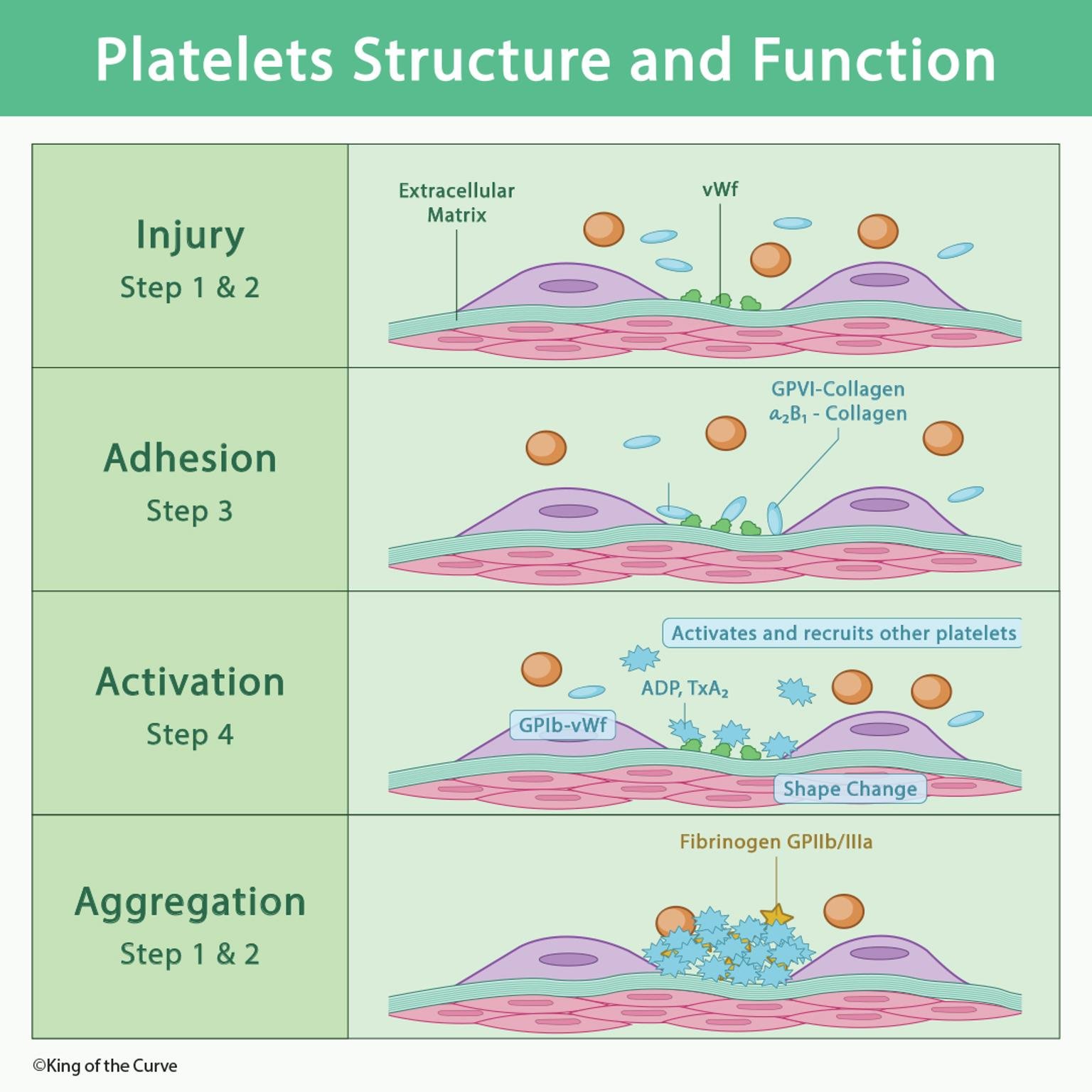
Platelets are essential for preventing blood loss and maintaining vascular stability. These small, disk-shaped cell fragments circulate in an inactive state until they encounter vascular injury. Once activated, they rapidly participate in a series of interconnected steps—injury recognition, adhesion, activation, and aggregation—that form the foundation of primary hemostasis.
🔍 Step 1 & 2: Injury – Initial Trigger
Injury to the blood vessel exposes underlying collagen and triggers the release of von Willebrand factor (vWF). Both collagen and vWF act as crucial signals that alert circulating platelets to the site of damage. This exposure marks the beginning of the hemostatic response.
🧲 Step 3: Adhesion – Platelets Attach to the Damage
Platelets bind to the exposed collagen and vWF using specialized adhesion receptors such as GPIb, GPVI, and α₂β₁ integrins. This essential anchoring step positions platelets so they can undergo activation and strengthen the response.
⚡ Step 4: Activation – Shape Change & Chemical Release
Once adhered, platelets become activated. They change shape, extend pseudopods, and release chemical signals including ADP and Thromboxane A₂ (TxA₂). These substances amplify the response by attracting and activating additional platelets.
🔗 Step 1 & 2 Again: Aggregation – Building the Platelet Plug
Activated platelets cross-link using fibrinogen and the GPIIb/IIIa receptor, forming a strong platelet plug. This plug is essential for stabilizing the injury and preventing further blood loss.
📘 Additional Insight: Clinical Relevance
Platelet function is not only vital for normal clotting but also central to understanding bleeding disorders and cardiovascular disease. Disorders such as von Willebrand disease, Bernard-Soulier syndrome, and Glanzmann thrombasthenia stem from defects in specific platelet receptors. Additionally, antiplatelet medications—like aspirin and clopidogrel—target these pathways to prevent heart attacks and strokes.
📊 Key Platelet Receptors and Their Functions
Below is a concise table summarizing the most important platelet receptors involved in hemostasis:
| Receptor | Ligand | Function |
|---|---|---|
| GPIb | vWF | Mediates initial adhesion to damaged vessel walls via von Willebrand factor. |
| GPVI | Collagen | Triggers platelet activation when collagen is exposed. |
| α₂β₁ Integrin | Collagen | Stabilizes firm platelet adhesion to collagen fibers. |
| GPIIb/IIIa | Fibrinogen | Enables platelet aggregation by cross-linking platelets through fibrinogen. |
🚀 Takeaway & Call to Action
Understanding platelet function not only clarifies how the body prevents bleeding but also enhances clinical reasoning for diagnosing clotting disorders and prescribing antiplatelet medications. Whether you’re a student, clinician, or educator, mastering these pathways is essential.

Frequently Asked Questions (FAQs)
-
Aim for 4-6 focused hours, ensuring you incorporate breaks to avoid burnout.
-
Practice mindfulness techniques, take practice exams under realistic conditions, and maintain a balanced lifestyle.
-
Set short-term goals, seek support from mentors, and reward yourself for small achievements.
-
Regular exercise improves focus, reduces stress, and enhances overall mental clarity.
-
KOTC offers personalized learning tools, gamification features, and adaptive question banks to help students stay on track without burnout.