
🔥 Phases of the Carnot Cycle: Understanding the Ideal Heat Engine
The Carnot cycle is an idealized thermodynamic cycle that describes the most efficient way a heat engine can convert heat into useful work. Developed by the French physicist Sadi Carnot, this model establishes the theoretical upper limit for the efficiency of any engine operating between a hot and a cold reservoir. Although no real engine can perfectly achieve the Carnot cycle due to friction and energy losses, it remains one of the most important concepts in thermodynamics and is frequently tested on the MCAT.
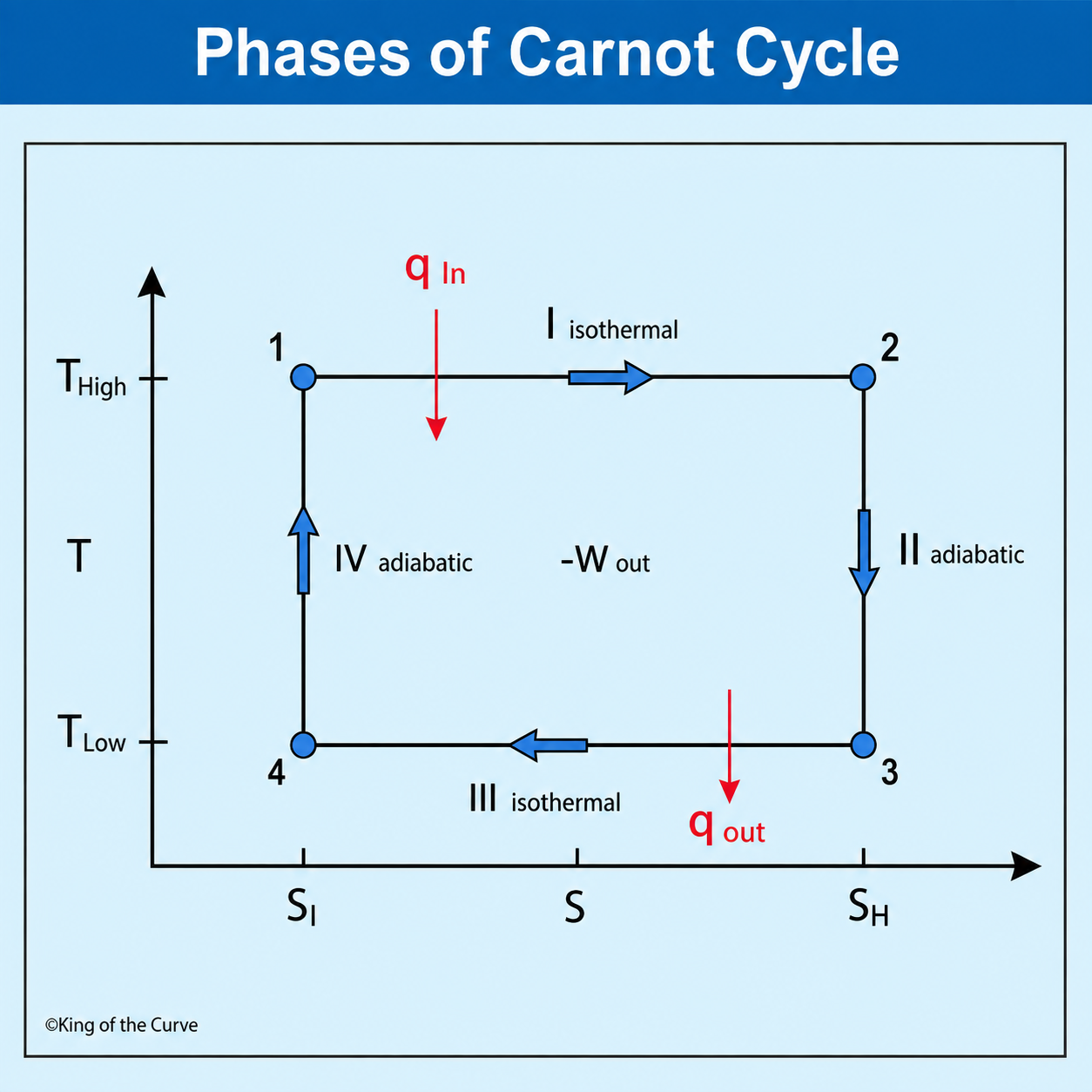
🌡️ Phase I: Isothermal Expansion
The cycle begins with the working gas in contact with a hot reservoir (Tₕ). During this stage, the gas absorbs heat (qₙ) while maintaining a constant temperature. As heat enters the system, the gas expands and pushes the piston outward, performing work on its surroundings.
Since the temperature remains constant throughout this process, all the absorbed heat contributes to expansion rather than increasing the internal energy of the gas. This is known as isothermal expansion, and it represents the primary stage where energy enters the engine.
❄️ Phase II: Adiabatic Expansion
After leaving the hot reservoir, the gas becomes completely insulated from its surroundings. Because no heat enters or leaves the system, the gas continues expanding using its own internal energy. As a result, its temperature gradually decreases from the hot reservoir temperature (Tₕ) to the cold reservoir temperature (Tₗ).
This process is called adiabatic expansion. Although heat transfer is zero, the gas continues doing work, causing both pressure and temperature to fall. This prepares the working substance for heat rejection in the next phase.
♨️ Phase III: Isothermal Compression
The expanded gas is then placed in contact with the cold reservoir (Tₗ). External work compresses the gas while keeping its temperature constant. During compression, the gas releases heat (qₒᵤₜ) to the cold reservoir, allowing it to remain at the same temperature despite decreasing in volume.
This stage is called isothermal compression. The rejected heat represents energy that cannot be converted into useful work. By the end of this phase, the gas has a much smaller volume and is ready for the final stage of the cycle.
🔄 Phase IV: Adiabatic Compression
The final phase occurs with the gas once again thermally insulated. As compression continues, no heat is exchanged with the surroundings. Instead, the work done on the gas increases its internal energy, causing its temperature to rise from Tₗ back to Tₕ.
This process is known as adiabatic compression. Once the gas returns to its original temperature and pressure, the Carnot cycle is complete and can begin again. Because every step is reversible, the cycle achieves the maximum theoretical efficiency.
📊 Carnot Efficiency
One of the most important features of the Carnot cycle is that its efficiency depends only on the temperatures of the hot and cold reservoirs. It does not depend on the type of gas or the design of the engine. This makes the Carnot engine the benchmark against which all real heat engines are compared.
The efficiency is calculated using the equation:
η = 1 − (Tₗ / Tₕ)
where η is efficiency, Tₕ is the hot reservoir temperature, and Tₗ is the cold reservoir temperature. Both temperatures must always be measured in Kelvin.
📋 Summary Table
| Phase | Process | Heat Transfer | Temperature | Volume Change | Key Event |
|---|---|---|---|---|---|
| 1 → 2 | Isothermal Expansion | Heat absorbed (qin) | Constant (TH) | Increases | Gas expands and performs work. |
| 2 → 3 | Adiabatic Expansion | No heat transfer | Decreases | Increases | Gas cools while continuing to expand. |
| 3 → 4 | Isothermal Compression | Heat released (qout) | Constant (TL) | Decreases | Gas rejects heat to the cold reservoir. |
| 4 → 1 | Adiabatic Compression | No heat transfer | Increases | Decreases | Gas returns to its original state. |
| Overall Efficiency | Carnot Engine | Depends only on reservoir temperatures | — | — |
η = 1 −
(TL / TH)
Temperatures must be measured in Kelvin. |
⚙️ Applications and Importance
Although no real engine can reach Carnot efficiency, the Carnot cycle provides a valuable theoretical model for understanding energy conversion. Engineers use it to improve the design of power plants, automobile engines, gas turbines, refrigerators, air conditioners, and heat pumps. It also demonstrates why some energy must always be lost as waste heat.
For MCAT students, the Carnot cycle is a high-yield topic because it connects concepts such as heat transfer, work, entropy, reversible processes, and thermodynamic efficiency. Understanding the relationship between these concepts helps solve both conceptual and calculation-based questions.
🎯 Key Takeaways
The Carnot cycle consists of two isothermal and two adiabatic processes that together form the most efficient theoretical heat engine. Heat is absorbed during isothermal expansion, rejected during isothermal compression, and conserved during the adiabatic stages. The area enclosed by the cycle represents the net work produced, while the efficiency depends only on the temperatures of the two reservoirs.
Mastering the Carnot cycle provides a strong foundation for thermodynamics and energy conversion. Whether studying physics, engineering, or preparing for the MCAT, understanding these four phases and their role in heat engines is essential.

Frequently Asked Questions (FAQs)
-
Aim for 4-6 focused hours, ensuring you incorporate breaks to avoid burnout.
-
Practice mindfulness techniques, take practice exams under realistic conditions, and maintain a balanced lifestyle.
-
Set short-term goals, seek support from mentors, and reward yourself for small achievements.
-
Regular exercise improves focus, reduces stress, and enhances overall mental clarity.
-
KOTC offers personalized learning tools, gamification features, and adaptive question banks to help students stay on track without burnout.