
🌊 Pascal’s Principle: Fluid Pressure and Force Multiplication
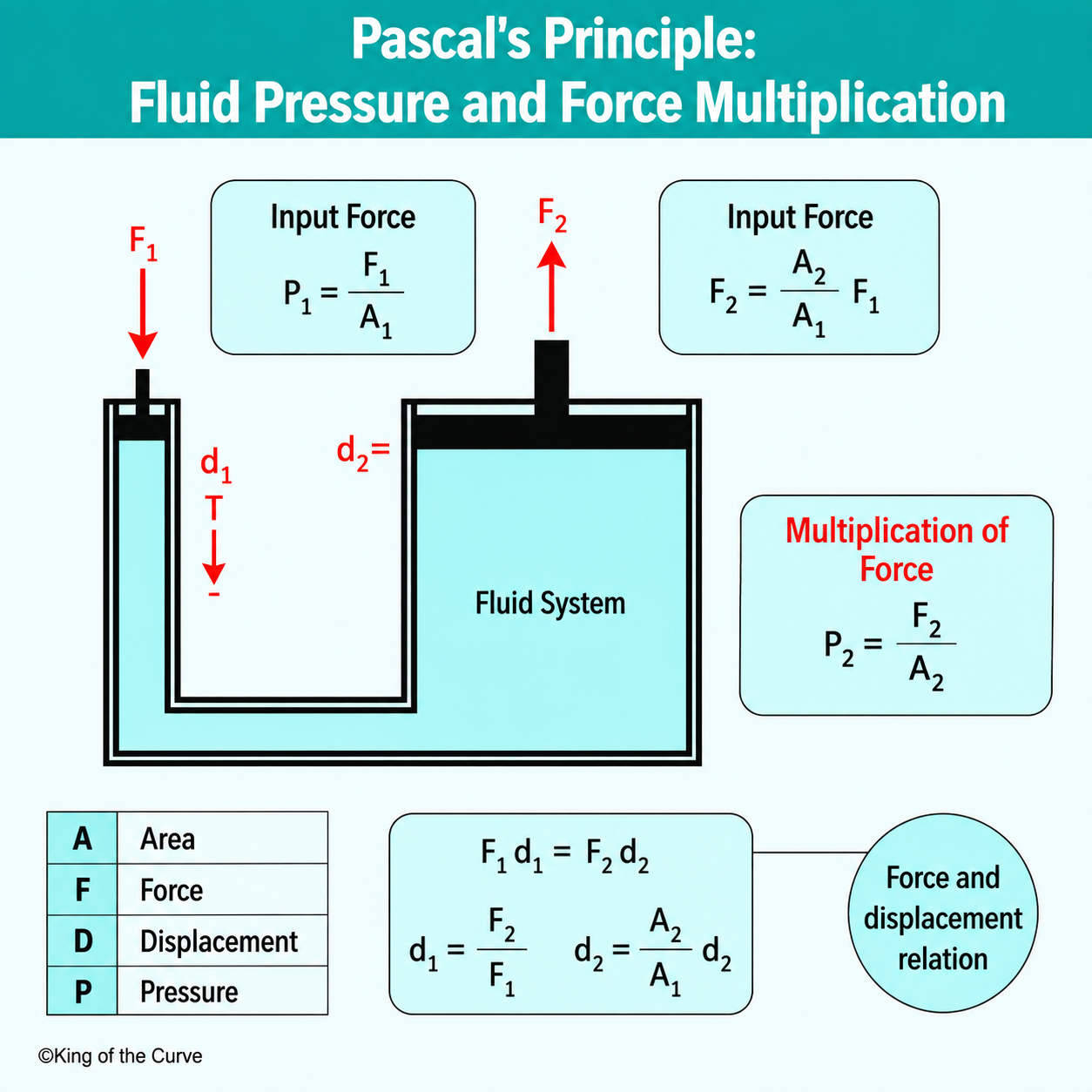
Pascal’s Principle is one of the most important concepts in fluid mechanics and frequently appears on the MCAT. It states that pressure applied to an enclosed fluid is transmitted equally throughout the fluid, allowing a small input force to generate a much larger output force. This principle explains how hydraulic systems work and serves as the foundation for many engineering and medical devices. The King of the Curve infographic visually demonstrates how pressure, force, area, and displacement are related, making this high-yield physics topic much easier to understand.
⚙️ What Is Pascal’s Principle?
Pascal’s Principle states that when pressure is applied to a confined, incompressible fluid, the pressure is transmitted equally in every direction. Because pressure remains constant throughout the fluid, a force applied to a smaller piston can produce a much larger force on a larger piston. This allows hydraulic systems to multiply force without violating the conservation of energy. The pressure relationship is expressed as:
P = F / A
where P is pressure, F is force, and A is the surface area over which the force is applied.
💪 How Hydraulic Force Multiplication Works
Hydraulic systems use two pistons with different surface areas connected by an enclosed fluid. A small force (F₁) applied to the smaller piston creates pressure that is transmitted throughout the fluid. Since the pressure is equal at both pistons, the larger piston produces a greater output force (F₂) according to the equation:
F₂ = (A₂ / A₁) × F₁
As the output piston has a larger surface area, the resulting force is amplified. This simple relationship allows hydraulic lifts, brakes, and heavy machinery to lift massive loads with relatively little input effort.
📏 The Relationship Between Force and Displacement
Although hydraulic systems multiply force, they do not create energy. According to the principle of conservation of energy, the work done on one piston equals the work done by the other. This relationship is expressed as:
F₁d₁ = F₂d₂
where d₁ and d₂ represent piston displacement. If the output force increases, the output piston moves a shorter distance. In other words, hydraulic systems trade distance for force, ensuring that total mechanical work remains constant.
📋 Key Equations at a Glance
| Equation | Meaning | Application |
|---|---|---|
| P = F / A | Pressure equals force divided by area. | Calculates pressure within a hydraulic system. |
| F2 = (A2 / A1) × F1 | Output force depends on the ratio of the piston areas. | Determines hydraulic force multiplication. |
| P1 = P2 | Pressure is transmitted equally throughout the enclosed fluid. | Represents the core concept of Pascal’s Principle. |
| F1d1 = F2d2 | Mechanical work is conserved. | Explains the inverse relationship between force and piston displacement. |
🏥 Real-World and Medical Applications
Pascal’s Principle is widely used in both engineering and medicine. Hydraulic lifts, automobile braking systems, hydraulic jacks, dental chairs, hospital beds, and surgical operating tables all rely on hydraulic pressure to produce large forces with minimal effort. In healthcare, hydraulic mechanisms allow clinicians to adjust heavy medical equipment smoothly and safely while minimizing the physical effort required.
📚 Why This Topic Is High-Yield for the MCAT
The MCAT commonly combines Pascal’s Principle with fluids, pressure, work, energy, and mechanical advantage. Students may be asked to calculate the output force after changing piston area or determine how displacement changes when force increases. Remember these key concepts: pressure is transmitted equally through an enclosed fluid, larger piston area produces greater force, and force multiplication always comes at the expense of displacement. Understanding these relationships allows you to solve hydraulic system problems quickly during the exam.
🎯 Key Takeaway
Pascal’s Principle explains how pressure applied to an enclosed fluid is transmitted equally throughout the system, allowing hydraulic devices to multiply force efficiently. A larger output piston produces greater force because pressure remains constant, while the smaller piston travels a greater distance to conserve energy. By mastering the relationships between pressure, force, area, and displacement, you'll be well prepared for MCAT questions involving fluid mechanics, hydraulic systems, and mechanical work.

Frequently Asked Questions (FAQs)
-
Aim for 4-6 focused hours, ensuring you incorporate breaks to avoid burnout.
-
Practice mindfulness techniques, take practice exams under realistic conditions, and maintain a balanced lifestyle.
-
Set short-term goals, seek support from mentors, and reward yourself for small achievements.
-
Regular exercise improves focus, reduces stress, and enhances overall mental clarity.
-
KOTC offers personalized learning tools, gamification features, and adaptive question banks to help students stay on track without burnout.