
⚡ Parallel Plate Capacitors: A High-Yield MCAT Physics Guide
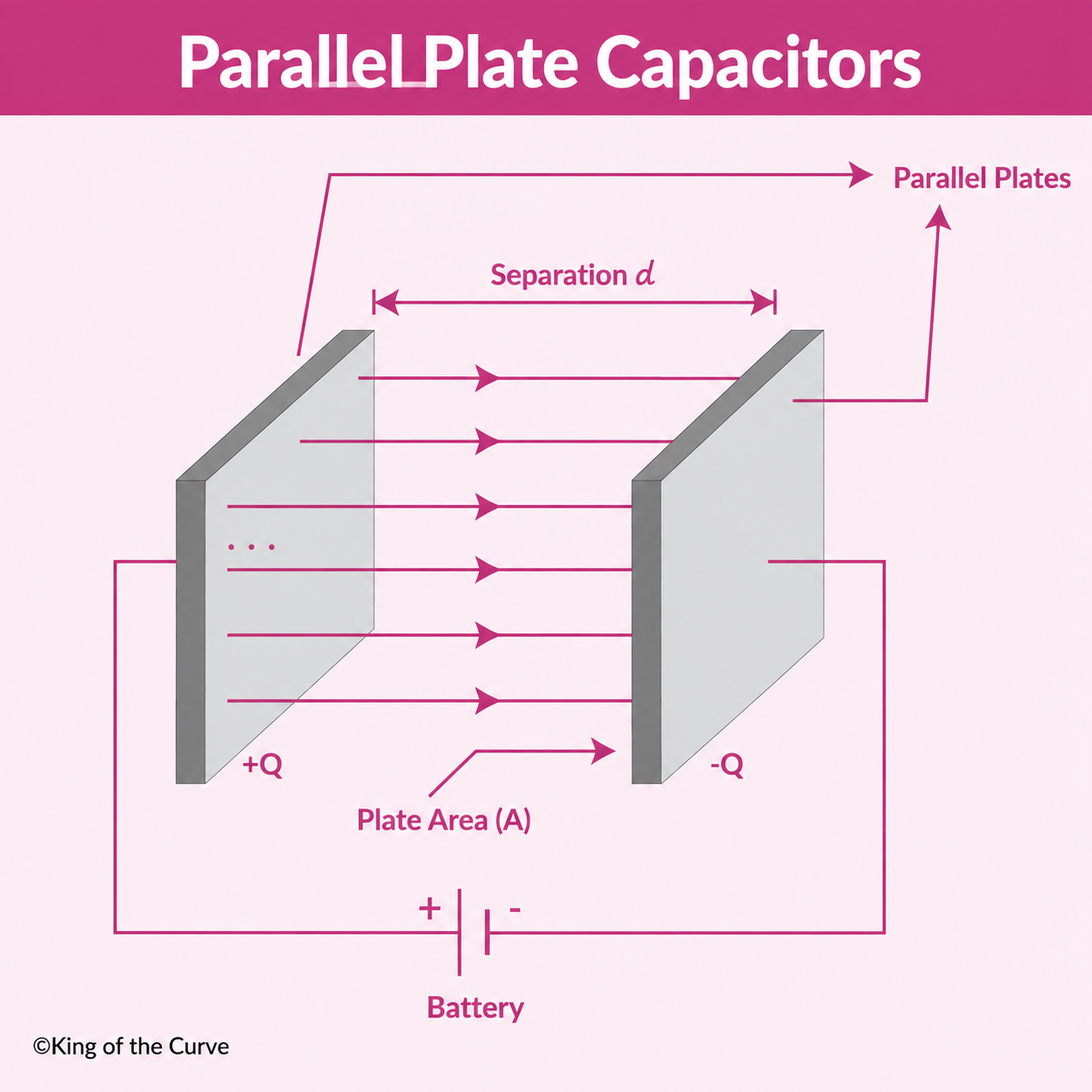
Parallel plate capacitors are one of the most fundamental topics in electrostatics and are frequently tested on the MCAT. These devices store electrical energy by separating equal and opposite charges on two conductive plates. Although the concept appears simple, understanding how plate area, plate separation, electric field, voltage, and capacitance interact is essential for solving physics problems quickly. The King of the Curve infographic provides a clear visual representation of the structure and function of a parallel plate capacitor, making this important concept easier to understand and remember.
🧲 What Is a Parallel Plate Capacitor?
A parallel plate capacitor consists of two large conducting plates separated by a small distance and connected to a voltage source such as a battery. When the battery is connected, electrons accumulate on one plate, giving it a negative charge (-Q), while electrons leave the opposite plate, creating an equal positive charge (+Q). This separation of charge establishes a uniform electric field between the plates, allowing the capacitor to store electrical potential energy until the circuit changes.
📏 How Plate Area and Separation Affect Capacitance
The capacitance of a parallel plate capacitor depends primarily on two physical characteristics: plate area (A) and plate separation (d). Increasing the surface area of the plates allows more charge to be stored, resulting in a higher capacitance. In contrast, increasing the distance between the plates weakens the electric interaction between them and decreases capacitance. This relationship is summarized by the equation:
C = εA / d
where C is capacitance, ε is the permittivity of the material between the plates, A is the plate area, and d is the separation between the plates.
⚡ The Role of the Electric Field
The electric field inside a parallel plate capacitor is nearly uniform, with field lines directed from the positively charged plate toward the negatively charged plate. This uniform field is one reason parallel plate capacitors are commonly used in both laboratory experiments and MCAT physics questions. The battery maintains a constant voltage across the plates, while the capacitor stores energy in the electric field formed between them. Once disconnected from the battery, the stored charge remains until a conducting path allows it to discharge.
📋 Key Relationships at a Glance
| Property | Effect on Capacitance | Explanation |
|---|---|---|
| Plate Area (A) | Increases capacitance ↑ | Larger plates can store more charge. |
| Plate Separation (d) | Decreases capacitance ↓ | Greater distance between the plates reduces capacitance. |
| Dielectric Material | Increases capacitance ↑ | A dielectric increases the permittivity between the plates. |
| Battery Voltage | Does not change capacitance | Voltage changes the stored charge, but capacitance depends on geometry and dielectric material. |
🧠 Clinical and Real-World Applications
Although capacitors are primarily discussed in physics, they play an important role in medical technology and biomedical engineering. Devices such as defibrillators use capacitors to rapidly store and release electrical energy during life-saving cardiac procedures. Capacitors are also found in imaging equipment, monitoring devices, pacemakers, and numerous electronic circuits used in healthcare. Understanding capacitor behavior provides valuable insight into how electrical energy is safely stored and delivered in medical settings.
📚 Why This Topic Is High-Yield for the MCAT
The MCAT frequently combines capacitor concepts with electrostatics, electric fields, circuits, and energy storage. Students may be asked how changing the plate area, plate separation, or dielectric material affects capacitance, stored energy, or electric field strength. Memorizing the equation C = εA/d and understanding the physical meaning behind each variable will allow you to solve many capacitor problems without relying solely on memorization. Visualizing charge distribution and electric field direction can also help eliminate incorrect answer choices during the exam.
🎯 Key Takeaway
Parallel plate capacitors store electrical energy by separating equal and opposite charges on two conductive plates. Capacitance increases with larger plate area and higher permittivity, but decreases as the distance between the plates increases. The electric field between the plates remains nearly uniform, making this system one of the most important models in electrostatics. By understanding the relationship between plate area, separation, voltage, and capacitance, you'll be well prepared for capacitor questions on the MCAT and develop a stronger foundation in electricity and circuits.

Frequently Asked Questions (FAQs)
-
Aim for 4-6 focused hours, ensuring you incorporate breaks to avoid burnout.
-
Practice mindfulness techniques, take practice exams under realistic conditions, and maintain a balanced lifestyle.
-
Set short-term goals, seek support from mentors, and reward yourself for small achievements.
-
Regular exercise improves focus, reduces stress, and enhances overall mental clarity.
-
KOTC offers personalized learning tools, gamification features, and adaptive question banks to help students stay on track without burnout.