
🩺 Diagnostic and Treatment Flowchart for Pancreatic Cancer
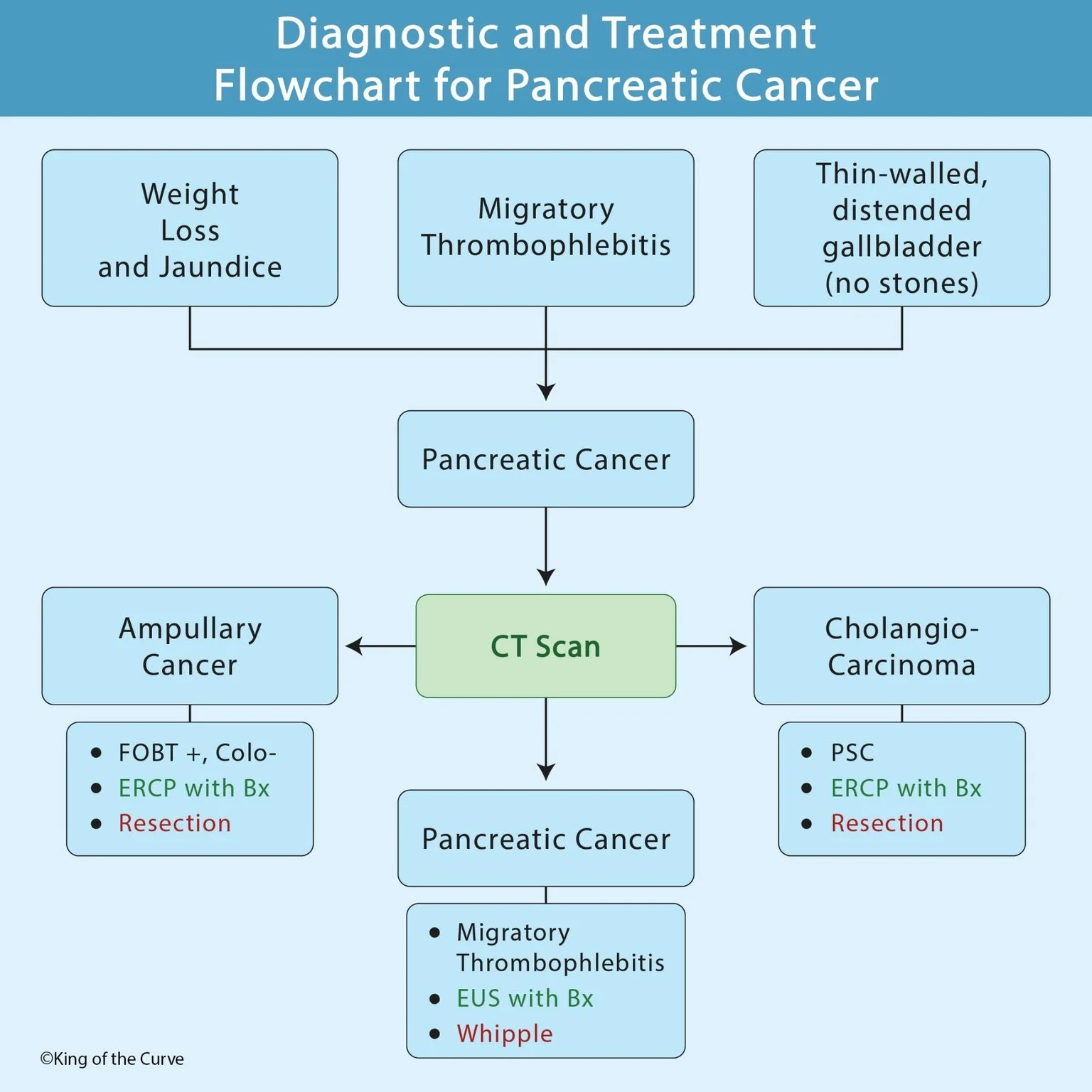
Pancreatic cancer is a highly aggressive malignancy that often presents late due to subtle and nonspecific early symptoms. Early recognition of key clinical signs and appropriate diagnostic pathways is crucial for improving patient outcomes. The flowchart above outlines a systematic approach to identifying and managing pancreatic cancer, integrating clinical features, imaging, and treatment strategies.
⚠️ Key Clinical Presentations
Patients with pancreatic cancer commonly present with a combination of symptoms that should raise clinical suspicion. Weight loss and jaundice are hallmark signs, particularly in cancers involving the head of the pancreas, where bile duct obstruction occurs. Another important clue is migratory thrombophlebitis (Trousseau syndrome), a paraneoplastic phenomenon associated with hypercoagulability.
Additionally, a thin-walled, distended gallbladder without stones (Courvoisier sign) strongly suggests malignant obstruction rather than gallstones. Recognizing these clinical indicators early can prompt timely diagnostic evaluation.
📊 Summary Table: Diagnosis and Management
| Category | Findings / Features | Diagnostic Tool | Treatment |
|---|---|---|---|
| Pancreatic Cancer | Weight loss, jaundice, migratory thrombophlebitis | CT scan, EUS with biopsy | Whipple procedure |
| Ampullary Cancer | FOBT positive, GI symptoms | Colonoscopy, ERCP with biopsy | Surgical resection |
| Cholangiocarcinoma | Associated with PSC | ERCP with biopsy | Surgical resection |
| Gallbladder Clue | Distended, thin-walled (no stones) | Ultrasound/CT | Indicates malignancy |
🧠 Importance of Early Detection
Early detection of pancreatic cancer remains a major clinical challenge due to its subtle onset and lack of specific early symptoms. By the time classic signs such as jaundice or significant weight loss appear, the disease is often advanced. This makes it essential for clinicians to recognize indirect clues like migratory thrombophlebitis or a painless, distended gallbladder. Utilizing a structured diagnostic approach, as shown in the flowchart, helps streamline evaluation and ensures that critical investigations like CT scans and biopsies are not delayed. Early identification of potentially resectable tumors can significantly improve survival rates and patient prognosis.
🧪 Role of CT Scan in Diagnosis
Once pancreatic cancer is suspected, a CT scan serves as the central diagnostic tool. It helps confirm the presence of a tumor, assess its size and location, and evaluate for metastasis or local invasion. CT imaging also assists in differentiating pancreatic cancer from other conditions such as ampullary cancer and cholangiocarcinoma.
This step is critical because treatment decisions largely depend on tumor staging and resectability.
🔍 Differential Diagnosis
The flowchart highlights two important conditions that can mimic pancreatic cancer:
Ampullary Cancer
Requires colonoscopy and confirmation via ERCP with biopsy, followed by resection.Cholangiocarcinoma
Often linked to primary sclerosing cholangitis (PSC) and diagnosed using ERCP with biopsy, with resection as treatment.
🧬 Confirmatory Testing and Treatment
For confirmed pancreatic cancer, further evaluation includes Endoscopic Ultrasound (EUS) with biopsy, which provides tissue diagnosis. One notable clinical feature that may persist is migratory thrombophlebitis, reinforcing the diagnosis.
If the tumor is resectable, the primary treatment is the Whipple procedure (pancreaticoduodenectomy)—a complex surgery offering the best chance for survival.
🧠 Key Takeaway
Pancreatic cancer diagnosis relies on recognizing classic symptoms, confirming findings with CT imaging, and differentiating from similar conditions. Early detection and timely surgical intervention significantly improve outcomes.

Frequently Asked Questions (FAQs)
-
Aim for 4-6 focused hours, ensuring you incorporate breaks to avoid burnout.
-
Practice mindfulness techniques, take practice exams under realistic conditions, and maintain a balanced lifestyle.
-
Set short-term goals, seek support from mentors, and reward yourself for small achievements.
-
Regular exercise improves focus, reduces stress, and enhances overall mental clarity.
-
KOTC offers personalized learning tools, gamification features, and adaptive question banks to help students stay on track without burnout.