
🧪 Mechanism of NH₄⁺ Excretion in the Proximal Tubule
The kidneys play a vital role in maintaining the body's acid-base balance by excreting excess hydrogen ions (H⁺) and generating new bicarbonate (HCO₃⁻). One of the most important processes involved is the production and excretion of ammonium (NH₄⁺) in the proximal tubule. This mechanism not only removes acid from the body but also replenishes bicarbonate in the bloodstream, helping maintain normal blood pH.
🧬 What Is Ammonium Excretion?
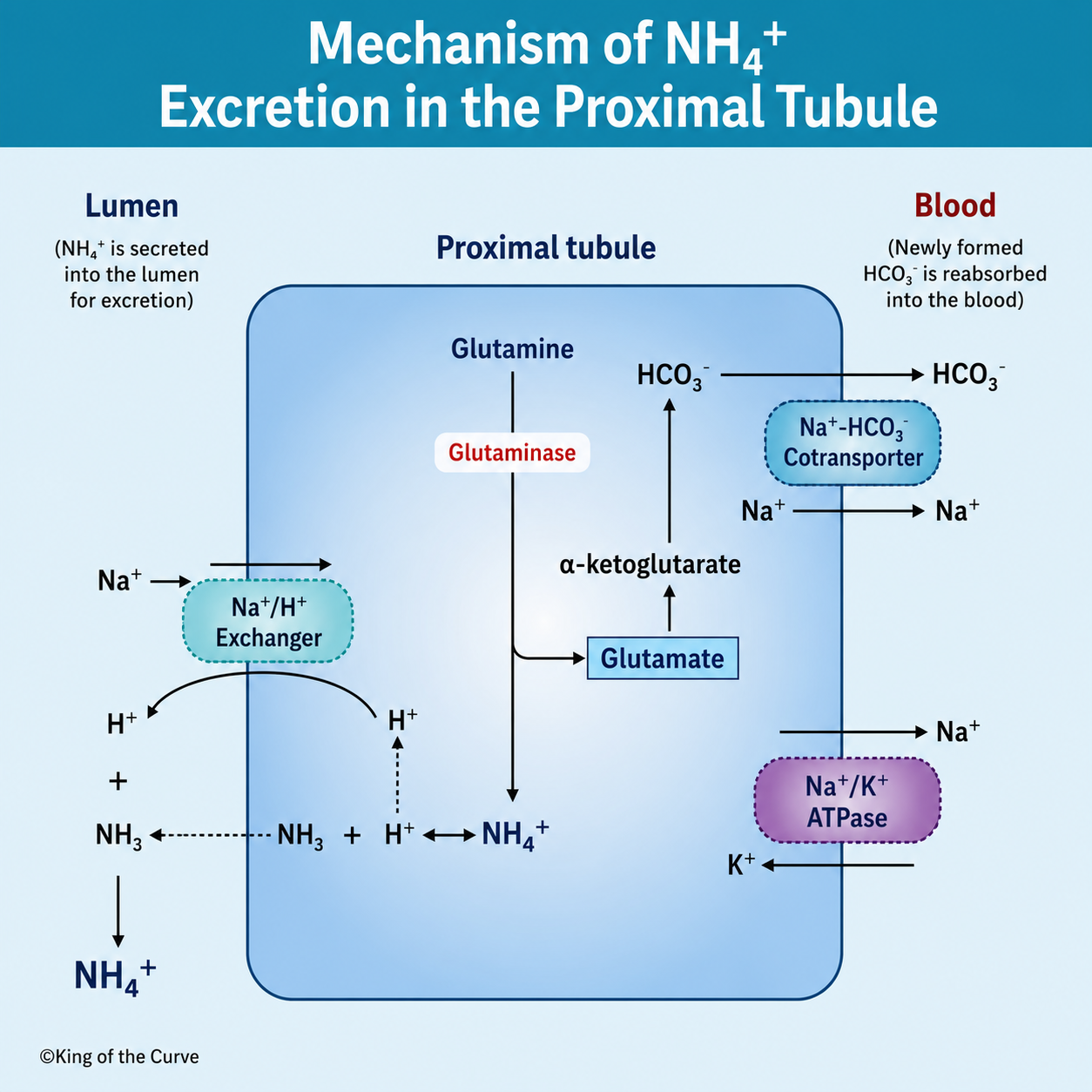
Ammonium excretion is a renal process that removes excess acid from the body. Cells of the proximal tubule metabolize the amino acid glutamine to produce ammonium (NH₄⁺) and bicarbonate (HCO₃⁻). The NH₄⁺ is ultimately excreted in urine, while the newly generated bicarbonate is returned to the blood, helping buffer acids.
⚙️ Step 1: Glutamine Metabolism
The process begins when glutamine enters proximal tubule cells. The enzyme glutaminase converts glutamine into glutamate while releasing ammonium (NH₄⁺). Glutamate is then further metabolized into α-ketoglutarate, producing additional ammonium and bicarbonate ions.
This pathway becomes more active during metabolic acidosis, allowing the kidneys to eliminate greater amounts of acid.
🔄 Step 2: Hydrogen Ion Secretion
Hydrogen ions (H⁺) are secreted from the proximal tubule cells into the tubular lumen through the Na⁺/H⁺ exchanger. As sodium (Na⁺) enters the cell, hydrogen ions move into the filtrate. These hydrogen ions combine with ammonia (NH₃) to form ammonium (NH₄⁺), which is trapped within the tubular fluid.
💧 Step 3: Ammonium Trapping and Excretion
Ammonia (NH₃) can freely diffuse across cell membranes, but once it combines with hydrogen ions to form NH₄⁺, it becomes charged and cannot easily diffuse back into cells. This phenomenon, known as diffusion trapping, ensures that ammonium remains in the tubular fluid and is eventually excreted in urine.
🩸 Step 4: Bicarbonate Reabsorption
While ammonium is excreted into the urine, the bicarbonate generated during glutamine metabolism is transported into the bloodstream. This newly formed bicarbonate helps replace bicarbonate lost during acid buffering and contributes to maintaining normal blood pH.
📊 Summary of the Mechanism
| Step | Process | Outcome |
|---|---|---|
| 1 | Glutamine enters proximal tubule cells | Produces glutamate and NH4+ |
| 2 | Glutamate converts to α-ketoglutarate | Generates additional NH4+ and HCO3− |
| 3 | Na+/H+ exchanger secretes H+ | H+ combines with NH3 to form NH4+ |
| 4 | NH4+ becomes trapped in the lumen | Excreted in urine |
| 5 | Newly formed HCO3− enters the bloodstream | Helps restore acid-base balance |
🩺 Clinical Significance
Ammonium excretion is essential for eliminating non-volatile acids produced during metabolism. During conditions such as metabolic acidosis, chronic kidney disease, or prolonged fasting, the kidneys increase glutamine metabolism to enhance ammonium production. Impaired ammonium excretion can contribute to persistent acidosis and worsening kidney dysfunction.
✅ Key Takeaways
The proximal tubule is the primary site for ammonium generation through glutamine metabolism. This process simultaneously removes hydrogen ions from the body and generates new bicarbonate for the circulation. Together, ammonium excretion and bicarbonate reabsorption are crucial mechanisms that allow the kidneys to regulate acid-base homeostasis and maintain normal physiological function.

Frequently Asked Questions (FAQs)
-
Aim for 4-6 focused hours, ensuring you incorporate breaks to avoid burnout.
-
Practice mindfulness techniques, take practice exams under realistic conditions, and maintain a balanced lifestyle.
-
Set short-term goals, seek support from mentors, and reward yourself for small achievements.
-
Regular exercise improves focus, reduces stress, and enhances overall mental clarity.
-
KOTC offers personalized learning tools, gamification features, and adaptive question banks to help students stay on track without burnout.