
🧠 MCAT Overview: Exam Structure and Preparation Guide
The Medical College Admission Test (MCAT) is a standardized exam required for admission to most medical schools in the United States and Canada. Administered by the Association of American Medical Colleges (AAMC), the MCAT evaluates a student’s ability to apply scientific knowledge, analyze complex passages, and reason critically about biological and social systems. Understanding the structure of the MCAT is essential for building an effective study strategy, because the exam tests a broad range of subjects including chemistry, physics, biology, psychology, sociology, and critical reading skills.
🧪 What Is the MCAT?
The MCAT is a computer-based multiple-choice exam designed to measure problem-solving, critical thinking, and scientific reasoning skills needed for medical school. Rather than testing simple memorization, the exam focuses heavily on applying concepts to new situations. Many questions are presented in passage-based formats, requiring students to interpret data, analyze experiments, and connect scientific principles across disciplines.
🧬 The Four Sections of the MCAT
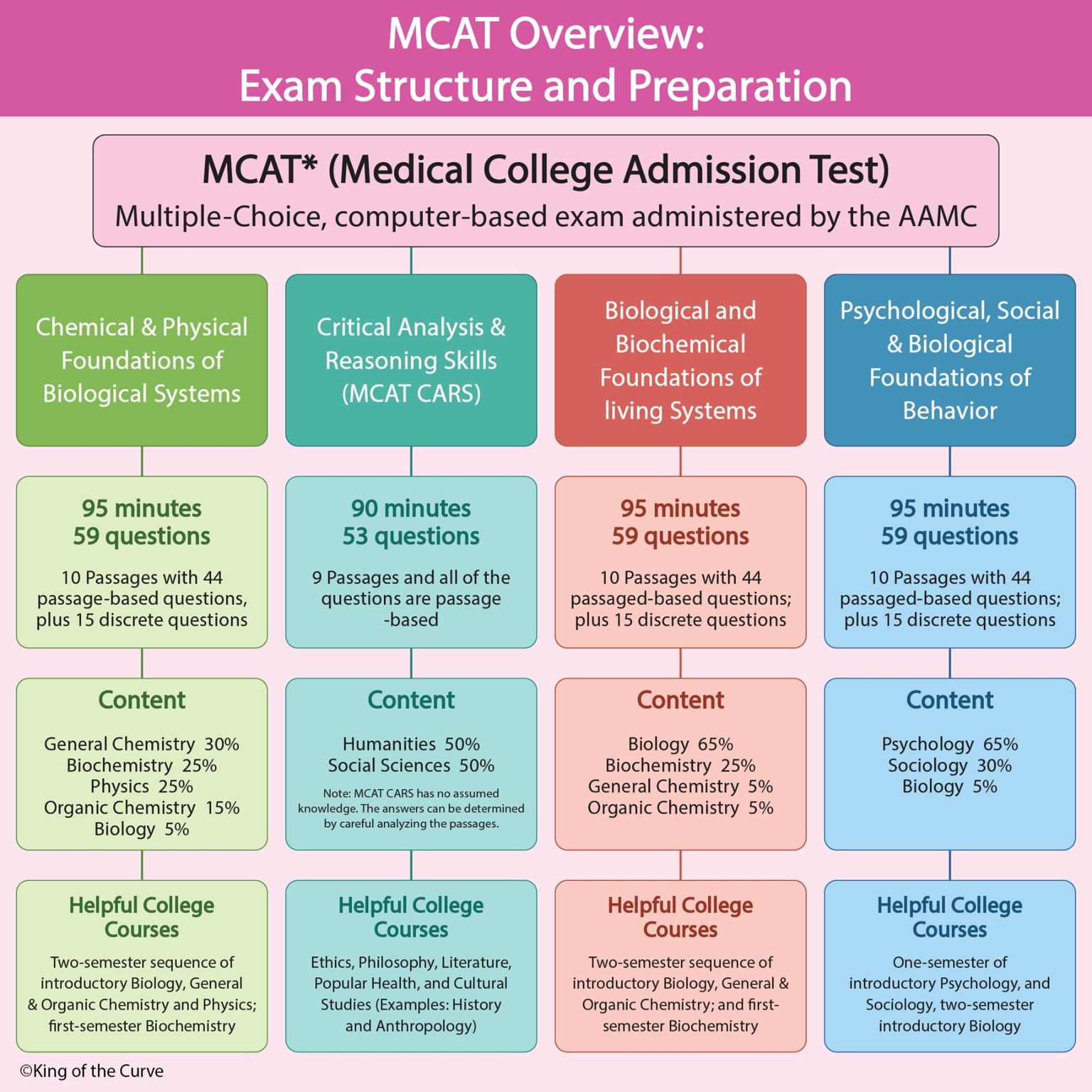
The MCAT is divided into four major sections, each designed to test different areas of knowledge relevant to medical education:
Chemical & Physical Foundations of Biological Systems
Critical Analysis and Reasoning Skills (CARS)
Biological & Biochemical Foundations of Living Systems
Psychological, Social, and Biological Foundations of Behavior
Each section emphasizes the interdisciplinary thinking required for modern medicine.
⏱️ MCAT Timing and Question Format
The MCAT is a long and demanding exam, lasting over seven hours including breaks. Each science section lasts 95 minutes with 59 questions, while the CARS section lasts 90 minutes with 53 questions. Most questions are passage-based, requiring students to read scientific passages and interpret experimental data before answering related questions.
📊 MCAT Section Breakdown
| MCAT Section | Time | Questions | Primary Focus |
|---|---|---|---|
| Chemical & Physical Foundations of Biological Systems | 95 minutes | 59 | Chemistry, physics, and biological systems |
| Critical Analysis & Reasoning Skills (CARS) | 90 minutes | 53 | Critical reading and reasoning |
| Biological & Biochemical Foundations of Living Systems | 95 minutes | 59 | Biology and biochemistry |
| Psychological, Social & Biological Foundations of Behavior | 95 minutes | 59 | Psychology, sociology, and behavior |
📚 Key Content Areas Tested
Each MCAT section emphasizes different academic disciplines. For example, the chemical and physical section includes general chemistry, organic chemistry, physics, and biochemistry concepts, while the biological section focuses heavily on cellular biology and biochemical pathways. The psychological and social section tests concepts from psychology and sociology that help explain human behavior in medical contexts.
🎓 Recommended College Courses
Medical schools recommend several undergraduate courses to prepare for the MCAT. These typically include general chemistry, organic chemistry, biology, physics, and biochemistry, along with courses in psychology and sociology. Humanities courses such as philosophy, literature, and ethics can also help strengthen critical reading skills required for the CARS section.
🧩 Strategies for Effective MCAT Preparation
Preparing for the MCAT requires consistent practice and strategic studying. Students should focus on mastering core scientific concepts, practicing passage-based questions, and building endurance for the long exam format. Using visual study tools, practice exams, and question banks can significantly improve comprehension and test performance.
🚀 Using Visual Learning for MCAT Success
Visual learning tools can make complex scientific concepts easier to understand and remember. Diagrams, concept maps, and illustrations help students quickly grasp relationships between biological systems, chemical reactions, and psychological principles. Explore mcat.kingofthecurve.org, a leading resource that provides 1000+ visual explanations of high-yield MCAT concepts, helping pre-med students prepare more efficiently.

Frequently Asked Questions (FAQs)
-
Aim for 4-6 focused hours, ensuring you incorporate breaks to avoid burnout.
-
Practice mindfulness techniques, take practice exams under realistic conditions, and maintain a balanced lifestyle.
-
Set short-term goals, seek support from mentors, and reward yourself for small achievements.
-
Regular exercise improves focus, reduces stress, and enhances overall mental clarity.
-
KOTC offers personalized learning tools, gamification features, and adaptive question banks to help students stay on track without burnout.