
🚀 Initiation of Protein Synthesis: Steps and Key Components Explained
Protein synthesis is one of the most essential biological processes in all living organisms. It allows cells to build proteins that perform critical roles such as enzyme function, structural support, signaling, and immune defense. The very first stage of this process is called initiation, where the ribosome assembles on messenger RNA (mRNA) and prepares to begin translation.
🧬 What Is Protein Synthesis?
Protein synthesis refers to the process by which cells convert genetic information into functional proteins. It occurs in two main stages:
Transcription: DNA is copied into mRNA
Translation: mRNA is decoded by ribosomes to build a protein
Initiation is the first and most regulated step of translation, ensuring that protein production begins accurately.
⚡ Why Initiation Is a Critical Step
The initiation phase is responsible for:
Positioning the ribosome correctly on the mRNA
Identifying the correct start codon (AUG)
Bringing in the first amino acid (methionine)
Setting up the ribosome’s functional sites for elongation
A mistake at this stage can lead to incorrect or nonfunctional proteins.
🧩 Key Players in Translation Initiation
Several components work together during initiation:
mRNA: carries the genetic code
Ribosomal subunits: small and large subunits form the complete ribosome
Initiator tRNA: carries methionine (Met)
Initiation factors (IFs or eIFs): helper proteins that guide assembly
Start codon (AUG): signals the beginning of translation
These elements ensure the ribosome begins translation at the correct location.
📌 Step 1: Ribosome Binding to mRNA
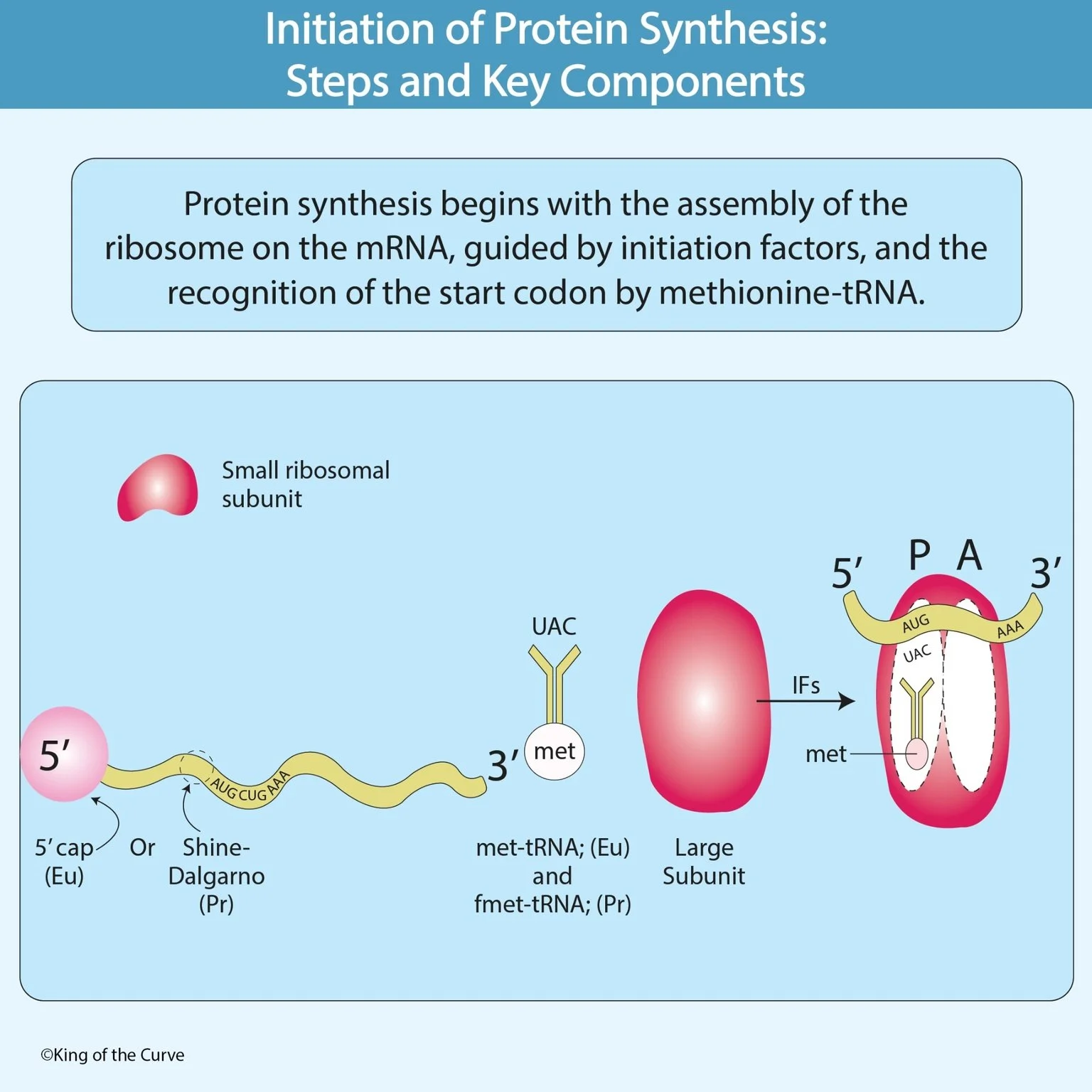
The initiation process begins when the small ribosomal subunit binds to the mRNA.
In different organisms, this recognition occurs in distinct ways:
Eukaryotes (Eu) use the 5′ cap structure on mRNA
Prokaryotes (Pr) use the Shine-Dalgarno sequence, which aligns the ribosome with the start codon
This step ensures proper positioning before protein synthesis begins.
🔍 Step 2: Start Codon Recognition
Once the small ribosomal subunit is bound, it must locate the start codon, usually AUG.
The AUG codon is crucial because it:
Defines the beginning of the coding sequence
Establishes the reading frame
Signals the recruitment of the initiator tRNA
Correct start codon recognition ensures that translation begins at the right point.
🧫 Step 3: Binding of the Initiator tRNA
The next step involves the arrival of a special tRNA molecule:
Met-tRNA (eukaryotes)
fMet-tRNA (prokaryotes)
This initiator tRNA carries the amino acid methionine and has an anticodon UAC, which pairs with AUG.
The initiator tRNA binds directly into the P site of the ribosome, unlike later tRNAs which enter through the A site.
🛠️ Step 4: Role of Initiation Factors (IFs)
Initiation factors are proteins that coordinate the assembly process.
They help by:
Preventing premature joining of ribosomal subunits
Assisting in start codon scanning
Ensuring the initiator tRNA is correctly positioned
Providing energy through GTP hydrolysis
Without initiation factors, translation initiation would be inefficient and error-prone.
🏗️ Step 5: Joining of the Large Ribosomal Subunit
After the start codon is recognized and the initiator tRNA is in place, the large ribosomal subunit joins the complex.
This forms the complete ribosome with functional sites:
P site: holds the growing peptide chain
A site: accepts incoming aminoacyl-tRNAs
E site: exit site for empty tRNAs
At this point, initiation is complete and elongation can begin.
📊 Summary Table: Key Components of Initiation
| Component | Function in Initiation |
|---|---|
| mRNA | Provides the codon sequence for translation. |
| Small ribosomal subunit | Binds mRNA and scans for the start codon. |
| Start codon (AUG) | Signals where translation begins. |
| Initiator tRNA (Met/fMet) | Brings the first amino acid to the ribosome. |
| Initiation factors (IFs/eIFs) | Guide ribosome assembly and improve accuracy. |
| Large ribosomal subunit | Completes ribosome structure for elongation. |
🎯 Final Thoughts: Why This Process Matters
Initiation of protein synthesis is one of the most important checkpoints in gene expression. By ensuring correct ribosome assembly, start codon recognition, and initiator tRNA binding, cells can produce accurate proteins essential for survival.
This process is also a major target in:
Antibiotic development (prokaryotic initiation)
Genetic disease research
Cancer biology (translation regulation)
Understanding initiation provides a foundation for mastering molecular biology and translational medicine.

Frequently Asked Questions (FAQs)
-
Aim for 4-6 focused hours, ensuring you incorporate breaks to avoid burnout.
-
Practice mindfulness techniques, take practice exams under realistic conditions, and maintain a balanced lifestyle.
-
Set short-term goals, seek support from mentors, and reward yourself for small achievements.
-
Regular exercise improves focus, reduces stress, and enhances overall mental clarity.
-
KOTC offers personalized learning tools, gamification features, and adaptive question banks to help students stay on track without burnout.